

Why puppies mouth
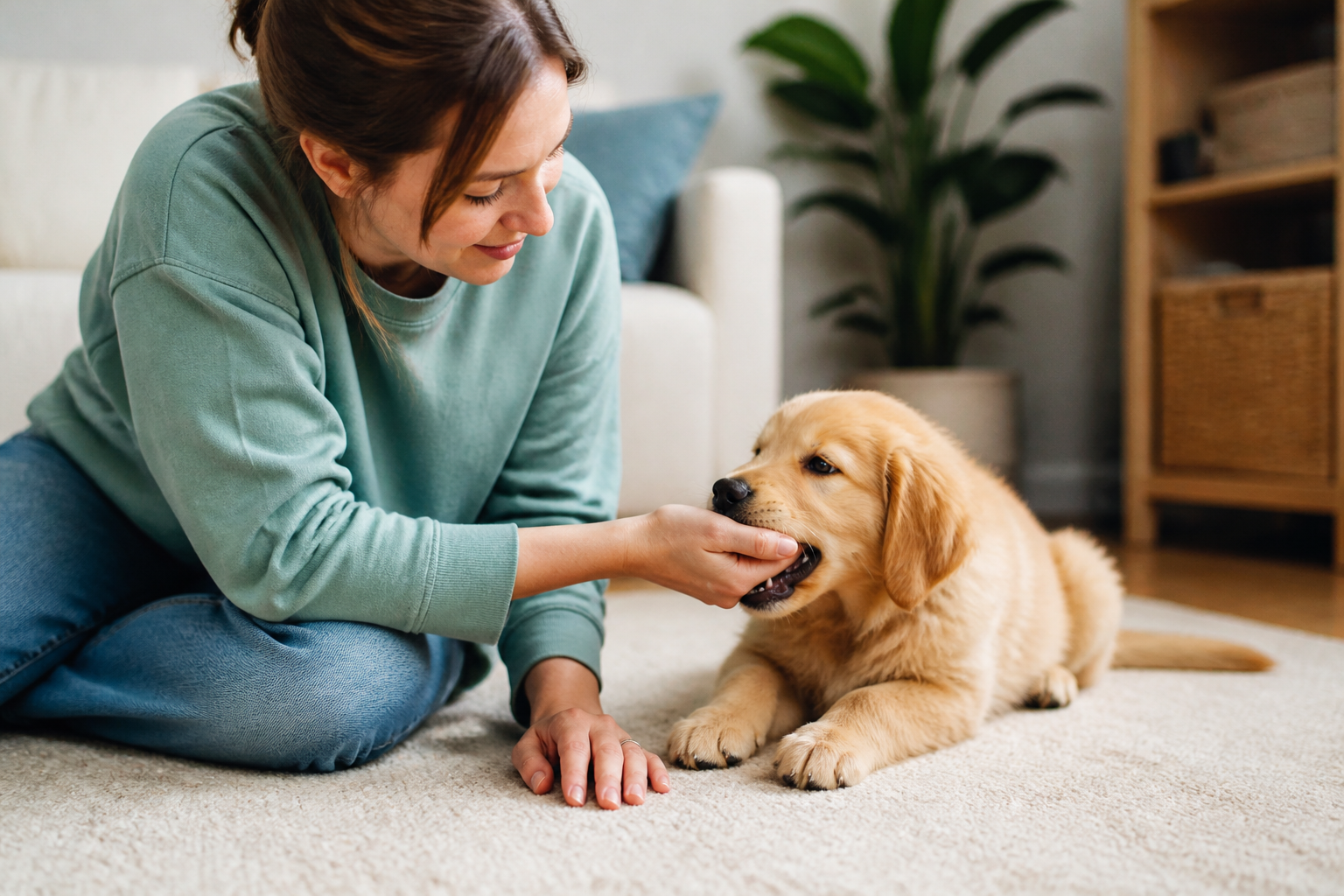
Puppy mouthing is normal, but normal does not mean it should be ignored. Young dogs explore with their mouths, investigate texture, begin teething, invite play, and communicate excitement. A puppy may grab fingers during greetings, chew clothing when tired, or bite harder when overstimulated. The goal of training is not to punish every contact. It is to teach a reliable alternative: human skin and clothes are gentle targets, while toys, chews, and appropriate games are available for biting.
Bite inhibition means controlling the force and intensity of a bite. It does not guarantee that a dog will never bite, and it cannot replace supervision, socialization, veterinary care, or professional help when serious aggression appears. Nevertheless, teaching softer behavior early can make everyday handling safer and give your puppy better emotional control.
Start by observing the pattern. Note when mouthing occurs, what happens immediately beforehand, how hard the contact is, and what ends it. Common triggers include moving hands, rough play, greetings, frustration, hunger, fatigue, and a need to chew. A short record helps you prevent predictable episodes rather than repeatedly reacting after the puppy is already overexcited.
The safest training principle
Use calm consequences, immediate feedback, and consistent choices. When teeth touch skin, make the interaction boring for a moment. Freeze your hand instead of jerking it away, because fast movement can turn fingers into a fascinating chase toy. Say a brief, neutral word such as “ouch” only if it helps your puppy pause. Some puppies become more excited when they hear a high sound, so observe the response and omit the sound if it increases biting.
The instant your puppy loosens the mouth or looks away, offer a toy and praise engagement with it. This sequence teaches a clear rule: gentle behavior keeps the interaction going, while biting people makes the game pause. Timing matters more than volume. A delayed lecture will not explain which action earned the consequence.
A practical response sequence
First, stop moving and remove attention for one or two seconds. Second, present a suitable toy at a comfortable distance. Third, praise when the puppy takes the toy or settles. Fourth, resume a quiet game, such as gentle tug, only while the mouth remains directed at the toy. If the puppy returns immediately to skin, stand up and calmly step behind a gate or leave the area briefly. Return when the puppy is calmer.
The observable checkpoint is simple: after repeated practice, the puppy should redirect to the toy more quickly and apply less pressure when contact occurs. If biting becomes faster, harder, or more frantic, your response may be adding excitement. Lower your voice, shorten the game, increase distance, or provide a nap.
Prepare the environment
Training succeeds more easily when the environment prevents rehearsal. Keep several durable toys in the rooms where mouthing usually occurs. Include different textures and shapes, but choose items appropriate for the puppy’s size, chewing style, and developmental stage. Inspect toys regularly and discard damaged pieces that could be swallowed. A veterinarian can help you select safe chewing options, particularly for a very small puppy or one with strong destructive habits.
Use gates, pens, or closed doors to create calm breaks without grabbing the puppy’s collar. Wear clothing that allows easy movement and avoid dangling sleeves or loose cords during active periods. Ask household members to follow the same rules. If one person permits hand wrestling while another punishes it, the puppy receives confusing information and may practice the behavior more often.
Management is not surrender. It gives the puppy enough success to learn. Preventing access to ankles during frantic evening activity, for example, lets you offer a chew before the puppy reaches the point where redirection is unlikely to work.
Reinforce gentle choices
Reward behaviors that compete with mouthing. Four paws on the floor, sitting for attention, touching a hand with the nose, carrying a toy, and settling on a mat can all earn food, praise, petting, or access to play. Deliver the reward promptly. A puppy cannot connect a treat to a calm choice if it arrives long afterward.
Practice when the puppy is already calm. Hold a treat in a closed hand. If teeth press against it, keep the hand still. The moment the puppy withdraws, open your hand and offer the treat. Progress gradually to an open palm, then add gentle handling. This exercise is not a contest of endurance; stop before frustration develops. The checkpoint is a soft mouth and a voluntary pause, not perfect obedience.
Choose games that teach control
Play is valuable when it has rules. Tug can teach a puppy to grab an object rather than a person, release on cue, and wait briefly before restarting. Move the toy smoothly rather than whipping it near the face. If teeth touch skin, freeze the toy and pause. When the puppy reengages appropriately, restart at a lower intensity.
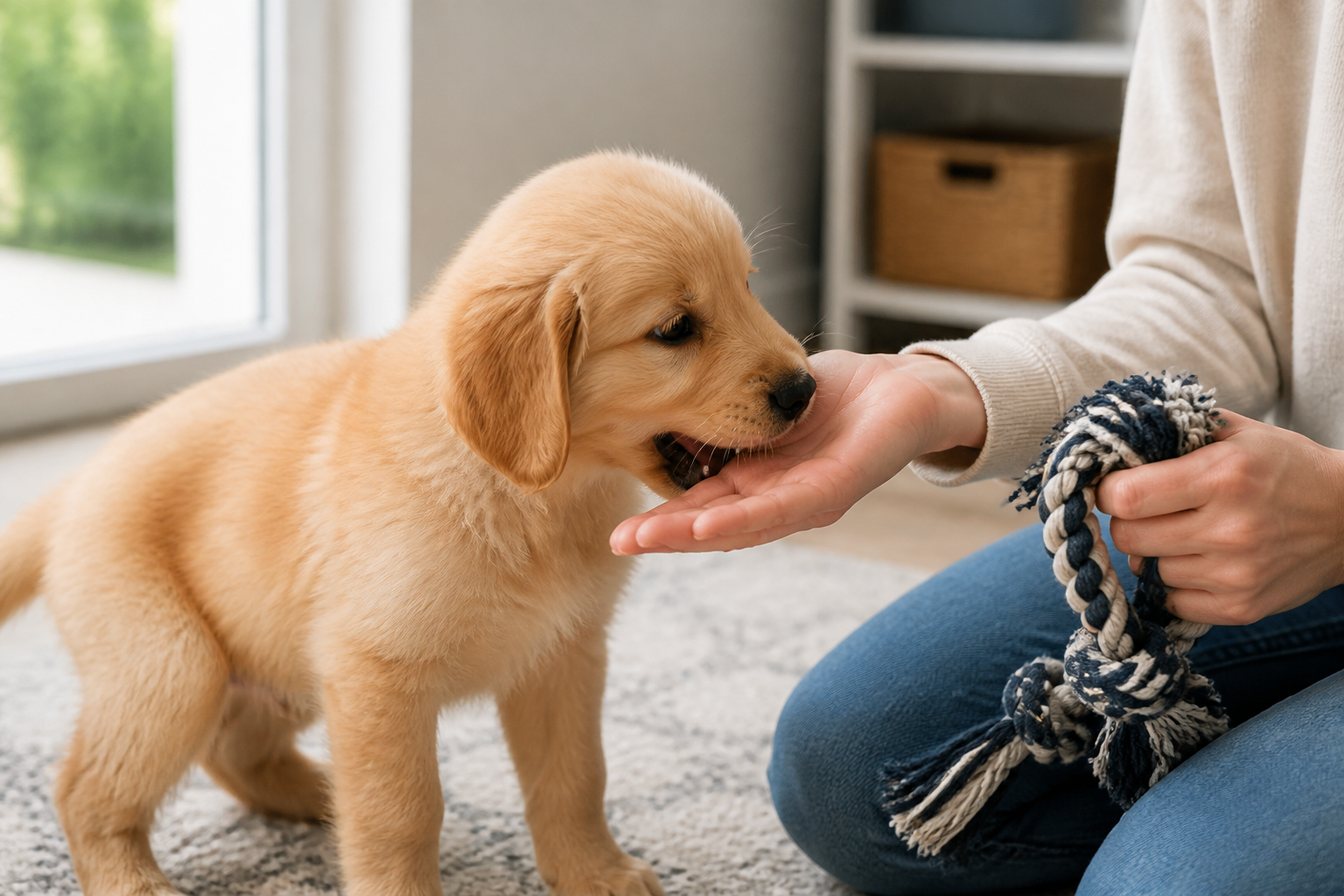
Teach “drop” by exchanging rather than forcibly pulling an object away. Present a treat near the puppy’s nose. When the mouth opens, mark the release with praise, give the treat, and return the toy when safe. Returning the toy prevents the cue from predicting permanent loss. Once the puppy understands the exchange, add the verbal cue just before the release.
Teach “take it” and “wait” separately. Invite the puppy to take a toy only after it is offered. Briefly hold the toy still if the puppy lunges, then reward a pause by beginning the game. These small pauses build impulse control without demanding adult-level self-restraint from a very young dog.
Avoid games that make human body parts the equipment. Hand wrestling, chasing fingers, pushing the puppy away repeatedly, and allowing ankle attacks can strengthen the exact habit you want to reduce. Everyone who interacts with the puppy should use toys as the target.
Manage teething, fatigue, and excitement
Teething puppies often need legitimate chewing outlets. Offer safe, size-appropriate items and rotate them so they remain interesting. Follow product directions for chilled or frozen items, and ask a veterinary professional about risks associated with very hard objects, which may damage teeth. Chewing alone will not solve social mouthing, but unmet oral needs can make training harder.
Sleep is equally important. Puppies commonly become mouthier when tired, just as children become less regulated when exhausted. After play, toileting, food, and a short training session, guide the puppy to a quiet rest area. Do not use confinement as anger or as a frightening surprise. Pair the area with calm rewards and predictable routines.
Overstimulation has recognizable signs: frantic running, repeated jumping, inability to take food gently, rapid grabbing, barking, or ignoring familiar cues. End the exciting activity before the puppy reaches that state. Scatter a few treats on the floor, guide the puppy toward a chew, dim household activity, and provide a quiet break. If the puppy cannot settle, increase distance from people and consult a qualified behavior professional for tailored advice.
Adjust the plan when progress stalls
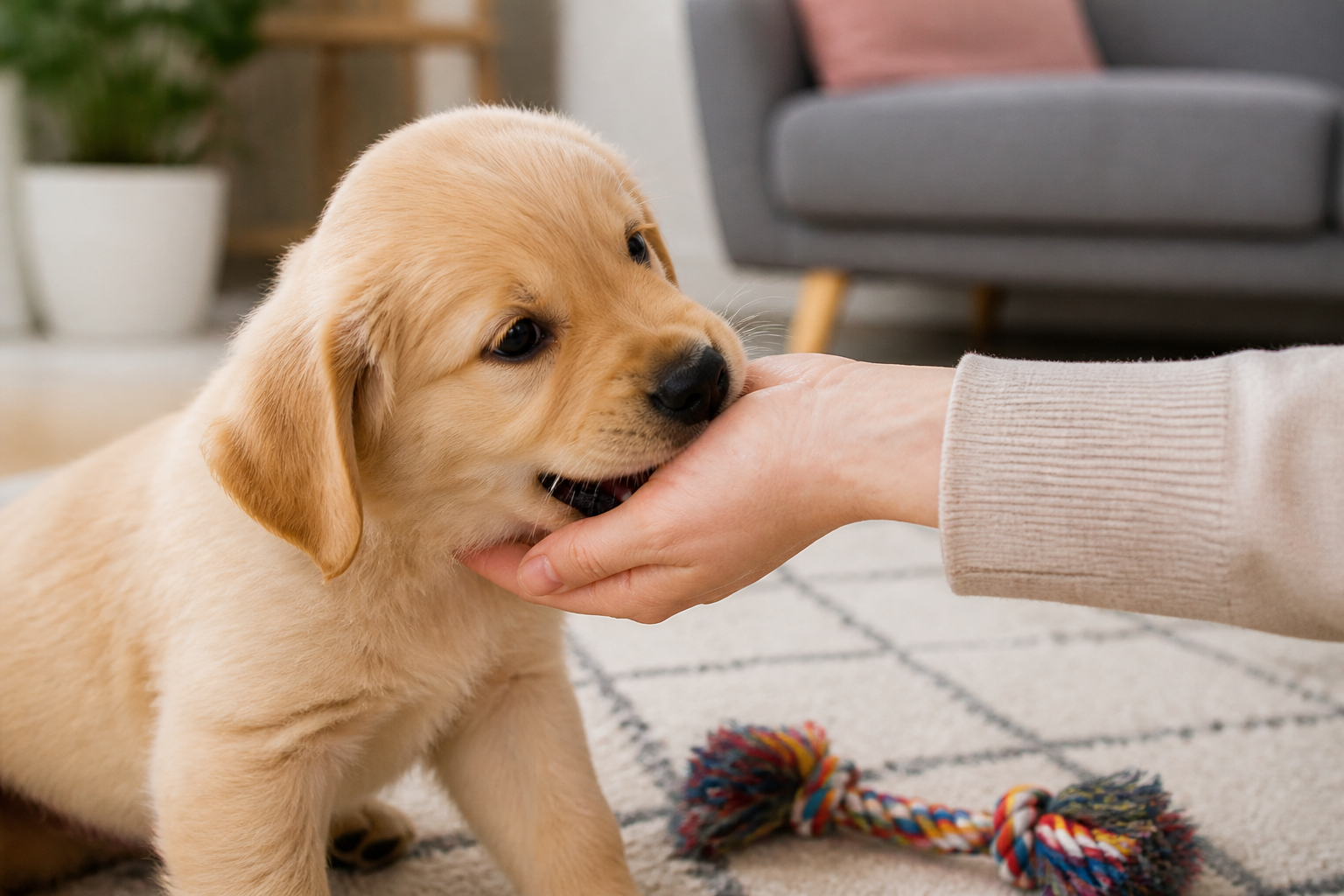
If the puppy bites during greetings, keep arrivals quiet. Visitors should ignore the puppy until four paws remain on the floor, then offer a toy or scatter treats away from their bodies. For ankle biting, stop walking, avoid chasing, and place a toy on the floor before movement resumes. For clothing grabbing, become still and exchange the fabric for a toy; do not pull hard, since resistance can become a rewarding tug game.
If biting appears during petting, shorten contact and pair touch with treats. Touch one area gently, reward calmness, and stop before the puppy squirms or grabs. Gradually build duration. Never force handling through growling, freezing, or repeated avoidance. Those signals communicate discomfort and deserve careful attention.
A useful checkpoint is recovery time. Can the puppy disengage, take a toy, and settle within a short period? If not, reduce intensity and increase rest. Progress is often uneven, especially during teething or changes in routine. Judge the trend across several days rather than expecting every interaction to improve.
Socialization without encouraging biting
Safe socialization teaches puppies that people, animals, surfaces, sounds, handling, and environments can be approached calmly. It does not mean exposing a puppy to overwhelming situations or permitting every dog to play roughly. Select healthy, appropriately vaccinated playmates and supervise closely. Interrupt play when one puppy repeatedly pursues, pins, hides, yelps, or cannot return to calm behavior.
Well-matched play includes pauses. Puppies should be able to separate, shake off, seek their handler, and choose whether to resume. Reward voluntary check-ins. If your puppy becomes mouthy after social activity, the session may have lasted too long or been too intense. Shorter sessions with rest are usually more educational than exhausting encounters.
Handling practice should be gradual. Touch paws, ears, collar area, and mouth area briefly, pairing each contact with food. Stop if the puppy shows fear or escalating resistance, then consult a veterinarian or force-free trainer for a safer plan. Cooperative handling protects both the dog and the people who may need to provide care later.
When mouthing requires professional help
Contact a veterinarian if biting begins suddenly, appears linked to pain, or accompanies unusual irritability, limping, appetite changes, or sensitivity to touch. Medical discomfort can alter behavior, and training alone will not resolve an untreated problem.
Seek qualified behavior assistance when the puppy bites hard enough to injure, repeatedly breaks skin, stiffens, guards food or objects, chases people with intense fixation, or cannot disengage after calm interventions. Growling, snarling, freezing, and hard staring deserve serious attention. Do not punish warning signals. Suppressing communication can make a future incident less predictable. A veterinarian can assess health and refer you to an appropriately credentialed behavior professional.
Children need especially careful supervision. Never leave a young child alone with a puppy, even if the puppy has seemed friendly. Teach children to keep hands still, avoid hugging, refrain from taking toys or food, and call an adult rather than running or screaming. Adults should manage the environment instead of expecting a child to execute training perfectly.
Common mistakes to avoid
Punishing with hitting, muzzle grabbing, shouting, or intimidation can create fear and may increase defensive behavior. It also fails to teach what the puppy should do instead. Repeatedly pushing a puppy away can become attention, while yelping can excite some individuals. Choose the response that lowers arousal, not the one that feels most dramatic.
Another mistake is offering a toy only after a prolonged struggle. Have the toy ready before the predictable trigger. Do not wave it wildly near the puppy’s face; present it steadily and reward the decision to choose it. Avoid giving food while teeth are actively clamped on clothing, because the puppy may learn that biting produces a snack. Wait for release, then reinforce the calmer behavior.
Inconsistent rules are also costly. If biting is unacceptable with bare hands but encouraged with sleeves, the puppy must guess where the boundary lies. Make the target clear: toys are for mouths, people are for gentle contact.
Frequently asked questions
Should I say “ouch” when my puppy bites?
You can test a brief, calm sound, but it is optional. If the puppy pauses, follow immediately with a toy and praise. If the sound causes harder biting, barking, or frantic excitement, stop using it and rely on stillness, withdrawal of attention, and redirection.
Is mouthing a sign of aggression?
Usually, puppy mouthing reflects exploration, play, teething, or excitement. Context matters. Relaxed movement, loose body language, and easy redirection are generally less concerning than stiff posture, guarding, freezing, intense staring, repeated injury, or inability to disengage. When uncertain, ask a veterinarian or qualified behavior professional.
How long does bite inhibition training take?
There is no universal timetable. Improvement depends on age, temperament, sleep, health, reinforcement history, and household consistency. Look for gradual changes: softer contact, quicker redirection, more pauses, and better recovery. Teething can temporarily increase chewing, so maintain management while skills develop.
Should I hold my puppy’s mouth closed?
No. Forcing the mouth shut can frighten the puppy, provoke resistance, and provide no useful alternative. Calmly remove attention, offer an appropriate object, and reinforce release or gentle behavior instead.
What if my puppy bites during cuddling?
Reduce or pause cuddling. Many puppies dislike prolonged restraint or become overexcited by close contact. Touch briefly, reward calmness, and allow the puppy to move away. Build affection through consent-based, low-pressure interactions rather than forcing stillness.
Can older puppies learn this skill?
Yes. Older puppies and adolescent dogs can learn, although a practiced habit may require more management and repetition. Begin with prevention, identify triggers, reward incompatible behaviors, and seek professional guidance if biting is forceful or emotionally driven.
Should I use a crate for time-outs?
A crate should remain a safe rest area, not a place associated with anger. A pen, gate, or brief caregiver withdrawal may be better for ending play. If a crate is used, guide the puppy calmly and provide a suitable chew, never forcing entry as punishment.
Conclusion
Safe bite inhibition training combines prevention, clear feedback, appropriate chewing, structured play, rest, and rewards for gentle choices. Freeze rather than chase, redirect promptly, pause attention when teeth touch people, and resume interaction when the puppy chooses a toy or settles. Keep sessions short, supervise children, and adjust the plan to the trigger and the puppy’s arousal level.
The most persuasive lesson is also the kindest: puppies learn through repeated consequences, not through fear. Every calm redirection teaches a practical alternative, and every prevented rehearsal protects future habits. Track small improvements, accept temporary setbacks, and obtain veterinary or behavior support whenever pain, fear, injury, guarding, or serious warning signals appear. With consistent handling, mouthing can become safer, softer, and increasingly manageable.