
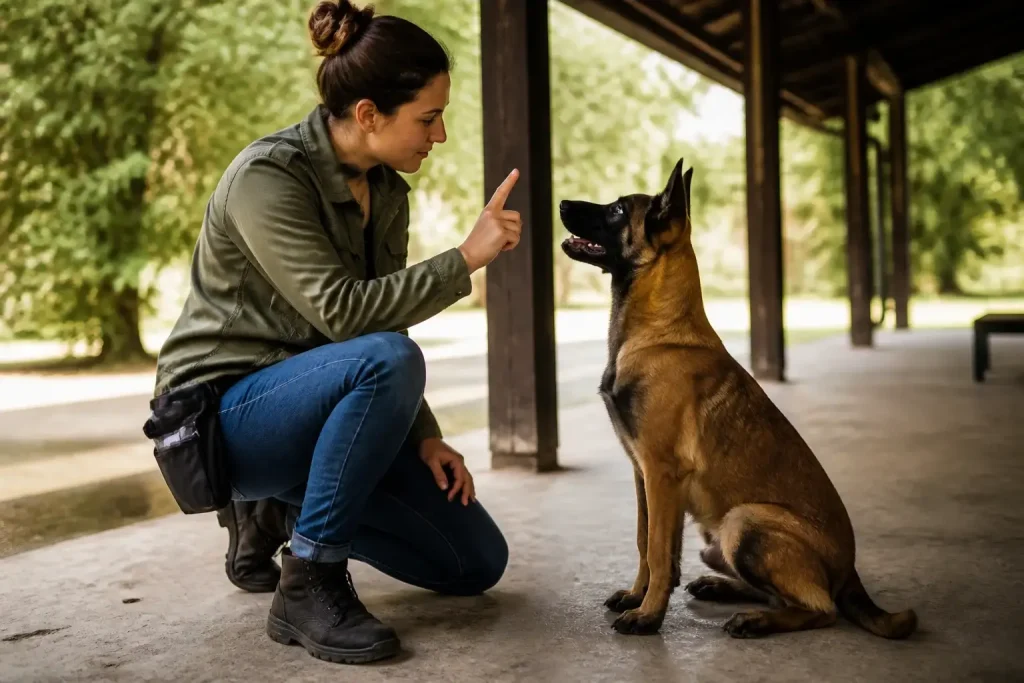
Understanding Advanced Dog Training
Advanced dog training is not simply teaching more commands. It is the process of developing reliable communication, emotional control, thoughtful decision making, and safe behavior across changing environments. A dog may respond perfectly in a quiet room yet struggle when another dog, visitor, bicycle, smell, or sudden sound appears. Advanced work bridges that gap by transferring learned skills into real life.
The most effective programs build on clear foundations. Your dog should understand a reward marker, respond reasonably to a name, accept handling, and know several basic behaviors before progressing. Advanced training should also respect health, breed tendencies, age, previous experiences, and individual motivation. A physically uncomfortable or frightened dog cannot learn efficiently, regardless of the trainer’s technique.
The goal is not mechanical obedience. It is a cooperative relationship in which the dog can pause, notice information, and choose an appropriate response. Training becomes especially valuable when it improves daily routines, public safety, confidence, and communication between dog and person.
Core Principles for Lasting Progress
Use precise communication
Dogs learn from consequences, not from explanations. A cue should have one consistent meaning, and the reward should arrive immediately after the desired behavior. If “here” sometimes means a pleasant game and sometimes means the end of freedom, the dog may hesitate. Make important cues clear, predictable, and worth answering.
A marker, such as a brief word or click, identifies the exact moment you like. First pair the marker with treats in a quiet setting. Then use it during training to bridge the small delay between behavior and reward. Over time, the marker can support precision without requiring constant food in your hand.
Reinforce choices, not just positions
Advanced training should reward useful decisions. If a dog notices a distraction and looks back at the handler, reinforce that check in. If the dog chooses to move away from a tempting object, reward the choice before asking for a formal command. This teaches flexible self-control rather than dependence on repeated instructions.
Reinforcement may include food, toys, access to a sniffing area, praise, movement, or permission to greet. The best reward depends on the dog and the context. A reward must be meaningful enough to compete with the environment, but it should not create frantic behavior. Calm delivery often produces calmer learning.
Raise difficulty gradually
Training difficulty has several dimensions: distance, duration, distraction, speed, location, and emotional intensity. Change only one or two dimensions at a time. For example, ask for a longer stay in a familiar room before combining a longer stay with a new park. If performance collapses, reduce difficulty rather than repeating the cue louder.
A useful guideline is to end while the dog is still succeeding. Short, focused sessions usually produce better learning than exhausting drills. Record simple observations: location, distraction, response quality, reward used, and the next reasonable challenge. These notes expose patterns that memory often misses.

Building Reliable Behavior in Real Environments
Proofing a behavior
Proofing means teaching a behavior under varied conditions so the dog learns that the cue remains relevant. Begin with easy changes: different rooms, handlers, flooring, lighting, and body positions. Progress to mild outdoor distractions, then busier places. Do not assume that a behavior learned indoors automatically generalizes elsewhere.
Carry appropriate rewards and practice in small intervals. Ask for one successful response, reward it, and release the dog. Then repeat with a modest variation. If the dog fails twice, simplify the exercise. Failure is information about the training setup, not proof of stubbornness.
Teaching a dependable recall
A strong recall is a safety skill. Choose a cue that is not routinely ignored, such as “come” or a whistle signal. Pair it with unusually valuable rewards and enthusiastic, safe interaction. Begin close enough that success is likely. Gradually increase distance, then add distractions while using a long line in open areas.
Never call the dog for punishment, forced handling, or the immediate end of every enjoyable activity. Sometimes call, reward, and release the dog again. During emergencies, use the cue confidently and reward even if the response is imperfect. A long line is management, not a substitute for training; it prevents rehearsal of running away.
Recall reliability is context dependent. A dog may respond in a garden but not near wildlife. Continue training around progressively stronger distractions, and retain physical management wherever a mistake could cause injury.
Developing a stable stay
A stay requires duration, distance, and distraction. Teach these separately. Ask for a brief pause, mark it, reward it, and release with a consistent word. Increase time in small increments. Then step away briefly, return, reward, and release. Later introduce mild movement, sounds, and people.
Avoid repeatedly saying “stay.” The cue should begin the behavior, while the release word ends it. If the dog moves, calmly reset with an easier version. Do not reward a prolonged attempt if the dog is struggling; shorten the interval so success remains understandable.
Impulse Control Without Suppression
Impulse control is often misunderstood as making a dog tolerate every frustration silently. Healthy self-control includes the ability to pause, recover, and choose an alternative. Exercises should provide a clear path to success rather than demanding indefinite restraint.
Teach “leave it” by presenting a low-value item in a closed hand. When the dog stops investigating, mark and reward from the other hand. Progress to an uncovered item, then movement, then real-life objects under careful management. Do not use dangerous items during early practice.
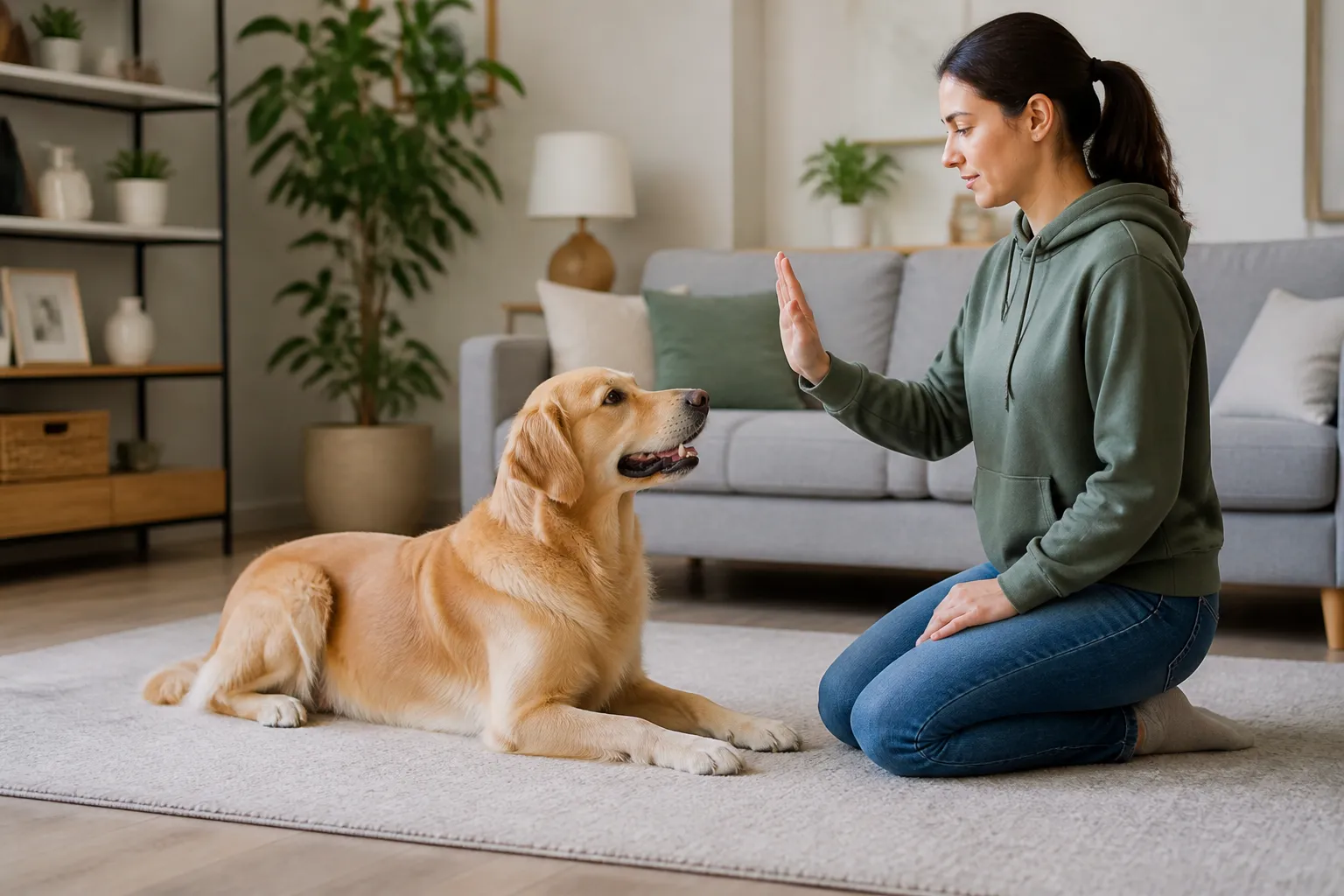
Teach waiting at doors, food bowls, car exits, and curb edges. Ask for a brief pause, then provide access as the reward. If the dog rushes, close or pause the opportunity without anger. The lesson is that calm behavior makes desired access happen.
Mat relaxation can support household life. Reward the dog for stepping onto a mat, lying down, lowering the head, and remaining settled while normal activities occur. Begin when the dog is calm. Gradually add conversation, cooking, visitors, and movement. This gives the dog a practical behavior during situations that previously produced jumping or pacing.
Advanced Leash Skills
Loose-leash walking is not one fixed posture. The useful outcome is a dog that can move safely without constant pulling, while also receiving permission to sniff and explore. Define a preferred zone near the handler, reward it frequently, and use a release cue for investigative time.
When tension appears, avoid automatically dragging the dog forward. Stop, change direction, or wait for slack, depending on the surroundings. Reward reconnection, then continue. In crowded areas, prioritize safety and distance instead of insisting on perfect position.
Teach emergency turns and hand targets. A hand target gives the dog a simple way to move toward you, while an upbeat turn cue can redirect attention before a trigger becomes overwhelming. Practice these skills in quiet locations first. Equipment should fit properly and be selected with professional guidance when necessary; no collar, harness, or lead replaces training and management.
Working Around Distractions and Reactivity
A reactive dog may bark, lunge, freeze, or spin when faced with a particular trigger. These responses can arise from fear, frustration, excitement, pain, or learned expectation. Labeling the dog as dominant does not explain the behavior or provide a useful plan.
Start below the reaction threshold, meaning the dog can notice the trigger while still eating, moving, and responding. Pair the trigger with valuable reinforcement. Over sessions, gradually reduce distance or increase exposure only when the dog remains able to learn. If the dog reacts, create distance and allow recovery.
Use visual barriers, quiet routes, timing, and controlled setups to prevent repeated explosions. Do not force greetings or punish warning signals. A qualified behavior professional is appropriate when there is biting, severe fear, redirected aggression, or rapid deterioration. Veterinary assessment is also sensible when behavior changes suddenly or appears connected to pain.

A practical threshold plan
Identify the trigger, early body signals, safe distance, preferred reward, and exit strategy. Early signals may include closed mouth, hard staring, weight shift, lip licking, scanning, or refusal of food. End sessions before the dog reaches an intense reaction. Keep a record of recovery time and environmental conditions, but interpret trends cautiously rather than expecting a perfectly linear improvement.
Teaching Complex Task Chains
A behavior chain combines several actions into one sequence, such as retrieving an object, carrying it, placing it in a container, and returning to the handler. Teach each component separately before combining them. Reward generously at first, especially at the points where the dog is learning a new transition.
If the dog repeatedly skips a step, the chain may be too long or the reinforcement pattern may be unclear. Split it into smaller sections. Sometimes reward the final result; at other times reward an intermediate behavior to maintain accuracy. Clear cues and consistent criteria prevent confusion.
For service-related or household tasks, define the exact function. “Help” is vague, while “touch the switch with your nose” describes an observable action. Consider whether the task is safe, physically appropriate, and genuinely useful. Complex training should improve independence, not turn every daily activity into a performance test.
Enrichment and Problem Solving
Advanced dogs need appropriate outlets for exploration and thinking. Scent searches, food puzzles, shaping games, discrimination exercises, trick training, and controlled retrieval can provide mental work. Enrichment should match the dog’s physical abilities and frustration tolerance.
In shaping, the handler reinforces successive approximations toward a goal without physically positioning the dog. Begin with an easy interaction, such as looking at or approaching an object. Wait for a small voluntary action, mark it, and reward. If the dog becomes confused, lower the criterion or offer a brief reset.
Rotate activities rather than making every session difficult. A dog that is mentally tired may need rest, not additional challenges. Observe whether an activity produces relaxed engagement or frantic searching. Modify the game accordingly.
Common Mistakes and Better Alternatives
One mistake is increasing distractions too quickly. The alternative is to create a progression and return to an easier stage whenever accuracy declines. Another mistake is repeating cues. Instead, make the first cue meaningful, help the dog succeed, and examine whether the environment is too difficult.
Inconsistent household rules also slow progress. If one person rewards jumping while another discourages it, the dog receives conflicting information. Agree on cues, boundaries, rewards, and responses. Everyone should use the same release words and avoid accidental reinforcement.

Training while angry is another serious error. Frustration can damage trust and may intensify fear or conflict. Pause, secure the dog safely, and resume later with a simpler plan. Punishment may suppress visible behavior without changing the underlying emotion, especially in reactive cases.
Finally, avoid measuring success only by obedience. A dog that can recover quickly, disengage from a distraction, accept handling, or settle peacefully is demonstrating valuable progress.
Safety, Welfare, and Professional Support
Use secure equipment and appropriate physical barriers during training. Long lines should be handled carefully to prevent burns, tangles, and sudden injuries. Avoid practicing near traffic, unstable surfaces, unsafe animals, or objects that could be swallowed.
Reward-based training is generally effective and supports communication, but rewards must be delivered thoughtfully. Food portions should fit the dog’s overall diet, and special medical needs should be discussed with a veterinarian. High arousal, pain, fear, and fatigue reduce learning capacity.
Seek professional assistance when behavior presents a safety risk, when progress has stalled despite careful management, or when the dog shows significant distress. Look for a trainer who explains methods clearly, prioritizes welfare, welcomes questions, and can collaborate with veterinary professionals. Credentials and local regulation vary, so evaluate actual practices rather than relying on labels alone.
A Practical Weekly Training Plan
Choose two or three priority skills instead of attempting everything. On the first day, practice a foundation behavior indoors, such as hand targeting or mat settling. The next day, repeat it in another room and add a mild distraction. Later, practice recall on a long line, then finish with decompression through sniffing.
Include rest days with normal walks and enrichment. During each session, define the criterion before beginning: for example, three calm responses around a distant bicycle. Stop after success, record what happened, and select the next challenge based on evidence.
A weekly plan should balance precision, generalization, emotional work, and enjoyable activity. It should also include management, because preventing rehearsal of unsafe behavior is part of training. Progress may be uneven. Weather, health, sleep, hormones, unfamiliar locations, and unexpected events can all affect performance.
Frequently Asked Questions
How long does advanced training take?
There is no universal schedule. Simple chains may develop in weeks, while reliable behavior around powerful distractions can require much longer. Progress depends on history, reinforcement, environment, health, and consistency. Measure improvement by better choices and recovery, not by a fixed deadline.
Should treats always be used?
Food is a useful teaching tool, but it is not the only reinforcement. Once a behavior is strong, vary rewards while continuing to reinforce periodically. In difficult settings, return to especially valuable rewards. Do not remove reinforcement so quickly that performance deteriorates.
Is advanced training suitable for older dogs?
Yes, with adjustments. Keep sessions short, consider mobility and sensory changes, and obtain veterinary advice for discomfort or sudden behavioral change. Older dogs can learn new tasks, though they may benefit from slower progress and more repetition.
What if my dog ignores a cue?
First check motivation, distraction level, clarity, hearing, pain, and reinforcement history. Avoid repeating the cue many times. Reduce difficulty, help the dog perform, and reward the response. If ignoring occurs suddenly or broadly, consult a veterinarian.
Can training eliminate fear or aggression?
Training can improve safety, coping, communication, and behavior, but no responsible professional can guarantee complete elimination. Fear and aggression require management and individualized behavior modification. Veterinary and qualified behavior support may be essential.
How do I choose the next skill?
Select a behavior that solves a real problem or expands safe freedom. Consider usefulness, risk, the dog’s current foundation, and your ability to practice consistently. A calm emergency turn may be more valuable than an impressive trick.
Conclusion
Advanced dog training succeeds when it combines clear communication, gradual difficulty, meaningful reinforcement, humane management, and realistic expectations. Reliable behavior is built across contexts, not demonstrated once in a quiet room. Teach foundations, proof skills carefully, protect the dog from overwhelming situations, and reward thoughtful choices.
The strongest program is not the most complicated one. It is the one that fits the dog, household, environment, and safety needs. With patient practice, careful observation, and professional help when necessary, advanced training can produce greater freedom, better emotional regulation, and a more cooperative daily relationship. Progress may arrive unevenly, but every calm recovery, safe decision, and voluntary connection strengthens the lasting results you are seeking.
Pingback: Dog Training for Kids: Fun, Safe Learning Tips: Guide
Pingback: Complete Guide to Leash Training Your Dog