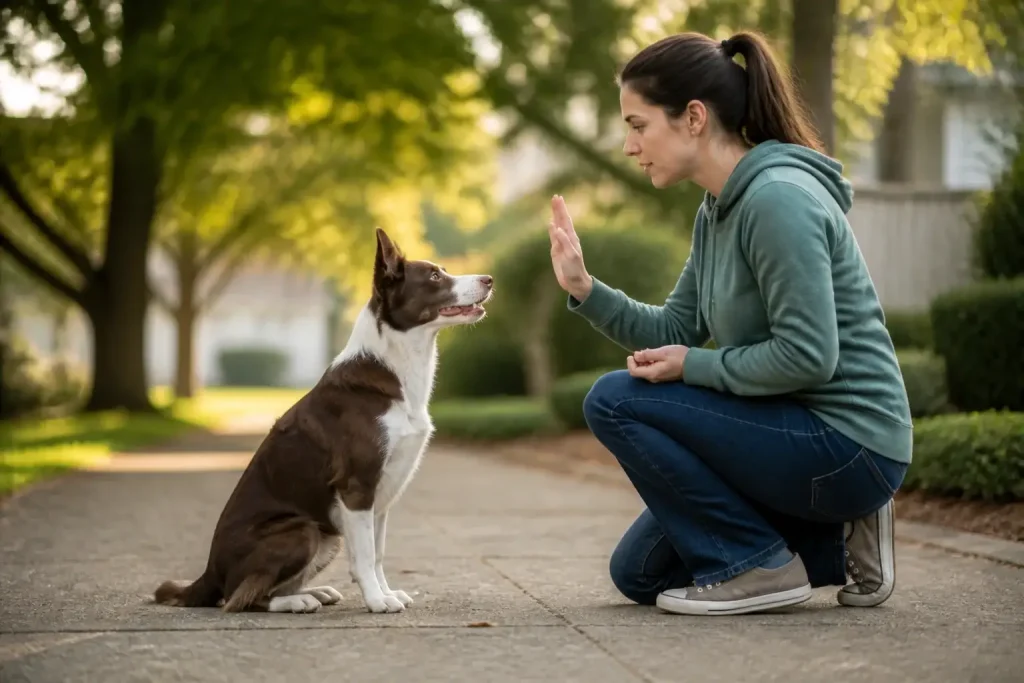
Advanced dog training is the process of teaching reliable behavior in distracting, changing, and emotionally demanding situations. It goes beyond asking a dog to sit in a quiet room. A trained dog should understand cues, make appropriate choices, recover from excitement, and respond safely when the environment is unpredictable. The most effective program combines clear communication, carefully arranged practice, reinforcement, patience, and humane handling.
Advanced work is not reserved for competition dogs. Families may use it to improve recall, polite greetings, loose leash walking, cooperative grooming, calm behavior around visitors, or safe responses near roads and wildlife. The objective is not robotic perfection. It is dependable cooperation while preserving the dog’s welfare, curiosity, and ability to relax.
What Advanced Dog Training Includes
Basic obedience usually introduces cues such as sit, down, stay, come, and leave it. Advanced training develops those behaviors under greater difficulty. Distance, duration, distractions, novel locations, movement, and emotional intensity can all be increased. A dog that remains in place for one minute in a kitchen may need a different lesson before remaining settled at a park while bicycles pass.
Advanced training also emphasizes fluency. Fluency means the dog responds promptly and accurately without needing repeated prompts. It includes generalization, which is the ability to perform a behavior across rooms, surfaces, handlers, weather conditions, and social settings. Dogs do not automatically assume that a cue learned at home has identical meaning elsewhere. Training must deliberately build that understanding.
Another important area is decision making. A dog may learn to disengage from another animal, orient toward the handler, wait at a doorway, or choose a mat instead of rushing toward a guest. These skills help replace impulsive behavior with practiced alternatives.
The Training Principles That Make Skills Last
Reinforcement and timing
Reinforcement increases the likelihood that a behavior will happen again. Food is often efficient, but toys, play, access to sniffing, praise, movement, and permission to greet can also be valuable. The best reward depends on the individual dog and the situation.
Timing matters because the dog learns from consequences associated with a specific action. Markers such as a clicker or a brief word can identify the correct moment, followed by a reward. A marker is not a substitute for reinforcement; it bridges the behavior and the reward when delivery takes a few seconds.
Begin by rewarding frequently while the behavior is developing. Once the response becomes reliable, vary reinforcement thoughtfully rather than reducing rewards abruptly. Intermittent reinforcement can maintain a learned behavior, but unpredictable payment should not replace clear feedback or create frustration.
Criteria and progression
Training criteria describe what earns reinforcement. Criteria might include turning toward the handler, taking one step beside a person, holding a position, or ignoring a dropped object. Raise only one major criterion at a time. If duration, distance, and distraction all increase together, the dog may fail without understanding why.

A useful progression is to teach in a low distraction setting, add modest duration, introduce distance, and then practice around controlled distractions. If performance falls sharply, lower difficulty immediately. Returning to an easier version is not a setback; it is information about the current learning threshold.
Motivation and emotional state
Motivation is influenced by hunger, fatigue, temperature, pain, fear, arousal, and previous experiences. A dog that refuses a familiar treat outdoors may be overwhelmed rather than stubborn. Observe body language: panting unrelated to heat, tucked posture, lip licking, avoidance, freezing, frantic scanning, or sudden grabbing can signal stress.
Short sessions often outperform exhausting drills. End after a successful response, provide decompression, and avoid forcing interaction with people, dogs, equipment, or environments. Training should build confidence, not merely suppress visible behavior.
Building Reliable Recall
Recall is one of the most valuable advanced skills because it can prevent danger. Start with a cue that is not repeatedly ignored. Use an enthusiastic tone, move away from the dog, and reward arrival generously. Never punish a dog for finally coming, even if the delay was inconvenient. Punishment can make future recall less likely.
Practice first indoors, then in a secure yard, and later in safely enclosed public areas. Use a long line attached to appropriate equipment while increasing distance and distractions. The line is a management tool, not permission to drag the dog toward the handler. Call once, help the dog succeed when necessary, and reward promptly.
Develop an emergency recall separately. Choose a distinct signal, condition it with unusually valuable rewards, and rehearse it rarely enough to preserve its importance. Do not use that signal for ordinary events the dog dislikes, such as ending all outdoor freedom or immediately entering a crate.
Recall should coexist with permission cues. Call the dog, reward the response, and sometimes release it back to sniff or play. This teaches that returning does not always end enjoyable activities. Safety still requires management around roads, cliffs, unfamiliar animals, and legally restricted areas.
Loose Leash Walking and Environmental Control
Loose leash walking is not the same as forcing a dog to remain beside one leg every moment. It means the leash stays reasonably slack while the team moves together. Teach this in small sections. Reward the dog for orienting toward the handler, walking beside the chosen position, and responding to changes in direction.

Use the environment as reinforcement. When the dog walks calmly toward a tree, allow sniffing. If pulling begins, pause or change direction without jerking the leash. The dog learns that slack movement provides access, while tension delays progress. Harnesses, collars, and leads should be selected for fit, comfort, and safe handling; equipment cannot replace training.
Generalize gradually. Sidewalks, trails, elevators, parking areas, and busy shopping districts impose different challenges. A dog may need more distance from traffic, joggers, or other dogs before it can respond successfully. Plan routes that allow space and avoid turning every walk into a test.
Proofing Stay, Place, and Impulse Control
A reliable stay is built through separate dimensions: duration, distance, and distraction. Reward calm stillness before adding another challenge. Include a release cue so the dog knows when the exercise has ended. If the dog moves, calmly reset at an easier level rather than repeating the cue with rising intensity.
Place training teaches a dog to settle on a mat, bed, or designated surface. Begin by rewarding investigation and contact with the surface. Then reinforce lying down, relaxed posture, and remaining there while the handler moves. Add household activity, door sounds, visitors, and eventually outdoor distractions.
Impulse control should not mean prolonged frustration. Teach practical patterns such as waiting for a food bowl, pausing before a doorway, exchanging an object, or looking at the handler when another dog appears. Reward the choice to disengage. Also provide appropriate outlets for chewing, sniffing, running, and play. A dog cannot be expected to suppress every natural behavior indefinitely.
Cooperative Care and Handling
Cooperative care prepares dogs for brushing, nail trimming, ear checks, medication, bathing, and veterinary procedures. The central idea is consent within practical limits: the dog learns that calm participation produces rewards and that handling can pause when a trained signal indicates discomfort or a need for a break.
Teach a chin rest, standing station, paw presentation, or nose touch separately. Pair brief contact with food, then remove the hand before the dog struggles. Increase duration and intensity slowly. For nails, touch the paw, show the tool, make a quiet sound away from the dog, and reward each comfortable step.
Never ignore pain signals or assume resistance is disobedience. Sudden handling changes, aggression, reluctance to move, or sensitivity may warrant veterinary assessment. A qualified force-free trainer can help create a plan, while medical professionals should address pain and procedures.
Training Around Reactivity and Strong Distractions
Reactivity may appear as barking, lunging, growling, spinning, or freezing toward dogs, people, vehicles, or other triggers. These behaviors can arise from fear, frustration, overexcitement, pain, or learned reinforcement. The visible action does not identify the underlying cause by itself.

Management comes first. Increase distance, use visual barriers, choose quieter routes, and avoid situations in which the dog repeatedly loses control. A basket muzzle, introduced positively, may add safety for some dogs, but it does not change emotions or replace supervision.
Desensitization presents a trigger at an intensity the dog can tolerate. Counterconditioning pairs that trigger with something valuable. For example, a distant dog may predict small food rewards while the observing dog remains able to eat and orient to the handler. Progress depends on body language, not a fixed number of sessions.
If the dog cannot eat, respond, or recover, the setup is too difficult. Do not flood the dog by forcing prolonged exposure. Serious aggression, bites, escalating fear, or unpredictable behavior requires individualized help from a qualified behavior professional and, when indicated, a veterinarian.
Working with distractions
Use controlled setups rather than hoping real life will provide perfect practice. Recruit a calm helper, select generous distance, and rehearse one response at a time. Reward noticing the distraction and returning attention. Gradually vary the helper’s movement, clothing, sound, and direction so the dog learns a flexible pattern rather than memorizing one scene.
A Practical Advanced Training Plan
Begin with an assessment. List the behaviors that matter for safety and daily life, the situations that cause failure, and the rewards your dog values. Note health concerns, sleep, feeding, exercise, and environmental limitations. This prevents ambitious goals from ignoring important foundations.
Choose two or three priority skills. A sample week might include short recall sessions in a fenced area, mat settling during household activity, and cooperative paw handling. Keep records of location, distractions, response quality, and recovery time. Simple notes reveal trends that memory often misses.
Use a session structure. First, provide a brief warm-up with easy behaviors. Next, practice the target skill at a manageable level. Then offer play, sniffing, or rest. Finish with an easy success. Several brief sessions may be more productive than one demanding lesson.
Schedule rest. Learning benefits from recovery, and physical fatigue can conceal confusion or pain. Avoid practicing difficult behavior when the dog is overheated, ill, distressed, or excessively hungry. Training should fit the dog’s daily welfare rather than compete with it.

Common Mistakes and Better Alternatives
One mistake is repeating a cue until the dog responds. Repetition can teach the dog that the first signal is optional. Instead, use a clear cue once, then simplify the environment or provide appropriate guidance.
Another mistake is rewarding only perfect behavior. Early reinforcement for approximate success helps the dog understand the task. Gradually refine criteria after the pattern is established.
Handlers also sometimes punish warning signals such as growling. Suppressing a warning does not necessarily remove the emotion and can reduce valuable communication. Address the cause, create distance, and seek professional guidance when safety is uncertain.
Inconsistent household rules create confusion. Everyone should agree on cue words, release signals, furniture access, greeting procedures, and responses to jumping. Consistency does not require harshness; it requires predictable consequences.
Finally, avoid comparing dogs. Breed tendencies, age, history, health, temperament, and learning conditions differ. Measure progress against the dog’s previous performance and prioritize functional improvement.
Choosing Professional Support
A professional can be especially helpful for aggression, separation-related distress, severe fear, complex working goals, or training that has stalled. Look for transparent methods, humane handling, continuing education, and willingness to explain the plan. Ask what equipment is used, how stress is monitored, and what happens if the dog struggles.
Be cautious of guarantees, intimidation, unexplained corrections, or claims that one method works for every dog. A good professional welcomes questions and adjusts training to the individual. Veterinary involvement is appropriate when behavior changes suddenly, pain is possible, medication may help, or the dog presents a serious safety risk.
Group classes can provide controlled distractions and instructor feedback. Private sessions may better suit reactivity, household conflict, or complex environments. Online education can support foundations, but it cannot replace direct assessment when risk is high.
FAQ
How long does advanced dog training take?
There is no universal timeline. A simple behavior in a familiar environment may develop quickly, while recall around wildlife or reactivity near dogs may require extended management and gradual practice. Progress depends on history, health, reinforcement, consistency, and difficulty. Evaluate improvement by response quality, recovery, and generalization rather than by a promised deadline.
Should rewards always be food?
No. Food is precise and useful, but play, praise, access to sniffing, movement, and social contact can reinforce behavior. Some rewards are more valuable in particular contexts. Use what motivates the dog without creating competition, digestive problems, or unsafe excitement.
Can an older dog learn advanced skills?
Yes. Older dogs can learn, although sessions may need slower pacing, comfortable surfaces, and more attention to hearing, vision, pain, and stamina. A veterinary check is sensible when limitations are suspected. Adjust goals to preserve confidence and physical comfort.
What if my dog ignores commands outside?
The behavior may not yet be generalized, or the environment may exceed the dog’s current threshold. Return to a quieter location, increase distance from distractions, use stronger reinforcement, and rebuild gradually. Avoid repeating the cue until it loses meaning.
Are training collars necessary?
They are not necessary for teaching advanced skills. Some equipment can cause pain, fear, or injury when misused. Prioritize humane methods, secure management, and professional advice. Equipment should improve safety and communication, not compensate for an unclear plan.
How do I know whether my dog is stressed?
Watch for changes in posture, movement, facial expression, breathing, appetite, vocalization, and recovery. Hiding, freezing, avoidance, frantic behavior, or inability to take food indicate that the situation may be too difficult. Pause, create distance, and reassess.
Conclusion
Advanced dog training is a structured process of building reliable choices without sacrificing welfare. Focus on clear cues, precise reinforcement, gradual difficulty, generalization, management, and emotional safety. Prioritize recall, calm settling, leash skills, impulse control, cooperative care, and thoughtful responses to distractions. Track small improvements, adjust criteria when the dog struggles, and seek qualified support for serious behavior concerns.
The strongest results come from repetition that is fair, practical, and relevant to daily life. A dog does not need to perform flawlessly everywhere to be well trained. It needs skills that protect safety, support communication, and make shared environments easier to navigate. When training respects both learning principles and the individual dog, obedience becomes a durable partnership rather than a short-lived performance.