
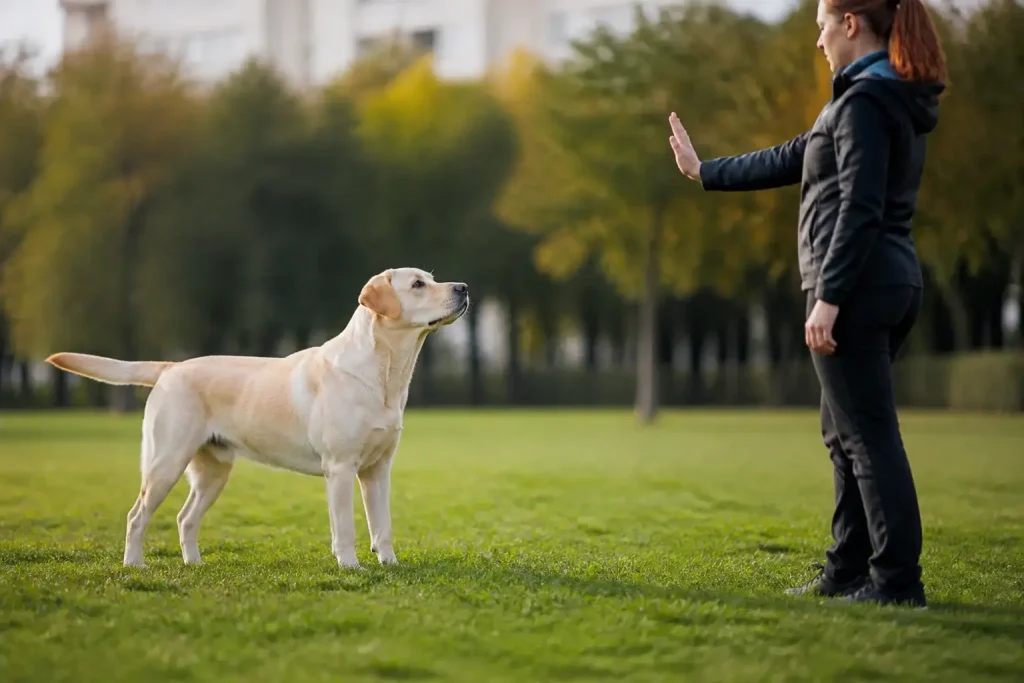
Understanding Advanced Dog Training
Advanced dog training builds reliable behavior in distracting, changing, and emotionally demanding situations. It is not simply teaching a longer list of tricks. Instead, it develops communication, self control, problem solving, confidence, and cooperation between a dog and handler. A trained dog should understand what a cue means, choose an appropriate response, and continue that response when rewards, surroundings, distance, or pressure change.
The most effective programs begin with realistic goals. A companion dog may need a dependable recall, calm greetings, loose leash walking, polite settling, and safe behavior around food or visitors. A working dog may require scent discrimination, directional signals, task persistence, or precise control at a distance. Advanced training should serve the dog’s daily life rather than showcase complexity for its own sake.
Training must also respect welfare. Fear, pain, intimidation, and overwhelming exposure can suppress behavior without creating understanding. Ethical instruction uses clear criteria, thoughtful reinforcement, gradual difficulty, and opportunities for rest. If a dog shows persistent fear, aggression, panic, or sudden behavioral change, consult a qualified veterinarian or behavior professional before increasing training demands.
Core Principles That Produce Lasting Results
Build fluency before difficulty
A behavior is ready for advancement when the dog performs it promptly, accurately, and comfortably in familiar conditions. Increase only one major challenge at a time. For example, after a dog holds a stay for twenty seconds in a quiet room, change either duration, distance, or distraction, not all three together. This approach makes errors easier to interpret and prevents the dog from feeling trapped by an impossible task.
Define the behavior precisely
Vague goals create inconsistent training. “Be good” cannot guide a dog or handler. A precise goal might be, “The dog walks beside the handler with a loose leash for ten steps, then checks in voluntarily.” Define where the dog’s body should be, how long the behavior should last, what cue starts it, and what release signal ends it.
Reinforce strategically
Rewards include food, toys, access to sniffing, movement, social interaction, and permission to greet. Match the reward to the dog and context. A small food reward may be ideal for precision, while a tossed toy can energize a retrieve. Deliver reinforcement promptly so the dog can identify the behavior that earned it. Over time, vary reward size and type while maintaining enough value to support performance.
Teach a release cue
Many advanced behaviors fail because the dog does not know when the exercise is finished. A release cue such as “free” or “all done” tells the dog that it may move, sniff, or change position. The cue should be consistent and should not be used accidentally during a stay, wait, or place exercise. Clear endings reduce guessing and improve persistence.

A Progressive Training Framework
Use a training ladder rather than jumping directly into difficult environments. First establish the behavior in a low distraction setting. Next practice with mild changes, such as a different room, a new handler, or a slightly longer duration. Then add controlled distractions and greater distance. Finally, test the behavior in realistic locations, while preserving safety and the ability to reduce difficulty immediately.
Step One: Choose an observable objective
Write one sentence describing success. Instead of “improve recall,” use, “When called once from fifteen meters in a fenced area, the dog turns, travels directly to the handler, and allows a collar touch.” This objective identifies the cue, starting conditions, response, and completion. It also reveals what must be practiced separately, including orientation, running toward the handler, and accepting restraint.
Step Two: Establish a reinforcement history
Begin with frequent rewards for correct responses. In early stages, reinforcement should be predictable enough to make participation worthwhile. Use a marker word or clicker if it helps identify the exact moment of success. Pair the marker with a reward consistently, and avoid marking behavior that is incomplete or unsafe. A marker is information, not a substitute for a reward.
Step Three: Add controlled variation
Dogs do not automatically generalize learning. A sit taught in a kitchen may not transfer to a park, veterinary clinic, or busy sidewalk. Practice with different surfaces, lighting, locations, handlers, and distractions. Change gradually and return to an easier version whenever accuracy declines. Generalization is achieved through many successful examples, not through repeating one exercise in one place.
Step Four: Thin rewards carefully
Once a dog performs reliably, reward schedules can become less predictable. Do not remove reinforcement suddenly. First reward every strong response, then alternate food with play, praise, environmental access, or a larger occasional reward. Keep safety behaviors, such as recall and emergency stops, highly valuable. Variable reinforcement can increase persistence, but poor timing or excessive reduction can weaken performance.
Advanced Recall and Emergency Control
Recall is one of the most important advanced skills because it can prevent injury. Begin in secure areas with a long line attached to appropriate equipment. Call once in a bright, inviting voice, then move away or crouch to encourage pursuit. When the dog arrives, reward generously and briefly hold the collar before releasing the dog again. This prevents recall from predicting the end of all enjoyable activity.
Avoid calling repeatedly when the dog is unlikely to respond. Repetition can teach the dog that the cue is optional. Instead, reduce distance, lower distraction, use the long line for safety, or choose a stronger reward. Practice recalls from mild interruptions before attempting them near wildlife, traffic, unfamiliar dogs, or other powerful triggers.
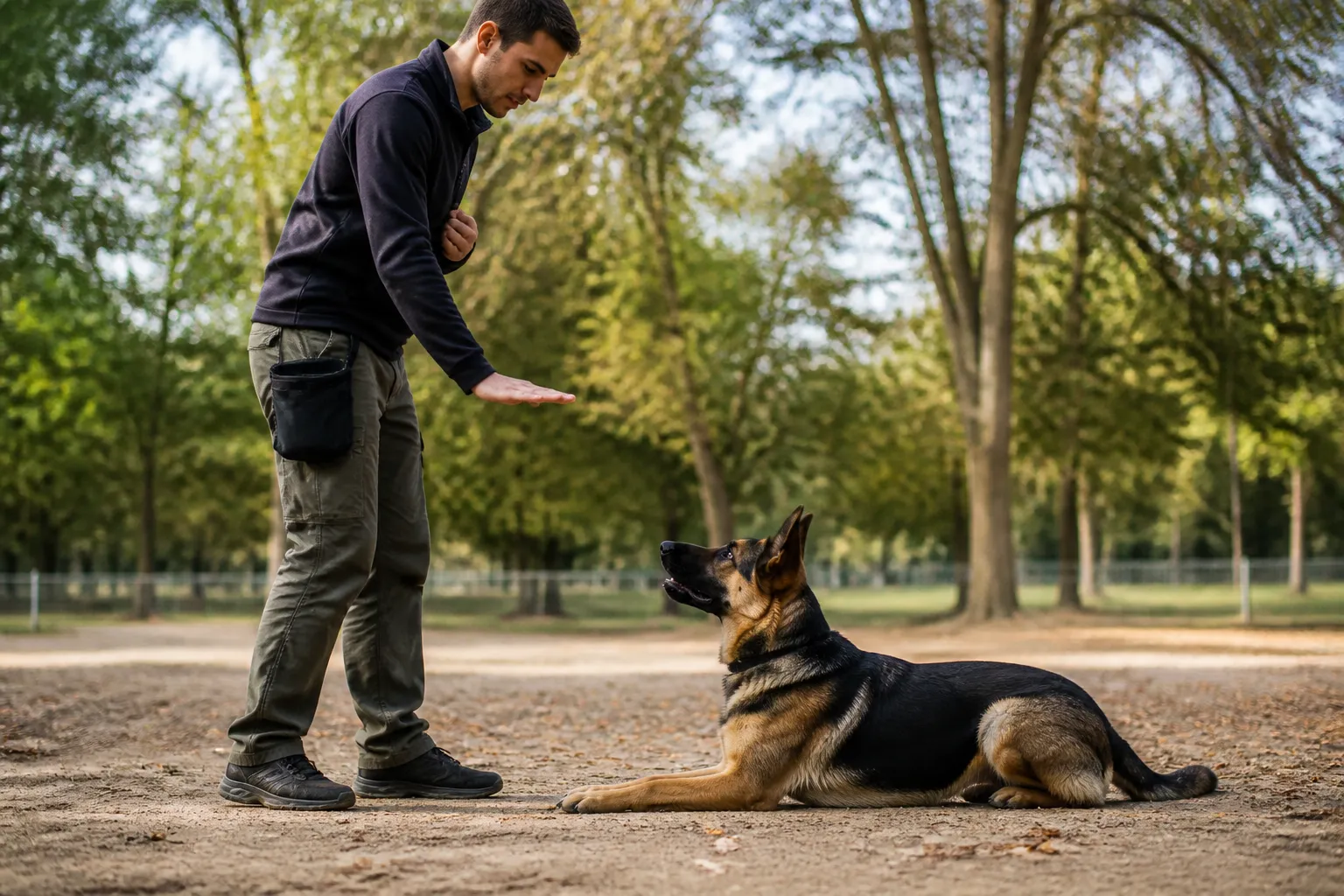
An emergency stop or down can provide a second layer of protection. Teach it first at close range, reward immediate motion, and gradually increase distance. Do not use emergency cues casually. They should remain distinctive and supported by substantial reinforcement.
Duration, Distance, and Distraction
The three dimensions of difficulty are duration, distance, and distraction. Duration asks how long the dog maintains behavior. Distance asks how far the handler can move away. Distraction asks what competing events the dog can ignore. Progress through these dimensions deliberately.
For a place behavior, begin with brief duration while standing nearby. Then step away and return immediately. Later add movement, household sounds, and visitors. If the dog leaves, calmly reset without punishment and make the next repetition easier. A successful session may include many short repetitions rather than one prolonged attempt.
Use a simple training record. Note the environment, cue, number of successful responses, major distractions, reward used, and signs of stress or fatigue. Patterns become visible quickly. If accuracy drops after several repetitions, the dog may need a break, a lower criterion, or a better reward rather than more pressure.
Impulse Control Without Frustration
Impulse control means choosing a useful response while excitement, anticipation, or temptation is present. It does not mean forcing a dog to endure overwhelming stimulation. Begin with manageable temptations. Ask for a brief pause before opening a door, receiving a bowl, chasing a toy, or greeting a familiar person. Release the dog promptly when it succeeds.
Teach the dog what to do instead of merely prohibiting behavior. A dog that jumps can place four paws on the floor, sit, or touch a hand. A dog that pulls toward another dog can orient toward the handler, walk in an arc, or take treats while increasing distance. Alternative behaviors are easier to maintain when they produce meaningful access or relief.

Watch for frustration signals, including frantic pawing, vocalizing, lunging, inability to eat, or rapid loss of focus. These indicate that the exercise may be too difficult. Increase distance from the trigger, shorten the repetition, or choose a calmer activity. Emotional regulation grows through successful practice, not prolonged struggle.
Precision Handling and Distance Work
Distance skills are useful for sport, assistance tasks, farm work, and everyday management. Teach each behavior close to the dog before adding space. Use clear hand signals alongside verbal cues, but introduce them deliberately so the dog does not receive conflicting information. Stand still when asking for a stationary behavior, and avoid accidentally guiding the dog with body movement.
A target, such as a mat, cone, or hand, can clarify location. Target training supports rear-end awareness, directional movement, positioning beside mobility equipment, and cooperative care. Reward contact or alignment precisely, then gradually increase duration and distance. If the dog starts offering random behaviors, simplify the target or reduce the time between repetitions.
For reliable handling, practice transitions. Ask for sit to down, down to stand, a front position to heel position, or a mat to recall. Reward smooth movement and attention, not merely final posture. Transitions reveal whether the dog understands each cue or is following physical prompts.
Scent, Problem Solving, and Cognitive Work
Mental enrichment should challenge the dog without creating confusion. Scent searches can begin with a familiar toy hidden in an easy location. Let the dog investigate, and reward discovery. Increase difficulty by changing containers, rooms, height, or search area one variable at a time. Keep searches safe, and prevent access to toxic substances or objects that could be swallowed.
Problem solving tasks should have a clear solution. Food puzzles, shaping exercises, object discrimination, and cooperative targeting can promote persistence. If the dog repeatedly fails, provide a smaller step or a partial reward. Persistence is valuable only when paired with confidence; endless unsuccessful attempts can produce avoidance or frantic behavior.
Shaping is especially useful for advanced learners. Mark small movements toward a goal, such as looking at a platform, approaching it, placing one paw, then standing on it. Wait quietly, observe carefully, and avoid rapid prompting. Shaping teaches the dog to offer behavior, while the handler learns to reinforce precise progress.

Cooperative Care and Handling
Advanced training should include voluntary participation in grooming, nail care, medication routines, and veterinary handling. Teach a chin rest, stationary position, or nose target as a communication behavior. The dog can learn that maintaining the position permits handling, while moving away pauses the procedure. This arrangement gives the dog information and helps identify when a break is needed.
Introduce equipment gradually. Show a brush, reward calm observation, touch the shoulder, reward, and remove the brush. Progress to one stroke, then several strokes. For nail tools, begin with the sound or sight of the tool at a distance. Never rush because a dog is physically restrained and unable to escape. Pain, illness, or previous distress may require professional support and veterinary assessment.
Common Training Errors
One frequent error is increasing difficulty too quickly. Handlers may move from a quiet room to a crowded park because the dog succeeded at home. A better plan uses intermediate steps and rewards orientation to distractions before expecting complete obedience.
Another error is inconsistent reinforcement. If one person permits jumping while another rewards four paws on the floor, the dog receives contradictory information. Everyone involved should agree on cues, boundaries, and consequences.
Late rewards also create confusion. Deliver reinforcement while the desired behavior is occurring, not after the dog has already broken position. If timing is difficult, use a marker and practice without a dog by marking imagined moments.
Finally, excessive repetition can reduce enthusiasm. End while the dog is still successful. Several brief sessions distributed through a day often produce better learning than one exhausting lesson.
FAQ
How often should advanced training occur?
Short, focused sessions are generally more effective than rare, lengthy lessons. The ideal schedule depends on the dog’s age, health, motivation, and task. Practice a few repetitions during ordinary routines, then stop before attention deteriorates. Include rest days or easy enrichment when the dog appears mentally tired.
Can an older dog learn advanced skills?
Yes. Older dogs can learn new behaviors, although physical limitations, sensory changes, and slower recovery may require adaptation. Use non-slip surfaces, moderate repetitions, and rewards that do not demand jumping or rapid turns. A veterinary check is appropriate when performance changes suddenly or movement seems uncomfortable.
Should treats always be used?
Treats are useful but not mandatory. Food often provides clear, immediate reinforcement, while toys, play, sniffing, praise, and access to preferred activities can also work. Do not reduce rewards merely to appear advanced. Instead, teach the dog that several appropriate outcomes can follow successful behavior.
What should I do when my dog ignores a cue?
First assess the environment, motivation, physical comfort, and clarity of the cue. The dog may not understand, may be distracted, or may find the reward insufficient. Avoid repeating the cue many times. Make the exercise easier, guide safely when appropriate, and reinforce the first correct response.
When is professional help needed?
Seek qualified help for aggression, serious fear, separation distress, resource guarding, bite history, or behavior that presents immediate risk. Choose a professional who explains methods clearly, prioritizes welfare, and can coordinate with a veterinarian when medical factors may contribute.
A Practical Weekly Plan
A balanced week might include precision work on one day, recall and outdoor generalization on another, cooperative care on a third, scent enrichment on a fourth, and relaxed review on a fifth. Keep every session connected to daily life. Ask for a calm wait before opening a gate, a hand target before clipping a leash, or a check-in before crossing a street.
At the end of each week, evaluate more than success percentages. Ask whether the dog appears confident, whether recovery after mistakes is quick, whether cues remain clear, and whether the behavior is useful outside training. Adjust the next week according to those observations.
Conclusion
Advanced dog training is a process of creating dependable choices under realistic conditions. The strongest results come from precise goals, gradual progression, meaningful reinforcement, careful generalization, and respect for emotional and physical limits. Recall, impulse control, distance work, scent games, and cooperative care all become more reliable when the dog understands both the requested behavior and the way to succeed.
Train one variable at a time, record useful observations, and treat mistakes as information. Reward effort and improvement, not only perfect performances. With patience and consistency, advanced skills can become practical habits that improve safety, communication, confidence, and the shared quality of everyday life.