Service Dog Training: Skills, Confidence, and Responsible Partnership
Service dog training is a structured process that prepares a dog to perform specific tasks for a person with a disability while remaining safe, calm, and manageable in public. Effective training is not simply obedience practice. It combines health screening, temperament assessment, task instruction, environmental socialization, handler education, and ongoing maintenance. The goal is a dependable working partnership, not a dog that performs tricks on command.
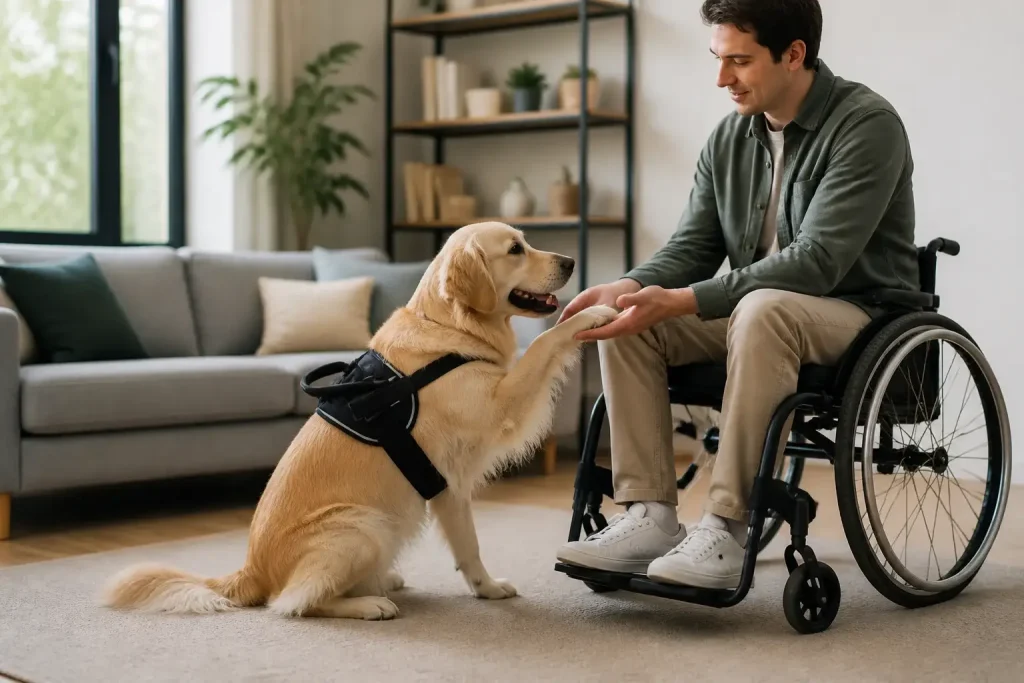
A well-trained service dog can help with tasks such as retrieving needed items, opening accessible doors, providing balance support when appropriately built and trained for it, interrupting harmful behaviors, alerting to changes, guiding a handler around obstacles, or assisting with transfers. The suitable tasks depend on the individual’s disability, physical needs, environment, and professional recommendations. Training should always protect the dog’s welfare and avoid duties that exceed its size, age, health, or abilities.
For families choosing a program, the strongest option is one that explains its methods, evaluates the dog honestly, builds skills gradually, and teaches the handler how to maintain them. Promises of instant certification, guaranteed public access, or a perfectly trained dog without meaningful handler participation deserve caution. Service dog work is demanding, but thoughtful preparation can produce greater independence, confidence, and safety.
What Service Dog Training Includes
Service dog training usually develops four connected areas: foundation behaviors, task skills, public manners, and partnership. Foundation behaviors include name response, recall, loose-leash walking, settling on a mat, leave-it, drop-it, wait, stay, and calm greetings. These behaviors give the handler practical control and help the dog understand expectations in unfamiliar places.
Task training teaches the dog to perform a behavior that directly mitigates a disability. For example, a dog may retrieve medication, provide a trained interruption, signal an alert, turn on a light, or locate a caregiver. A behavior becomes a service task because it addresses a disability-related need, not because it looks impressive. Trainers should define the task clearly, identify its cue, establish a reliable response, and decide how success will be measured.
Public-access preparation adds another layer. The dog must learn to ignore food, people, animals, noise, automatic doors, elevators, shopping carts, and unexpected movement. Training should begin in controlled settings and progress only when the dog remains relaxed and responsive. Repeated exposure without adequate distance or recovery can create fear rather than confidence.
Partnership training teaches the person to give consistent cues, recognize stress, reinforce useful choices, and manage equipment. The handler must understand when the dog is working, when it needs a break, and when a task is unsafe. The dog is a living partner, not a machine or a substitute for medical care.
Choosing a Suitable Dog
Not every dog is suited to service work, even if it is intelligent, friendly, or highly trainable. Important qualities include stable temperament, physical soundness, resilience, attention to the handler, and the ability to recover after surprises. Excessive fear, persistent reactivity, uncontrolled aggression, intense prey drive, or inability to relax in public may make service work inappropriate.
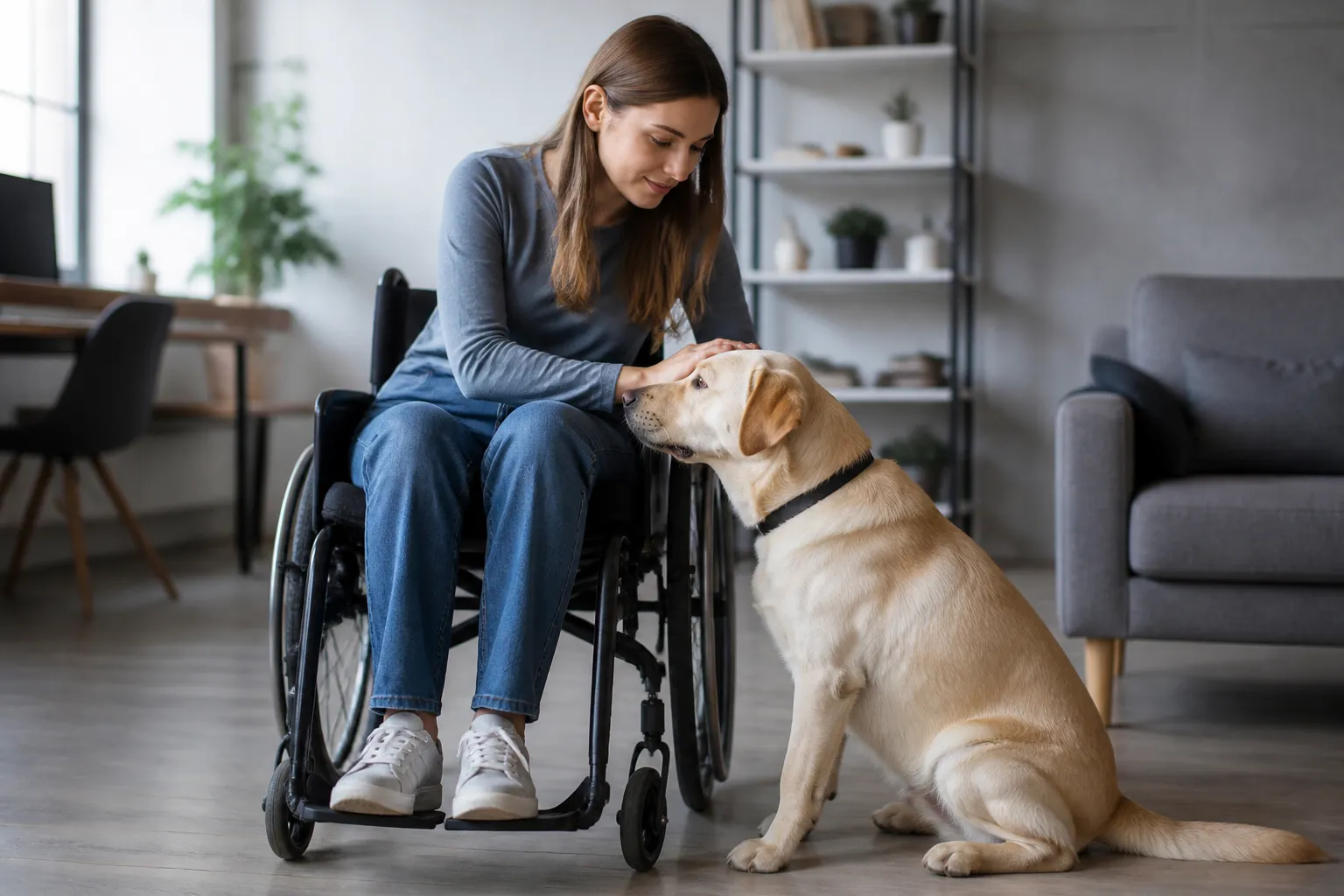
Breed can influence tendencies, but it does not guarantee success. Individual evaluation matters more than appearance or popularity. A veterinarian should assess overall health, movement, vision, hearing, and conditions that could affect working comfort. The dog’s expected adult size should also match the intended tasks. Mobility assistance, for instance, can place significant stress on joints and should never be improvised.
Age affects the plan. Puppies need sleep, exploration, house training, bite inhibition, and carefully managed socialization. Adolescents may test boundaries or struggle with impulse control. Mature dogs may learn efficiently but have established habits that require adjustment. A program should allow development rather than demanding full public-access reliability before the dog is ready.
A professional temperament assessment can identify strengths and concerns, but no evaluation predicts every future situation. Ask how the trainer tests recovery, environmental confidence, handling tolerance, and motivation. Honest trainers explain disqualifying concerns instead of accepting every dog for payment.
Owner-Trained and Professional Programs
Some handlers train their own dogs with guidance from a qualified professional. This approach can build a strong relationship and accommodate unusual task needs, but it requires time, consistency, access to suitable environments, and careful self-evaluation. Professional programs may provide breeding, puppy raising, advanced task work, or team placement. They may also cost more and involve waiting periods.
A blended arrangement is often practical: the handler teaches daily manners and reinforces skills while a trainer helps design tasks, troubleshoot behavior, and evaluate progress. Before enrolling, request a written outline covering methods, milestones, communication, cancellations, follow-up support, and what happens if the dog cannot complete the program.
Building Foundation Skills
Training should begin with reinforcement-based learning. Reward the behavior you want with food, play, praise, access to sniffing, or another meaningful consequence. The reward should arrive promptly so the dog can connect it with the correct choice. Clear markers, such as a spoken word or clicker, can help identify the moment of success.
Start in a quiet environment and keep sessions short enough to preserve enthusiasm. Teach one small piece at a time. For a settle, reward the dog first for looking at the mat, then stepping onto it, lying down, relaxing, and remaining calm while the handler moves. Increase only one challenge at a time: duration, distance, or distraction.
House training and reliable elimination routines are essential for public work. Feed and exercise on predictable schedules, supervise carefully, and reward outdoor toileting. If accidents or sudden behavior changes occur, consult a veterinarian because health problems can affect training.
Loose-leash walking should be taught without relying on constant physical restraint. Reward the dog for staying near the handler, changing direction willingly, and checking in. Practice beside calm distractions before entering busy locations. A dog that pulls toward every person or scent may be friendly, but it is not yet ready for demanding public environments.
Recall deserves special attention. Use a secure area, high-value rewards, and gradual distance increases. Never repeatedly call the dog for unpleasant events, such as ending every outing. For safety, recall training does not replace appropriate leashes, barriers, or local requirements.
Teaching Disability-Related Tasks
Task training begins with a precise description of the need. “Help me when I struggle” is too broad to train. A useful plan identifies the observable situation, the dog’s response, the handler’s next action, and the conditions under which the task is safe.
Suppose the goal is retrieval. The trainer may first reward looking at an object, then touching it, picking it up, carrying it, and delivering it to the hand. Different objects require different textures and weights. The dog should learn a release cue and should not chew medication containers, mobility equipment, or fragile items.
For an interruption task, the trainer must define what the dog should notice and how it should respond. The response might be a nose touch, paw target, sustained contact, or retrieval of a support item. Training should avoid deliberately escalating distress beyond what is safe. A qualified clinician or behavior professional may help coordinate the task with the handler’s care plan.
Alerts require particular caution. Some dogs notice patterns that precede a medical or psychiatric event, but natural sensitivity is not the same as a reliable trained alert. Do not depend on an unverified alert as the sole safety measure. Use established medical guidance, backup plans, and monitoring systems where appropriate.
Mobility tasks require the greatest physical caution. Bracing, counterbalance, and pulling should be considered only with veterinary input and equipment designed for the specific purpose. Puppies, dogs with joint disease, and dogs whose structure is unsuitable should not perform weight-bearing work. Retrieval, item delivery, or positional assistance may offer safer alternatives.
Generalization is crucial. A task learned in a living room may fail in a vehicle, workplace, school, clinic, or crowded store. Practice across locations, surfaces, lighting, noise, and handler positions. Add distractions gradually and reward calm, accurate responses rather than rushing for completion.

Public Access and Confidence
Public-access training should resemble real life while remaining controlled. Begin with quiet sidewalks, building entrances, calm stores that permit dogs, or other lawful settings. Work at a distance from distractions, reward attention, and leave before the dog becomes overwhelmed. Progress is measured by relaxed behavior and recovery, not by the number of locations visited.
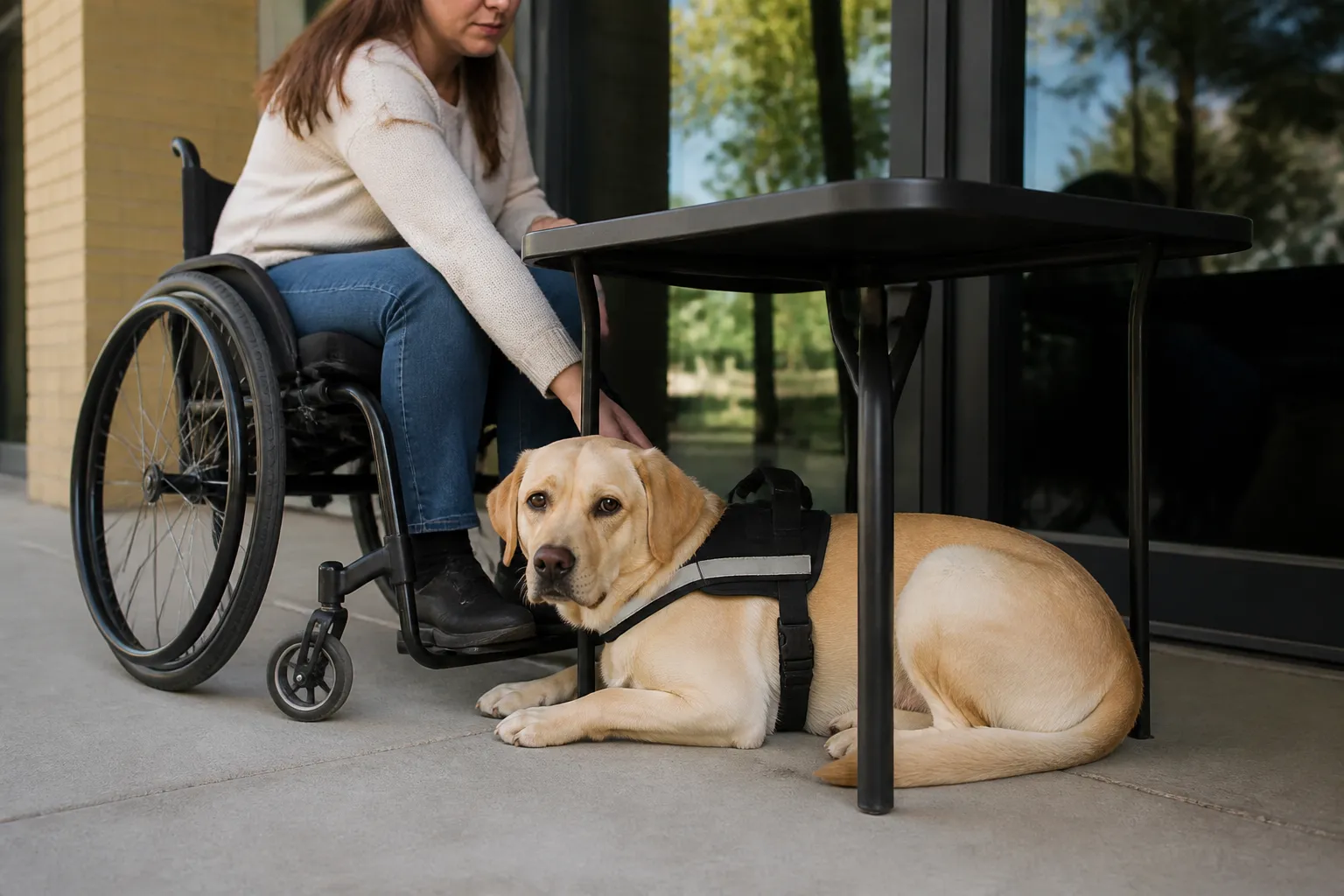
A working dog should walk without dragging the handler, remain near its person, avoid soliciting attention, and settle quietly under a chair or beside a workstation. It should ignore dropped food, respond to a safety cue, and tolerate routine handling. These standards protect the handler, the public, employees, and the dog.
Confidence does not mean forcing the dog to approach every stimulus. A confident plan gives the dog choices, uses distance, and permits recovery. Watch for lip licking, yawning, freezing, tucked posture, scanning, hiding, panting unrelated to heat, or repeated attempts to escape. These signs indicate that the challenge may be too difficult. End the session or create more space.
Public etiquette also matters. Do not allow strangers to pet, feed, call, or distract a working dog without permission. A vest may communicate that the dog is working, but equipment alone does not create training or legal status. Requirements differ by jurisdiction, and handlers should consult current official guidance rather than relying on social media claims.
Measuring Progress and Solving Problems
Use observable criteria. Instead of saying a dog is “better,” record whether it responds within a reasonable period, completes the task, remains calm around a defined distraction, or settles for a planned duration. Notes reveal patterns and help trainers adjust difficulty.
When a skill fails, reduce complexity before adding stronger corrections. Consider whether the cue is clear, the reward is valuable, the environment is too difficult, or the dog is tired, hungry, uncomfortable, or frightened. A sudden decline in performance warrants a health check, especially if it includes changes in movement, appetite, sleep, elimination, or mood.
Reinforcement schedules can change as skills become reliable. Continue rewarding difficult or high-value work, while occasionally varying rewards for familiar behaviors. Do not remove reinforcement so quickly that the dog loses motivation. Praise, access to a break, and permission to sniff can supplement food, but they should remain meaningful to that individual dog.
Equipment should support communication and safety. A properly fitted collar, harness, leash, identification, waste supplies, water, and emergency information are basic considerations. Specialized equipment requires instruction and regular inspection. Avoid tools that cause pain, fear, breathing restriction, or injury. If a trainer cannot explain how equipment protects welfare and improves learning, seek another opinion.

Handler Responsibilities and Daily Care
The handler is responsible for more than issuing cues. Daily care includes nutrition, exercise appropriate to the dog, grooming, dental care, veterinary visits, parasite prevention, rest, and emotional decompression. A tired, painful, or overstimulated dog cannot work reliably.
Plan working days realistically. Schedule breaks, water, toileting opportunities, and quiet periods. Some dogs can manage a long outing, while others need shorter shifts. Do not interpret fatigue as disobedience. A dog that repeatedly struggles may be communicating that the workload or environment needs adjustment.
The handler should also maintain records of vaccinations, medical instructions, training goals, emergency contacts, and task procedures. A backup plan is valuable if the dog is ill, injured, retired, or temporarily unable to work. Independence should not depend on one animal being available every hour.
Retirement deserves respectful planning. Age, pain, sensory changes, reduced stamina, or repeated stress may signal that work should decrease. Consult veterinary and training professionals, then introduce alternatives gradually. A retired service dog remains a companion whose needs may change as its role changes.
Selecting a Training Provider
Ask prospective providers how they teach, what welfare standards they follow, how they assess dogs, and how they handle setbacks. Look for transparent answers, written agreements, realistic timelines, and continuing support. Observe a class or consultation if possible. Training should be calm, structured, and adaptable rather than dominated by intimidation.
Be cautious about guaranteed outcomes, instant certification, pressure to purchase expensive packages, or claims that equipment can solve every behavior problem. A provider should explain that success depends on the dog, handler, task, health, environment, and consistency. References can be useful, but they do not replace direct questions about methods and obligations.
Clarify whether fees cover evaluation, private sessions, group practice, task training, public-access coaching, travel, equipment, and follow-up. Ask what happens if the dog is unsuitable. Ethical programs discuss alternatives, including reassignment, career change, or stopping service work, without treating that outcome as failure.
Frequently Asked Questions
How long does service dog training take?
There is no universal schedule. Time depends on the dog’s age, temperament, health, task complexity, training history, and the handler’s availability. Foundation behaviors may develop relatively quickly, while reliable public work and complex tasks require sustained practice. Quality and readiness matter more than a promised deadline.
Can any breed become a service dog?
No. Many breeds and mixed-breed dogs can succeed, but individual temperament, health, size, and motivation determine suitability. A friendly dog may still be too reactive, distracted, fragile, or uncomfortable for the intended work. Evaluation should precede major investment.
Is a vest enough to identify a service dog?
No. A vest can communicate that a dog is working, but it does not train the dog or establish legal rights by itself. Rules vary by location and may address public access, housing, transportation, or documentation differently. Check current official information for the relevant jurisdiction.
Should service dogs greet people in public?
Usually, no. The dog should remain focused unless greeting is part of a specifically trained task or the handler gives permission. Preventing spontaneous greetings reduces distraction and protects the dog’s concentration.
What should I do if my dog shows fear?
Increase distance, reduce the challenge, and allow recovery. Do not punish fear or force interaction. Record what happened and consult a qualified trainer or veterinary behavior professional. If fear is sudden, intense, or accompanied by physical changes, seek veterinary advice.
Can a service dog play and relax?
Yes, and it should. Rest, enrichment, play, and social connection support welfare. A dog that understands both working and off-duty cues can transition more easily between roles. Balance prevents the animal from remaining tense throughout the day.
What happens if training does not work?
Reassess the goal, dog, environment, health, and teaching method. Some tasks may need redesigning, and some dogs may be better suited to another role. Continuing unsuitable work can harm both partners. An ethical decision may involve career change, retirement, or a different support strategy.
Conclusion
Service dog training succeeds when it treats training, health, welfare, and human needs as one connected system. Begin with an honest suitability assessment, teach foundation behaviors through clear reinforcement, define disability-related tasks precisely, and generalize skills gradually. Measure calm reliability rather than impressive demonstrations.
Choose professionals who value transparency and safety, and participate actively in every stage. Your consistency, observation, and willingness to adjust will shape the partnership as much as the dog’s natural abilities. With realistic goals and compassionate preparation, service work can provide meaningful assistance while preserving the dog’s dignity, confidence, and quality of life.