

Understanding Behavioral Dog Training
Behavioral dog training addresses the reasons behind a dog’s actions, not merely the actions themselves. Barking, lunging, chewing, jumping, hiding, guarding, or refusing to cooperate can reflect fear, frustration, confusion, pain, excitement, genetics, or a learned history. Effective training therefore combines observation, humane teaching, environmental management, and realistic expectations. The goal is not to suppress every inconvenient behavior. It is to help the dog feel safer, understand what earns reinforcement, and choose responses that work in everyday life.
A useful program begins with a specific description. “My dog is aggressive” is less informative than “my dog growls and stiffens when an unfamiliar person reaches toward his collar.” Note what happens before the behavior, what the dog does, what follows, and how quickly recovery occurs. This pattern, often called an antecedent-behavior-consequence sequence, reveals opportunities for change.
Behavioral training is suitable for puppies, adult dogs, and senior companions, although the plan should reflect age, health, learning history, and living conditions. It may address household manners, separation-related distress, fear of handling, resource guarding, reactivity on walks, or overexcitement around visitors. Serious cases require individualized professional guidance rather than a generic course.
What Behavioral Training Includes
A comprehensive service or program usually combines assessment, a written plan, practical instruction, follow-up, and adjustments. During assessment, the trainer gathers information about the dog’s routine, diet, sleep, exercise, relationships, environment, medical background, and previous training. A video of the behavior, recorded safely from a distance, may help a qualified professional identify details that are easy to miss in conversation.
The training plan should define observable goals. “Be calmer” can become “settle on a mat while a guest enters” or “look at a bicycle and then turn toward the handler without lunging.” Clear goals make progress measurable and prevent everyone from changing several variables at once.
Most ethical programs use reward-based methods. Food, play, access to sniffing, social interaction, and freedom can reinforce behavior when delivered at the right moment. Reinforcement is not bribery when it is planned thoughtfully; it teaches the dog that a specific choice produces a useful consequence. A reward may eventually become intermittent, but new skills generally need frequent, immediate reinforcement.
Management is equally important. Gates, secure harnesses, covered windows, separate feeding areas, long-lasting chews, quiet rooms, and carefully chosen walking routes prevent rehearsal of unwanted behavior while learning develops. Management does not mean failure. It is a safety and learning strategy.

Start With Health, Safety, and Context
A sudden behavior change deserves veterinary attention. Pain, skin irritation, dental disease, impaired senses, gastrointestinal discomfort, neurological conditions, medication effects, and age-related changes can influence behavior. A dog that snaps when touched may be frightened by pain, not displaying a simple obedience problem. Medical assessment cannot solve every behavioral concern, but overlooking health can make training ineffective or unsafe.
Safety planning comes first when aggression, biting, escaping, fighting, or severe panic is involved. Use secure equipment, barriers, controlled distances, and a clear emergency plan. Do not test a dog by deliberately exposing it to a trigger. Children should not be responsible for managing a dog’s reactivity or guarding behavior, and interactions should be supervised according to the dog’s risk profile.
Context matters because behavior is rarely identical everywhere. A dog may respond well in a quiet living room but struggle near a crowded sidewalk. Training should progress from easier settings to harder ones, changing only one major challenge at a time. Distance, movement, duration, noise, novelty, and social pressure all affect difficulty.
Reading Early Signals
Dogs often communicate discomfort before growling or snapping. Turning away, freezing, lip licking, yawning, crouching, hiding, pinned ears, whale eye, rapid scanning, or sudden sniffing can indicate stress, depending on context. Excitement may appear as bouncing, whining, pulling, grabbing, or inability to pause. Learning these signals allows the handler to intervene early, increase distance, or offer a simpler behavior.
Growling is valuable information, not a moral offense. Punishing it may remove a warning without changing the underlying emotion. The safer response is to stop the interaction, create space, record what preceded it, and seek qualified help when risk is significant.
A Practical Training Process
Step One: Define the Behavior
Write a neutral description that another person could recognize. Include the trigger, distance, body language, intensity, duration, frequency, and recovery time. “Barks at dogs” should become “barks, pulls forward, and scans continuously when another dog is within approximately one block.” Avoid labels such as stubborn, dominant, spiteful, or jealous unless they are being discussed as casual impressions, because labels can hide the practical details needed for planning.
Step Two: Identify the Function
Ask what the behavior achieves for the dog. Barking may make a person move away, provide stimulation, attract attention, or express alarm. Pulling may reach an interesting smell. Stealing objects may produce a chase game. Hiding may create relief from frightening contact. The same outward behavior can have different functions, so interventions should be based on observation rather than assumptions.
Step Three: Control the Learning Environment
Prevent avoidable repetitions while teaching begins. If a dog raids a kitchen bin, secure the bin and provide appropriate enrichment. If window barking is frequent, close blinds during busy periods and teach an alternative resting location. If visitors cause panic, arrange distance behind a barrier rather than requiring greetings. Every successful rehearsal can strengthen a pattern, while prevention creates room for new learning.
Step Four: Teach a Replacement Skill
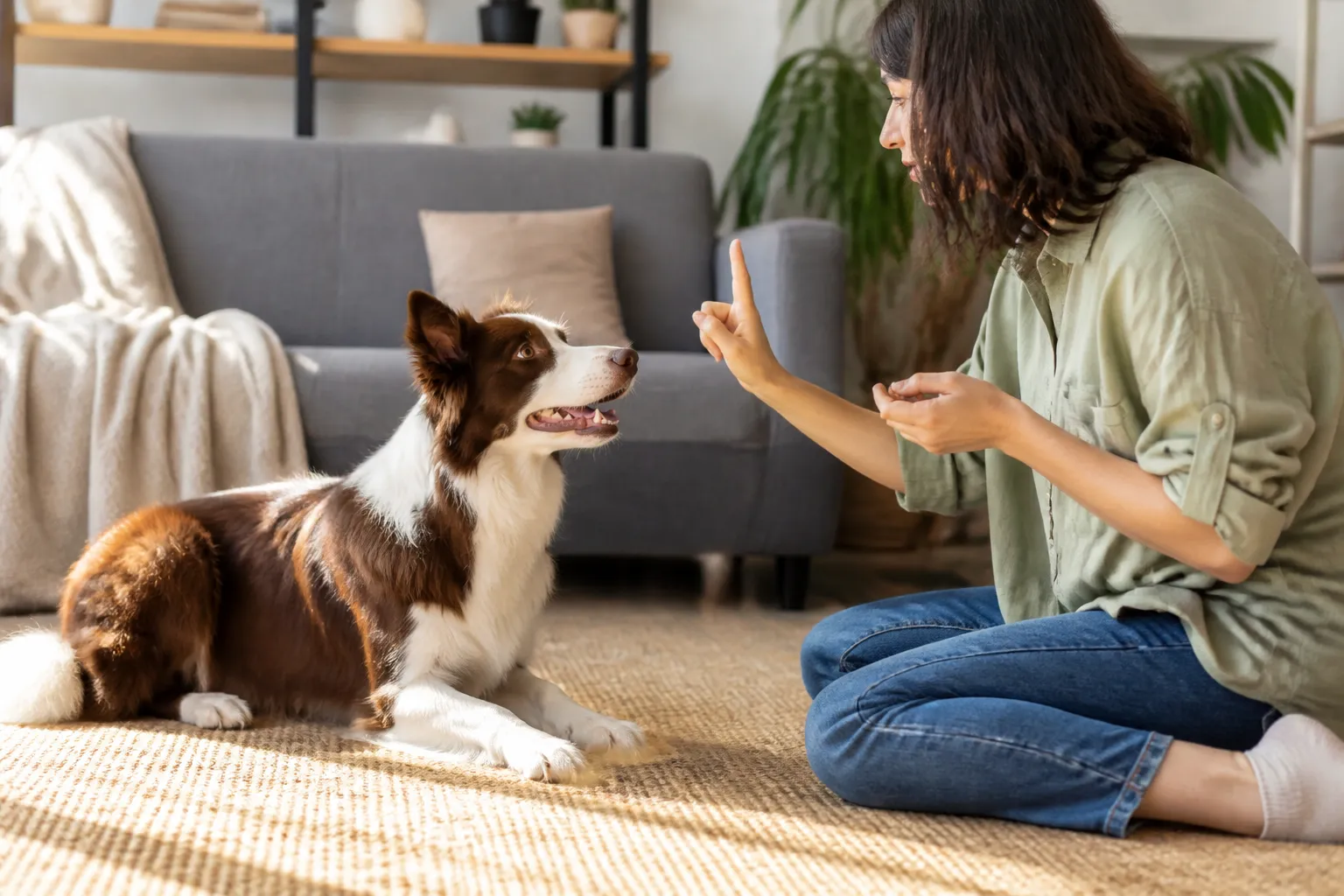
A replacement behavior must be physically possible and useful in the relevant situation. Teach name response, hand targeting, loose-leash walking, a mat settle, “find it,” leave it, recall, or a calm orientation toward the handler. Practice first without the trigger, reward generously, then introduce mild versions of the challenge.
Step Five: Change the Emotional Response
For fear or reactivity, desensitization and counterconditioning are common approaches. Present the trigger at a low enough intensity that the dog can remain functional, then pair it with something valuable. When the dog notices the trigger and remains relaxed, reinforce and end or reduce the exposure. Gradually adjust distance or intensity. If the dog freezes, trembles, barks, lunges, refuses food, or cannot respond, the setup is too difficult.
This process is not a forced greeting or an endurance test. Flooding, which exposes an animal to an overwhelming trigger without escape, can increase distress and is not a suitable default strategy. Progress may be uneven; a difficult day does not erase earlier learning.
Step Six: Generalize and Maintain
Dogs do not automatically transfer a behavior from one room to every location. Practice with different surfaces, handlers, times, sounds, and distances while preserving manageable difficulty. Reinforce periodically after a skill becomes reliable, and return to easier exercises when circumstances change, such as moving house, illness, adolescence, or a new family member.

Common Behavioral Concerns
Reactivity on Walks
Reactivity includes barking, growling, lunging, spinning, or intense pulling toward dogs, people, vehicles, or other triggers. Begin by selecting routes and times that permit space. Use a well-fitted harness or other equipment recommended by a qualified professional, and avoid retractable leads near hazards. Reward noticing the trigger and turning away before escalation. A practiced U-turn can provide an emergency exit, but it should be taught in calm conditions first.
Separation-Related Distress
A dog with separation-related distress may vocalize, destroy exit points, pace, eliminate, drool, or panic soon after being left. Video can reveal what occurs after departure, but do not leave a distressed dog for extended periods merely to make it “get used to” absence. A behavior professional may design gradual departures below the dog’s panic threshold. Temporary support from family, sitters, or daycare may reduce repeated distress while the plan develops. Veterinary input can be appropriate, especially when panic is severe.
Resource Guarding
Guarding may involve food, toys, resting places, stolen objects, or people. Never remove a valued item by force as a routine lesson. Instead, prevent access to dangerous objects, trade for something better, and teach exchanges when the dog is relaxed. Do not allow children to approach a dog while it eats or possesses a valued item. Guarding with bites or rapid escalation warrants professional assessment.
Jumping and Mouthing
Jumping often succeeds because it gains attention, movement, or access. Teach greeting with four paws on the floor, reward calm orientation, and make attention predictable. For puppy mouthing, redirect to suitable toys, stop rough interaction briefly, and provide sleep and appropriate activity. Avoid grabbing the muzzle, pinning the dog, or encouraging physical struggle, which can increase arousal or fear.
Barking
First identify whether barking serves alarm, social contact, frustration, boredom, fear, or access. Reduce unnecessary triggers, increase appropriate enrichment, and reinforce quiet pauses rather than shouting over the noise. A cue for looking toward the handler can replace repeated vocalizing in some contexts. Expecting complete silence is usually unrealistic; a practical goal is fewer episodes, faster recovery, and safer communication.
Choosing a Trainer or Program
Look for a professional who explains behavior clearly, welcomes questions, observes the dog’s body language, and adapts the plan. Ask what methods are used, how safety is handled, what happens if the dog does not improve, and whether the professional collaborates with veterinarians or veterinary behavior specialists. Transparent pricing, written goals, realistic timelines, and clear follow-up are useful signs of a structured service.

Be cautious of guaranteed results, claims that every problem is caused by dominance, promises of instant obedience, or pressure to use intimidation. Choke chains, prong collars, shock collars, leash corrections, alpha rolls, shouting, and physical punishment can suppress visible behavior while increasing fear, conflict, or handling risk. Equipment alone is not a training plan. If a professional cannot describe the learning process or refuses to discuss welfare, choose another provider.
A group class can suit dogs who are comfortable learning around others and need foundational skills. Private sessions are often more appropriate for fear, aggression, severe distraction, household conflict, or highly specific routines. Online instruction can provide demonstrations and coaching, but it may not be enough when direct risk assessment is required.
What Owners Should Expect
Behavior change is usually measured in trends, not perfect performance. Track trigger distance, recovery time, successful repetitions, sleep, appetite, and the frequency of unwanted behavior. A simple log can show whether a plan is helping and reveal patterns involving weather, visitors, exercise, pain, or fatigue.
Set criteria before each session. Decide what the dog should do, what reward will follow, and what signal means the exercise is too difficult. Keep practices short enough to preserve success. Several brief sessions may be more productive than one exhausting session. End with an easy behavior and allow recovery.
Use consistent household rules, but do not demand identical wording from every person. The important relationship is between the dog’s response and its consequence. Everyone should know how to prevent unsafe interactions, when to give space, and how to reinforce the replacement behavior.
Regression can follow stress, illness, environmental change, or a trigger appearing unusually close. Respond by reducing difficulty rather than labeling the dog disobedient. If risk increases, pause challenging exercises and contact the trainer or veterinarian.
FAQ
Is behavioral dog training only for aggressive dogs?
No. It can help with fear, separation distress, leash reactivity, compulsive patterns, excessive barking, handling problems, resource guarding, jumping, and everyday self-control. Early support may prevent a mild concern from becoming more disruptive, although not every behavior requires formal professional treatment.
How long does training take?
There is no universal timeline. It depends on the behavior’s history, intensity, frequency, health factors, environment, and the consistency of management. A dog may learn a replacement response quickly while emotional recovery takes longer. A responsible professional should explain short-term benchmarks without promising a fixed cure date.
Can old dogs learn new behaviors?
Yes, older dogs can learn, but sessions may need to account for pain, hearing or vision changes, fatigue, and slower physical movement. Use clear cues, appropriate rewards, comfortable surfaces, and frequent breaks. Veterinary review is sensible when an older dog develops a new concern.
Should treats be used forever?
Rewards may remain part of training, but their form and frequency can change. Food is often efficient for teaching difficult skills, while praise, play, sniffing, or access to a preferred activity may reinforce familiar behaviors. Do not remove reinforcement abruptly after reliability; maintain the behavior with varied, appropriate consequences.
What if my dog will not take food?
Refusing food can indicate fear, illness, distraction, or a reward that is not valuable in that context. First lower the difficulty and check health. Do not force food toward the dog. A professional can help identify alternative reinforcers and a safer starting point.
Is a private trainer better than a class?
Neither is automatically better. Classes offer controlled practice and social learning for suitable dogs. Private work provides customization, privacy, and more careful management of complex or risky behavior. The choice should reflect the dog’s needs, the household environment, and the instructor’s competence.
When is veterinary behavior support needed?
Seek veterinary guidance for sudden changes, severe anxiety, panic, aggression involving injury, compulsive behavior, suspected pain, or cases that do not improve with appropriate training. A veterinarian can investigate medical contributors and, when indicated, discuss treatment options alongside behavior modification.
Conclusion
Behavioral dog training is a structured process of understanding causes, preventing unsafe rehearsal, teaching practical alternatives, and changing emotional responses at a manageable pace. It works best when goals are observable, rewards are timely, environments are carefully arranged, and health and safety receive priority. Progress does not require perfection; it requires repeated opportunities for the dog to make successful choices.
Start by documenting one concern, arranging a health check when appropriate, and identifying a qualified, humane professional if the behavior carries meaningful risk. Practice easy skills before difficult ones, respect early stress signals, and adjust the plan when the dog struggles. With patience, consistent management, and realistic expectations, training can improve communication, daily cooperation, and the relationship between dogs and the people responsible for their care.