

Behavioral dog training helps dogs replace unwanted responses with safer, more useful behavior. It is not simply obedience practice, and it should not depend on intimidation, pain, or punishment. The most effective plan identifies what a dog is communicating, changes the conditions surrounding the behavior, teaches an alternative response, and rewards progress consistently. This approach can address barking, jumping, pulling, fear, reactivity, guarding, separation-related distress, and household manners while protecting the relationship between dog and caregiver.
A behavioral training program is a process rather than a single product or quick fix. Its value lies in structured assessment, humane teaching, practical management, and follow-up. The description below explains what a well-designed program includes, how to use it, when professional support is necessary, and what realistic improvement looks like.
What Behavioral Dog Training Includes
Behavioral dog training is an organized service, course, or home-training plan designed to change patterns that interfere with safety, welfare, or daily life. It combines observation, prevention, skill building, and reinforcement. A responsible program begins by asking why the behavior occurs instead of labeling the dog as stubborn, dominant, or bad.
For example, a dog may bark at visitors because of fear, excitement, territorial behavior, frustration, or a learned history of receiving attention. Those causes can look similar from a distance, yet they require different strategies. A fearful dog may need increased distance and gradual exposure. An excited dog may need impulse-control exercises and a predictable greeting routine. Accurate interpretation makes training more humane and more efficient.
A complete program commonly includes an intake conversation, a behavior history, goal setting, environmental management, lesson plans, practice instructions, progress tracking, and adjustments. It may be delivered through private sessions, group classes, video guidance, written resources, or a combination. The format matters less than the quality of assessment and the clarity of the plan.
Core Principles
Learning theory provides the foundation. Behaviors that produce rewarding outcomes become more likely, while behaviors that no longer achieve a desired result may decrease. In practical terms, caregivers reinforce calmness, orientation toward the handler, loose-leash walking, settling, and appropriate communication. Food is often useful, but play, access to sniffing, movement, praise, and social interaction can also function as rewards.
Management is equally important. A dog cannot practice lunging at every passing dog and then be expected to improve quickly. Barriers, leashes, gates, visual screens, closed doors, secure harnesses, and carefully selected walking routes reduce rehearsal of unwanted behavior. Management is not failure or avoidance; it creates the safety and emotional space needed for learning.

Humane training also considers emotional state. A dog that is frightened, highly aroused, or physically uncomfortable may be unable to respond to familiar cues. Training should therefore reduce unnecessary pressure and work below the point at which the dog loses control. If the dog cannot eat, look away, respond, or recover, the situation is probably too difficult.
Assessing the Behavior
The first practical step is to describe the behavior precisely. “Aggressive” or “disobedient” is too broad to guide a plan. Record what the dog does, where it happens, who is present, how close the trigger is, what occurs immediately beforehand, and what follows. Note body language, duration, intensity, recovery time, and whether the behavior is changing.
An antecedent-behavior-consequence record can reveal patterns. The antecedent is the event or condition before the behavior. The behavior is observable action, such as barking, freezing, snapping, jumping, or escaping. The consequence is what happens afterward, such as distance from a trigger, attention from a person, or access to an object. This record does not assign blame; it helps identify what may be maintaining the pattern.
Health deserves early attention. Pain, skin irritation, digestive problems, sensory decline, neurological conditions, hormonal changes, and medication effects can influence behavior. Sudden changes, unusual aggression, persistent restlessness, disorientation, or sensitivity to touch warrant veterinary evaluation. Training cannot solve an untreated medical problem, and behavioral observations can provide useful information for a veterinarian.
The assessment should also consider sleep, exercise, diet, social experiences, previous training, household routines, and opportunities for species-typical activities such as sniffing, chewing, exploring, and resting undisturbed. A dog with inadequate rest may react more readily. A dog receiving constant exposure without recovery may become increasingly sensitized.
Setting Useful Goals
Good goals are specific, observable, and realistic. Instead of “stop being reactive,” a useful goal might be “when a bicycle appears at a manageable distance, the dog notices it, turns toward the handler, and walks away without lunging.” Instead of “be good with guests,” define a routine: the dog moves behind a gate, receives a chew, and remains relaxed while visitors enter.
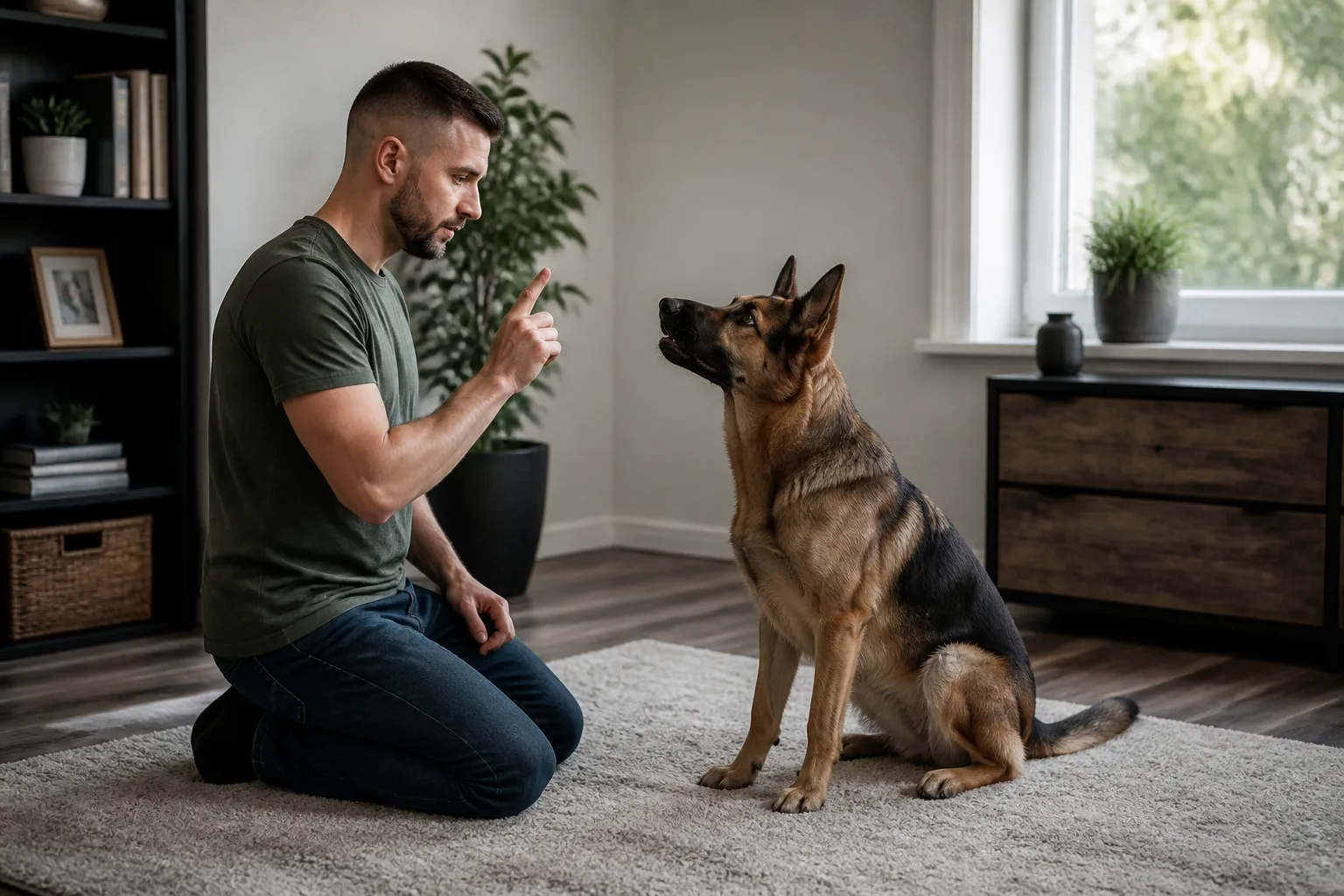
Goals should include safety, function, and quality of life. Decide what the dog needs to do, what the caregiver will do, and how improvement will be measured. A simple scale can track trigger distance, response intensity, recovery time, or the number of successful repetitions. Progress is rarely linear, so compare patterns over several sessions rather than judging one difficult day.
Teaching Replacement Behaviors
Stopping a behavior is rarely enough. The dog needs a practical alternative that meets a similar need. A dog that jumps for attention can learn to sit or keep four paws on the floor. A dog that pulls toward an interesting smell can learn to pause, check in, and receive permission to investigate. A dog that barks when someone approaches the home can learn to move to a mat and receive reinforcement there.
Teach the replacement behavior first in a quiet setting. Keep sessions brief, use clear signals, and reward promptly. Once the behavior is reliable, add mild distractions. Increase only one difficulty at a time: distance, duration, movement, novelty, or proximity. If performance collapses, reduce the challenge rather than repeating the cue more loudly.
For fear or reactivity, controlled exposure and positive association are central. Present the trigger at a distance where the dog can remain sufficiently calm, then provide valuable reinforcement. Over repeated sessions, the trigger may predict safety and good outcomes. The distance should change gradually and only when the dog is recovering well. Flooding, which forces prolonged exposure to an overwhelming trigger, can worsen fear and does not teach dependable coping.
Common Training Applications
For barking, first identify the category. Alarm barking at sounds may benefit from sound reduction, a visual barrier, and a trained settle routine. Attention-maintained barking requires consistent responses from people, along with reinforcement for quiet behavior. Frustration barking during walks may require more distance, alternative routes, and opportunities to sniff. Expecting one universal “quiet” command to solve every cause is unrealistic.
For jumping, remove accidental rewards. People should turn away or pause interaction when paws leave the floor, then provide attention when the dog is grounded. Practice with familiar people before attempting busy entrances. If the dog is large or intense, use a leash, gate, or tether under supervision so training does not depend on guests tolerating unsafe contact.
For leash pulling, reward slack frequently before the dog reaches a high level of tension. Change direction, pause, or increase distance when necessary. A suitable harness may improve management, but equipment does not teach walking by itself. Avoid equipment that causes pain, breathing restriction, or fear, especially when a dog is already reactive.

For resource guarding, do not take valued items by force or punish growling. Growling is communication and may precede a bite if earlier warnings are suppressed. Manage access, trade for something better when appropriate, and seek qualified professional guidance for guarding involving food, objects, resting places, or people. Children should not participate in these exercises.
For separation-related distress, gradual absences may help, but the plan must remain below the dog’s panic threshold. Video monitoring can show when distress begins. Crating is not automatically a treatment and may intensify panic if the dog is not comfortable in a crate. Veterinary and behavior-professional support may be appropriate, particularly when there is escape behavior, self-injury, or prolonged distress.
Designing Daily Practice
Training succeeds through ordinary routines, not only formal lessons. Build small opportunities into feeding, doorways, walks, play, grooming, and rest. Ask for an easy behavior, deliver reinforcement, and end before frustration rises. Several short sessions are often easier for a dog and caregiver than one demanding session.
Everyone in the household should use the same cues and boundaries. Agree on words, hand signals, reward rules, visitor procedures, and emergency plans. Inconsistency does not make a dog spiteful; it makes consequences difficult to predict. A written household plan can prevent accidental reinforcement, such as allowing jumping sometimes but correcting it at other times.
Rewards should be meaningful to the individual dog. Tiny food pieces are convenient for frequent practice, while toys or access to sniffing may be more valuable in other contexts. Deliver the reward where it supports the goal. For calm walking, reward near the handler. For settling, place reinforcement on the mat rather than encouraging movement.
Avoid drilling cues when the dog is overwhelmed. A cue repeated during panic may lose meaning or become associated with pressure. Instead, create distance, reduce stimulation, wait for recovery, and choose an easier exercise. Safety always outranks completing a training repetition.

Choosing Professional Support
A qualified trainer should explain methods clearly, welcome questions, observe the dog’s behavior, and adapt instruction to the individual. Look for humane, evidence-informed practice and transparent policies. Be cautious of guarantees, claims that every problem has one cause, or advice based on dominance as a universal explanation.
Some cases require a veterinary behaviorist or another appropriately qualified behavior professional. Seek help for biting, serious aggression, severe fear, compulsive behavior, dangerous escape attempts, intense separation distress, or sudden behavioral change. A trainer may work alongside a veterinarian, while medication, if considered by a veterinarian, can sometimes support learning by reducing overwhelming anxiety. Medication is not a substitute for training, and training is not a substitute for medical assessment.
Ask prospective professionals how they handle growling, fear, reactivity, and refusal to perform. The answer should prioritize safety, distance, management, and gradual skill building. It should not center on punishment, forced confrontation, or physical corrections. Request a clear explanation of expected homework, communication, progress measures, and referral procedures.
Troubleshooting Slow Progress
Plateaus usually contain information. The trigger may be too close, rewards may be insufficient, practice may be too infrequent, or the dog may be tired, painful, hungry, or overstimulated. Review the plan without blame. Return to an easier level and rebuild fluency.
Regression after an upsetting event is common. A frightening encounter can temporarily lower tolerance, so reduce exposure and increase recovery opportunities. Do not interpret a setback as proof that training failed. Look for gradual trends across weeks, while recognizing that some dogs will always need management around particular triggers.
Caregivers also need realistic expectations. A successful outcome may mean fewer incidents, faster recovery, safer handling, and reliable use of coping behaviors, rather than complete indifference to every trigger. Individual temperament, genetics, early experiences, health, environment, and learning history influence results. Ethical training aims for functional improvement and welfare, not an artificial promise of perfection.
Frequently Asked Questions
Is behavioral training only for aggressive dogs?
No. It can address everyday concerns such as jumping, barking, pulling, stealing, handling difficulties, overexcitement, fear, guarding, and settling. Aggression is one important category, but many behavior problems begin as manageable communication or arousal issues.
Does positive reinforcement mean allowing unwanted behavior?
No. Positive reinforcement means adding something valuable after a desired behavior to increase its future frequency. Humane training still uses boundaries, prevention, strategic removal of access, and safety procedures. The difference is that it teaches and manages without deliberately causing pain or fear.
How long will training take?
There is no reliable universal timetable. Mild habits may improve with consistent practice, while fear, guarding, separation distress, and aggression often require longer management and professional support. Progress depends on cause, intensity, health, environment, practice quality, and the dog’s ability to remain below threshold.
Should I punish growling?
Punishing growling can remove an important warning without changing the underlying discomfort. Instead, increase distance, prevent the situation from escalating, and obtain guidance. If a bite has occurred or seems possible, prioritize separation and professional assessment.
Are treats necessary?
Treats are not mandatory, but effective reinforcement is necessary. Food is often convenient because it can be delivered quickly and repeatedly. Some dogs prefer play, praise, access to movement, sniffing, or a valued activity. The reward must matter to that dog in that situation.
Can an older dog learn new behavior?
Yes. Older dogs can learn, although health, sensory changes, fatigue, and established habits may affect pacing. Veterinary assessment is sensible when behavior changes, and training should use short sessions, clear repetition, and comfortable physical demands.
Should children train the dog?
Children can participate in simple, supervised exercises with an adult directing the session. They should not handle guarding, aggression, intense reactivity, or other high-risk situations. Adults remain responsible for management, interpretation, and safety.
What should I do during an unexpected incident?
Create distance, use barriers, guide the dog away if this can be done safely, and avoid grabbing near the mouth or forcing contact. Afterward, record what happened, check for injuries, and reassess the environment. Seek urgent veterinary or professional help when injury, repeated attacks, or immediate danger is involved.
Conclusion
Behavioral dog training works best when it combines compassion with structure. Begin by identifying the behavior’s likely function, checking for health contributors, and preventing repeated rehearsal. Teach a replacement response, reinforce it in manageable conditions, and raise difficulty gradually. Track meaningful indicators such as recovery, distance, safety, and daily cooperation rather than demanding instant perfection.
A strong program respects canine communication, including signs of discomfort, and treats caregivers as active partners. It uses management without shame, professional collaboration when needed, and methods that preserve trust. With realistic goals and consistent practice, many dogs can develop safer habits and more effective ways to cope, while their families gain practical skills for supporting lasting positive change.