

Understanding Behavioral Dog Training
Behavioral dog training is a structured approach for changing actions that create difficulty, risk, or stress for a dog and the people around it. Instead of focusing only on obedience commands, it examines why a behavior happens, what maintains it, and which replacement behavior can meet the same need more safely. Barking at visitors, pulling toward dogs, guarding food, jumping on people, hiding, chasing, and separation-related distress can all require behavioral planning.
Effective training is not about dominance, punishment, or forcing a dog to tolerate frightening situations. It combines observation, management, humane teaching, patience, and consistent communication. The goal is lasting positive change: the dog learns better choices, caregivers understand how to respond, and daily life becomes more predictable.
Every dog has an individual history, temperament, learning speed, and physical condition. A plan that helps one dog may overwhelm another. Therefore, training should begin with careful assessment rather than a ready-made correction. A veterinarian should be consulted when behavior changes suddenly, intensifies rapidly, or appears connected with pain, illness, sensory decline, or medication. A qualified behavior professional is especially important when aggression, severe fear, biting, or dangerous escape behavior is present.
How Behavior Develops
Behavior usually has an immediate trigger, an observable response, and a consequence. This sequence is often called an antecedent, behavior, and consequence. For example, a dog sees a stranger near the gate, barks, and the stranger walks away. The dog may learn that barking makes the perceived threat disappear, even if the person left for unrelated reasons.
Consequences influence repetition. A dog that receives food after sitting may sit more often. A dog that gains distance by lunging may lunge sooner when another dog approaches. Understanding this process helps caregivers replace accidental reinforcement with deliberate teaching.
Emotions matter as much as visible actions. A growling dog may feel fear, frustration, pain, or possessiveness. A dog that destroys objects when alone may be distressed rather than mischievous. Treating the surface action without addressing the underlying emotion can suppress warning signals while leaving the problem intact.
Start With Observation
Keep a simple behavior record for several days. Note the time, location, trigger, distance, intensity, body language, response from people, and recovery time. Also record sleep, exercise, meals, illness signs, and significant changes at home. Patterns often emerge: barking may increase near windows, guarding may occur only when a particular item is present, or reactivity may be worse after an overstimulating day.

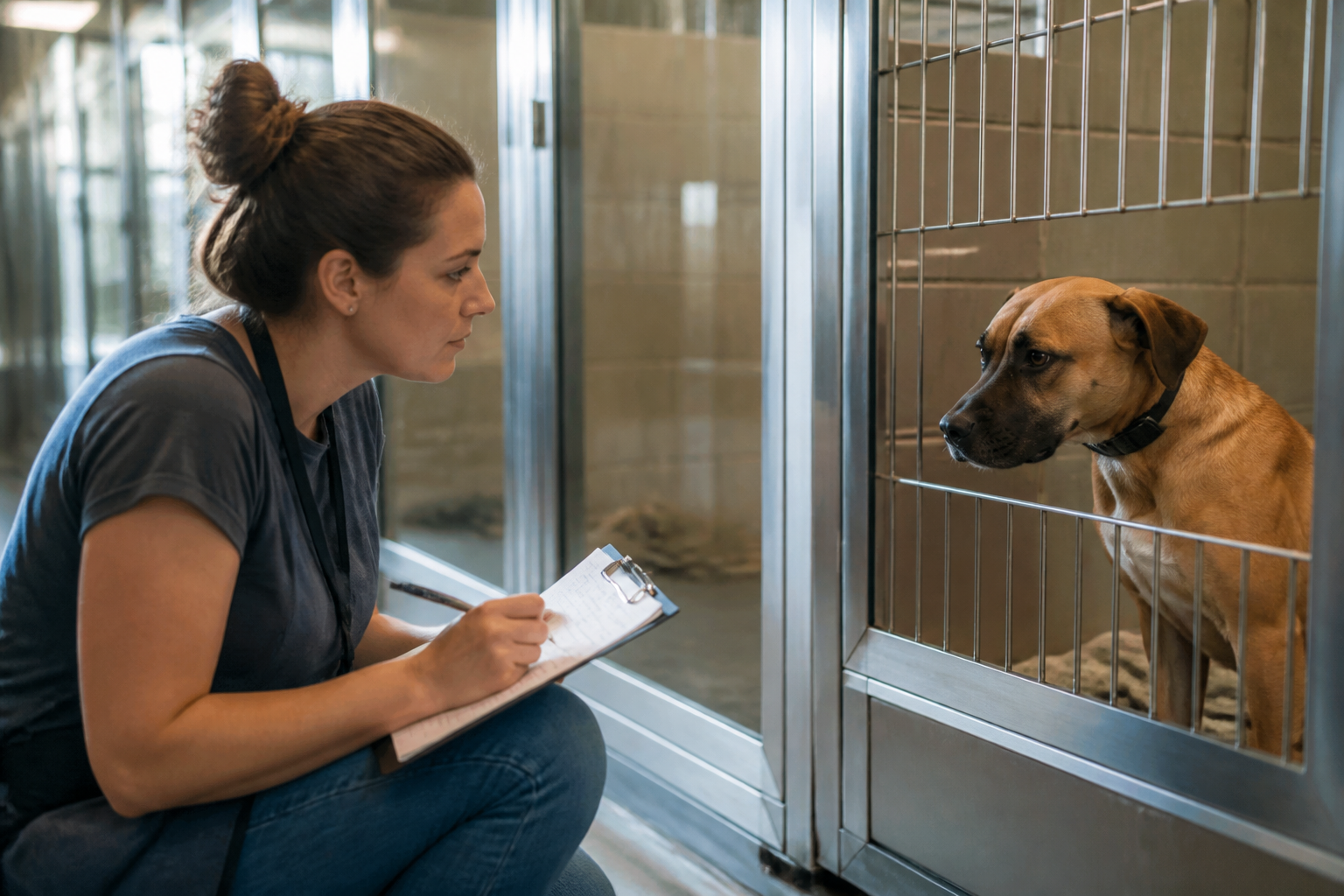
Observe early warning signals. Lip licking, turning away, freezing, lowered posture, pinned ears, whale eye, pacing, and sudden sniffing can indicate discomfort. Recognizing these signs allows intervention before a dog escalates to barking, snapping, or biting.
Building a Safe Training Plan
Safety comes before progress. Prevent rehearsal of the unwanted behavior whenever possible. Use gates, closed doors, window coverings, secure harnesses, leashes, crates when introduced positively, and carefully managed household routines. Management is not failure; it reduces risk while new skills develop.
Identify the dog’s threshold, meaning the point at which it can still notice a trigger and respond to the handler. If a dog cannot eat, look away, or follow a familiar cue, the situation is probably too difficult. Increase distance, reduce intensity, shorten exposure, or leave the area. Training below threshold supports learning; overwhelming exposure commonly produces fear, frustration, or defensive behavior.
Choose rewards that genuinely matter to the dog. Small food pieces are often useful, but toys, sniffing opportunities, movement, praise, or access to a preferred location can also function as reinforcement. Deliver the reward promptly after the desired response so the dog can connect action and outcome.
Teach Foundation Skills
Begin in a quiet setting with simple behaviors. Teach the dog to respond to its name, orient toward a handler, follow a hand target, settle on a mat, come when called, and exchange an object willingly. These skills are not merely tricks. They create practical options when distractions arise.
Train in short sessions and stop while the dog remains successful. Several brief practices are usually easier to manage than one exhausting lesson. Change only one major difficulty at a time. For instance, increase distance before adding movement, or practice a new location while keeping the trigger mild.
Use a clear marker, such as a click or a brief word, to identify the exact moment the dog performs correctly. Follow it with a reward. If timing is difficult, simplify the exercise rather than repeating a cue. Repeated commands can teach the dog that the first instruction is optional.
Common Behavioral Concerns
Fear and Anxiety
Fear-based behavior may include hiding, trembling, barking, fleeing, freezing, or defensive snapping. The first priority is reducing exposure to overwhelming triggers. Do not drag a fearful dog toward a person, animal, object, or environment. Forced contact can confirm that the trigger is dangerous.
Desensitization presents a trigger at a tolerable intensity, while counterconditioning pairs that trigger with something valuable. A dog worried about bicycles might begin watching a distant, stationary bicycle while receiving treats. When the dog remains relaxed, the distance or movement can change gradually. Progress is measured by relaxed body language and recovery, not by mere silence.
Reactivity on Leash
Leash reactivity may arise from fear, frustration, excitement, or a history of successful lunging. Select quieter routes, cross the street, use visual barriers, and avoid greetings that exceed the dog’s capacity. Teach the dog to notice another dog, turn toward the handler, and receive reinforcement before escalation.
A front-clip harness may improve handling for some dogs, but equipment does not replace training. Avoid retractable leashes in crowded or unpredictable areas. A secure, comfortable setup gives the handler control without adding unnecessary discomfort.
Jumping and Mouthing
Jumping often produces attention, touch, or movement. Teach an incompatible behavior, such as standing with four paws on the floor or sitting. Everyone must respond consistently: attention arrives when paws remain down, not while the dog is jumping. During greetings, people can turn away or pause interaction without shouting.

Puppy mouthing is common, but painful biting should be addressed calmly. Offer appropriate chew items, end play briefly when teeth contact skin, and provide naps and decompression. Overtired puppies often lose impulse control. Avoid hitting, holding the muzzle shut, or rough handling, which can increase fear and conflict.
Guarding Food or Objects
Resource guarding can involve food, toys, beds, spaces, or people. Never forcibly remove a guarded item or punish a growl. Growling is valuable communication that warns of discomfort. Instead, prevent access to risky situations and teach trades using items of greater value. Practice only at a level that remains safe and relaxed.
Children should not approach a dog while it eats, sleeps, rests, or owns a valued object. If guarding includes lunging, biting, or rapid escalation, seek individual guidance from a veterinary behaviorist or qualified reward-based professional.
Separation-Related Distress
Dogs with separation-related distress may vocalize, pace, eliminate indoors, damage doors, or attempt escape when left alone. Begin with absences shorter than the point at which distress starts. Gradually increase duration while maintaining calm departures and arrivals. Food puzzles may help mild cases, but they are not a complete solution when panic is severe.
A camera can reveal whether distress begins immediately or after a longer interval. Arrange temporary companionship, daycare, or other support when necessary to prevent repeated panic during the training process. Veterinary assessment may be appropriate, because medication can support learning for some dogs when combined with a carefully designed plan.
A Practical Training Schedule
Start with a baseline assessment and define one observable goal. “Be calmer” is less useful than “look at the handler when a person appears twenty feet away.” Identify the trigger, the starting distance, the reward, the marker, and the emergency plan if the dog struggles.

During the first stage, concentrate on management and foundation skills. Practice name response, hand targeting, loose-leash movement, settling, and trading. In the second stage, introduce a mild version of the problem trigger. Reward orientation, calm observation, disengagement, and movement away. In later stages, vary locations, people, distances, and distractions one at a time.
Keep records of successful repetitions and warning signs. If the dog reacts, do not label the session a failure. Increase distance, help the dog recover, and make the next repetition easier. Advancement should be based on consistent success, not a fixed calendar.
Generalization requires deliberate practice. A dog that sits reliably in the kitchen may not understand the cue at a park. Rebuild skills in new environments, beginning with low distraction. Ask familiar helpers to follow the plan, and communicate rules clearly before they interact with the dog.
Choosing Professional Support
Look for professionals who explain behavior in terms of learning, emotion, environment, and health. Ask what methods they use, how they handle setbacks, whether they coordinate with veterinarians, and what safety measures they recommend. Be cautious of guarantees, claims that every problem has one cause, or advice centered on intimidation and punishment.
A credential alone does not replace sound practice, but transparent education and humane methods are important selection criteria. For serious aggression, complex anxiety, compulsive behavior, or suspected medical involvement, begin with a veterinarian and request referral to a qualified clinical behavior specialist.
Group classes can help with basic skills when the dog can remain below threshold around other participants. Private sessions are usually more suitable for intense reactivity, guarding, fear, or household-specific problems. Online education may support simple training, but it cannot safely replace individualized assessment in high-risk cases.
Frequently Asked Questions
Is behavioral training different from obedience training?
Yes. Obedience training teaches cues and practical responses, while behavioral training addresses patterns involving emotion, motivation, environment, and consequences. They overlap: a reliable recall or mat settle can help manage a behavioral concern, but a cue alone may not resolve fear or guarding.
How long does behavior change take?
There is no universal timetable. Progress depends on the dog’s history, health, intensity of the problem, consistency of management, and quality of practice. Some changes appear quickly; deeper emotional change may require extended work. Measure smaller improvements, such as faster recovery, greater distance tolerance, or fewer rehearsals.
Should punishment be used for aggression?
Punishing aggressive displays can increase fear, arousal, or conflict and may suppress warning signals without changing the underlying emotion. Prioritize safety, distance, management, and professional assessment. Humane behavior modification is generally a safer foundation.
What should I do if my dog suddenly becomes reactive?
Stop exposing the dog to avoidable triggers, use safe handling, and schedule a veterinary examination. Sudden behavior changes can be associated with pain, illness, sensory changes, or environmental events. Do not assume stubbornness is the cause.
Can treats create dependence?
Rewards do not inherently create dependence. They help establish and strengthen behavior. Once a response is reliable, rewards can become intermittent, while natural consequences such as access to sniffing, play, or movement continue to reinforce it. Keep rewarding difficult or newly learned behaviors.
Is a crate appropriate for behavioral problems?
A crate can support rest, prevention, and safe management when the dog already experiences it positively. It should never be used as punishment or as a solution for panic in confinement. A dog showing escape attempts, intense vocalizing, or self-injury needs a different plan and professional guidance.
How should children participate?
Children should follow adult-designed safety rules and should not manage aggression, guarding, or severe fear. They can help by tossing treats for calm behavior from a safe distance, practicing simple cues with supervision, and respecting the dog’s choices. Never leave children and dogs unsupervised.
Product Description and Everyday Tools
A behavioral dog training program is most useful when it provides more than a list of commands. A well-designed resource should explain triggers, thresholds, reinforcement, body language, management, and gradual exposure. It should include practical exercises, troubleshooting guidance, progress records, and clear safety boundaries.
Helpful equipment may include a comfortable harness, standard leash, treat pouch, small high-value rewards, baby gates, food enrichment items, a mat, and visual barriers. Select equipment for fit, durability, and the individual dog’s comfort. Test new items in calm conditions before using them around difficult triggers.
The best product is not necessarily the most elaborate. A simple plan that caregivers can apply consistently is usually more valuable than complicated equipment or promises of instant results. Look for instructions that tell you what to do before, during, and after a challenging event, and that explain when to stop and seek assistance.
Conclusion
Behavioral dog training succeeds when it combines safety, empathy, observation, and precise reinforcement. Identify what precedes the behavior, understand what the dog may be feeling, prevent unnecessary rehearsal, and teach a practical alternative at a manageable level. Progress should make the dog safer and more capable, not merely quieter under pressure.
Use professional help when behavior is dangerous, severe, sudden, or medically complicated. With realistic goals and consistent practice, many dogs can develop stronger coping skills and more reliable responses. Lasting change is built through repeated experiences in which the dog can remain safe, understand the task, and discover that appropriate behavior produces worthwhile outcomes.