
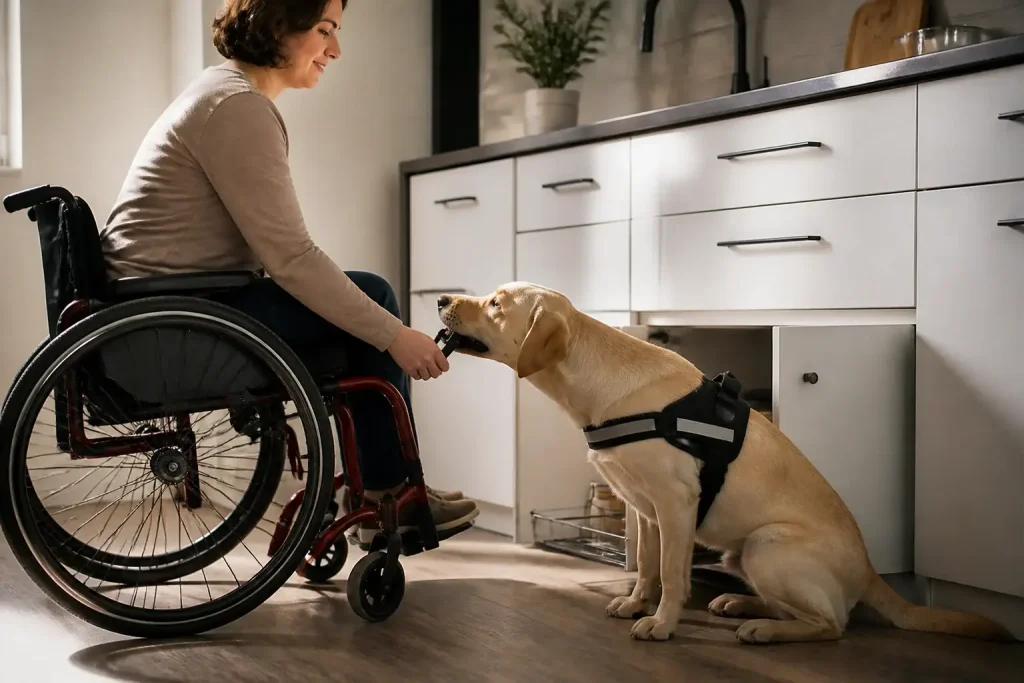
Mobility assistance dog training can help a person complete everyday tasks with greater safety, confidence, and independence. A carefully trained dog may retrieve dropped objects, open or close accessible doors, operate suitable switches, provide balance support when properly conditioned, summon assistance, or help a handler rise from a stable position. The right program is not simply obedience training with a few tricks added. It combines task work, public access behavior, health screening, handler education, and an honest assessment of whether a particular dog and person can work safely as a team.
This guide explains what mobility assistance dog training involves, how to evaluate a program, what progress commonly looks like, and which precautions matter most. It is educational information, not a medical or legal determination. Occupational therapists, physicians, veterinarians, qualified assistance-dog organizations, and relevant authorities can help with individual decisions.
Mobility Assistance Dog Training: What Mobility Assistance Dogs Do
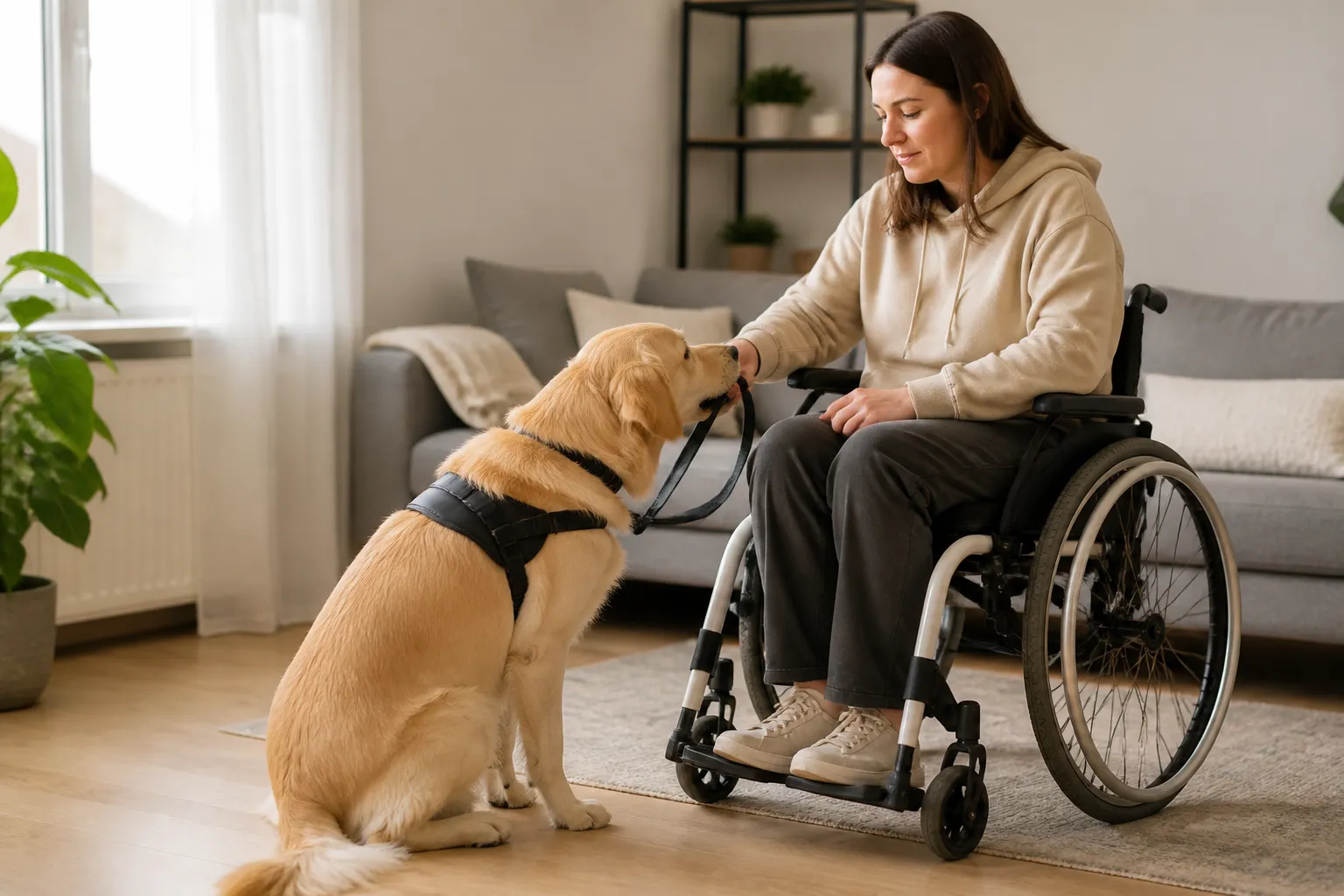
A mobility assistance dog is trained to perform disability-related tasks that reduce the practical effects of a person’s impairment. The dog’s work should be specific, repeatable, and genuinely useful. “Providing companionship” can be valuable, but companionship alone is not a mobility assistance task. A trained dog might pick up keys, bring a phone, carry lightweight items in an appropriate harness or pouch, press an automatic door button, pull a drawer open, remove clothing, or retrieve an emergency device.
Some dogs also provide carefully defined stability assistance. This area requires exceptional caution. A dog’s skeleton, joints, muscles, age, and conditioning must be suitable for the task, and a professional should determine whether the proposed support is safe. A dog should never be expected to absorb sudden, heavy, or unpredictable force, nor should a person place full body weight on a dog without expert guidance. Many handlers use environmental supports, forearm crutches, walkers, grab bars, or wheelchairs alongside the dog.
Task selection begins with the handler’s real routine. Write down difficult activities, when they occur, what assistance would solve each problem, and whether the dog can perform the task without risk. A dog may be excellent at retrieving from the floor but unsuitable for bracing during transfers. Practical training is more effective when it addresses concrete needs rather than an impressive collection of behaviors.
Choosing the Right Dog
Temperament is usually more important than appearance, breed reputation, or enthusiasm. A suitable candidate should be socially steady, responsive without being frantic, comfortable in varied environments, and able to recover after startling events. The dog should show low, manageable interest in strangers, food, animals, traffic, noises, and floor surfaces. Persistent fear, defensive behavior, uncontrolled chase behavior, or intense reactivity can make assistance work unsafe and stressful.
Physical suitability depends on the tasks. A dog intended for retrieval may have different size requirements from one carrying light items or interacting with accessible equipment. Larger size does not automatically make a dog capable of weight-bearing work. Conformation, joint health, growth stage, body condition, and veterinary evaluation all matter. Puppies should not be asked to perform demanding physical tasks while their bodies are developing.
A reputable program uses transparent selection standards and explains why a dog is or is not appropriate. It should discuss genetic history when available, orthopedic screening, routine veterinary care, grooming needs, expected working lifespan, and retirement planning. Rescue dogs can succeed, but their behavioral history, health, and adaptability need careful evaluation rather than assumptions based on good intentions.

The handler and dog must also fit socially. Consider pace, communication style, home environment, allergies, transportation, available support, and the amount of daily care required. A dog is not a piece of equipment that can be stored between uses. Feeding, exercise, grooming, veterinary appointments, rest, play, and emotional welfare remain lifelong responsibilities.
Training Foundations
Training normally begins with relationship building and reliable everyday skills. The dog learns its name, attention, recall, walking politely, settling on a mat, waiting at doors, accepting handling, and responding to rewards. A clear reinforcement system helps the dog understand which behavior earns access to food, play, praise, movement, or another meaningful reward.
Positive reinforcement is widely useful because it teaches the dog what to do and supports willing participation. Corrections, equipment, and boundaries should be handled by knowledgeable professionals who prioritize safety and welfare. Harsh or confusing methods can create avoidance, fear, or unreliable responses, especially in crowded public places. The goal is dependable cooperation, not mechanical obedience at the expense of confidence.
Socialization means controlled exposure, not forcing a dog to greet everyone. Training should include elevators, ramps, public transportation where appropriate, automatic doors, shopping environments, medical buildings, quiet offices, busy sidewalks, and different floor textures. The dog learns to ignore ordinary distractions, maintain safe positioning, and settle when the handler is stationary.
Generalization is essential. A dog that retrieves a wallet in a training room may not understand the same request in a bedroom, vehicle, restaurant, or unfamiliar building. Trainers vary locations, objects, distances, lighting, surfaces, and distractions gradually. They also practice rest periods, because a working dog must know when active assistance is needed and when relaxing is the correct behavior.
Building Reliable Communication
Use consistent verbal cues, hand signals, or assistive communication methods that match the handler’s abilities. A cue should have one meaning and should be given in a way the dog can perceive. If speech is difficult, the team might rely more on gestures, tactile prompts, target objects, or an electronic communication aid, provided its use is safe and humane.
Mark successful behavior promptly. A marker can identify the precise moment the dog makes the correct choice, followed by a reward. Over time, rewards may become varied, but reliability should not be assumed merely because a dog performs in familiar conditions. Practice should include maintenance sessions and occasional reinforcement throughout the dog’s working life.
Teaching Practical Tasks
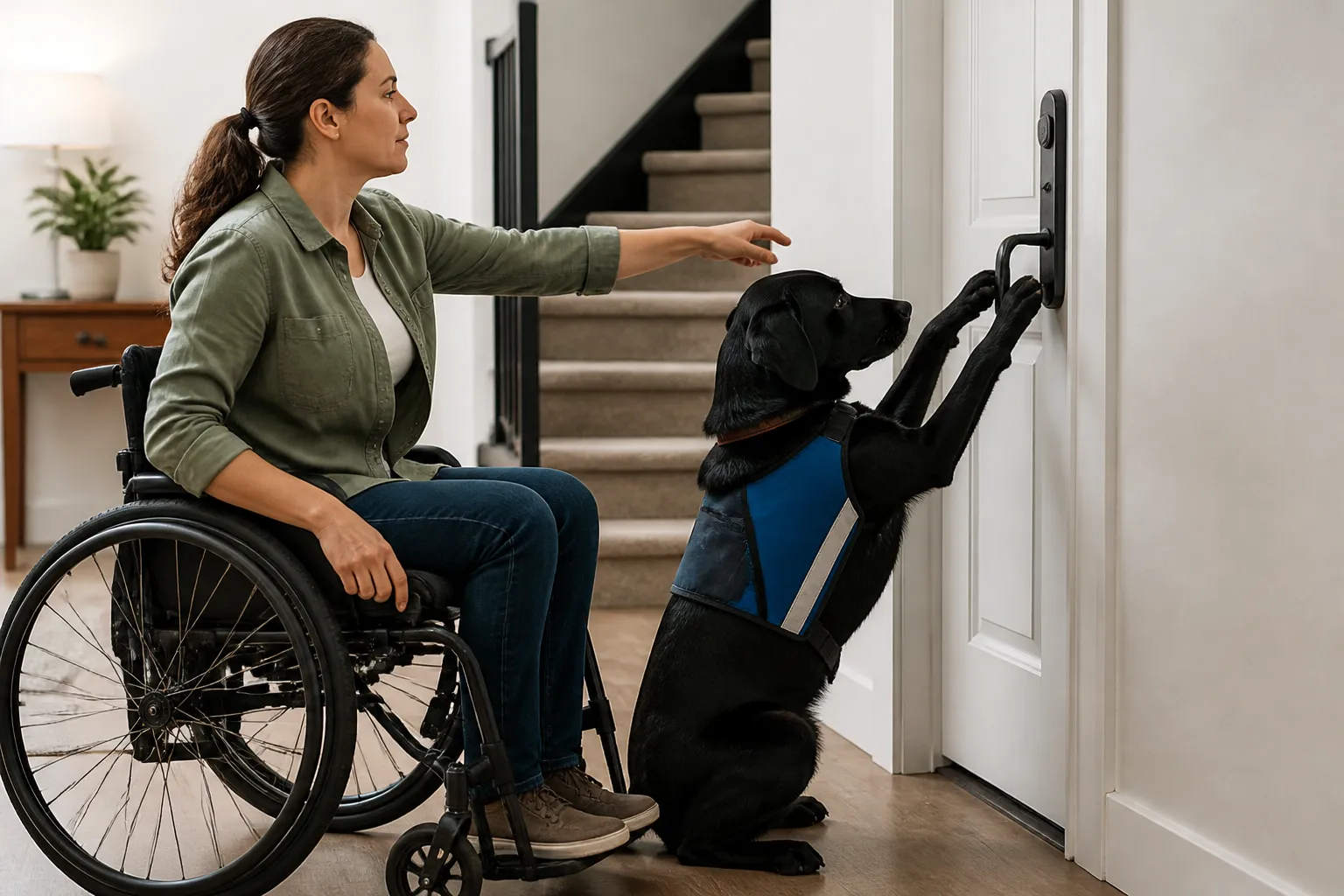
Task training should proceed in small, observable steps. First, identify the final behavior. Then divide it into actions the dog can learn separately. For example, retrieving a dropped phone might involve locating the object, approaching it, taking it gently, holding it without chewing, returning to the handler, and releasing it into a hand or container. Each component is taught before the sequence is combined.
Retrieval objects should be durable, cleanable, and safe to carry. Avoid items that contain medication, sharp edges, fragile glass, toxic materials, or small parts that could be swallowed. The dog should learn to distinguish approved objects from household items that must remain untouched. A verbal cue and a designated storage place can reduce confusion.
Opening doors requires environmental planning. The dog may pull a properly designed tug, press a button, or activate a switch, but the setup must prevent entanglement and protect paws, teeth, and equipment. Automatic doors can close unexpectedly, so the handler needs a safe positioning strategy and a backup plan. Training should never encourage the dog to enter traffic, block other people, or pull beyond its physical capacity.
Retrieving clothing, moving blankets, or bringing a phone can be especially useful during fatigue or limited reach. The task should account for hygiene and privacy. Some objects need washable covers or dedicated pouches. A dog should not be trained to pull at skin, medical tubing, braces, or mobility equipment unless a qualified professional has designed and supervised the behavior.
Assistance with balance or transfers deserves separate evaluation. A dog’s harness is not automatically a lifting device, and a commercially advertised handle does not prove that a task is safe. A rehabilitation professional and veterinary professional can help assess forces, positioning, surfaces, and alternatives. If any participant observes pain, limping, hesitation, slipping, or repeated stress, stop the activity and reassess.
Emergency and Alert Behaviors
A dog may be taught to bring a communication device, activate an accessible alert button, bark on cue, find another person, or remain near the handler during a planned emergency procedure. These behaviors require realistic rehearsal and clear limits. A dog cannot reliably replace emergency services, clinical monitoring, or a human support network.
Alert tasks should be matched to the handler’s actual needs. A dog that is trained to respond to a fall may need a specific cue or environmental signal, because not every fall looks or sounds the same. The handler should maintain a backup communication method and tell trusted people what the dog is trained to do.
Public Access and Community Skills
A mobility assistance dog must behave safely around the public. This includes remaining under control, avoiding unsolicited greetings, ignoring dropped food, staying clear of aisles, and settling beside the handler. Toileting should be managed responsibly, and the handler should carry cleanup supplies. The dog should be clean, groomed, and free from strong odors when entering shared environments.
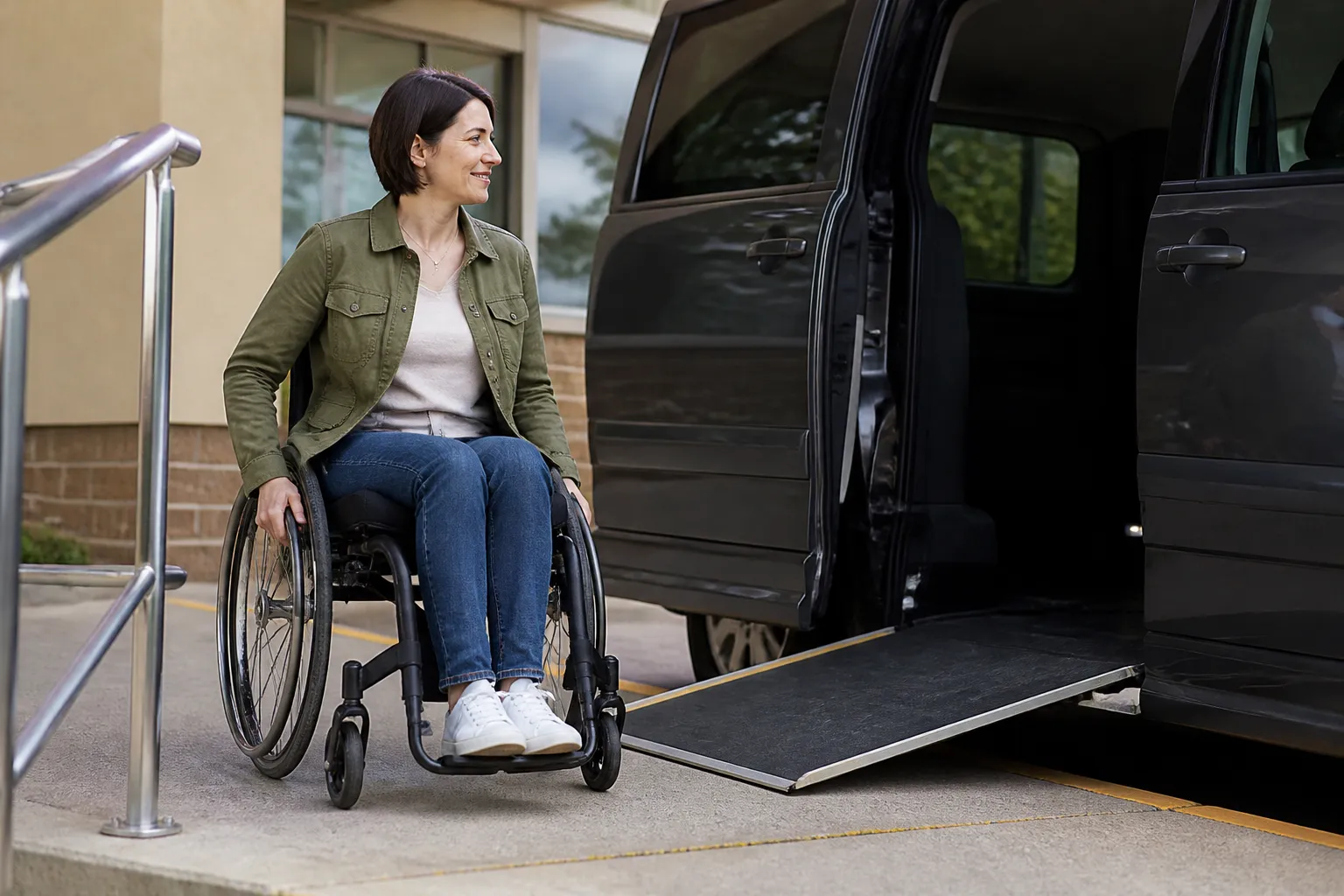
Public access training should be gradual and purposeful. Begin with quiet locations, then increase duration, movement, noise, and social complexity. Practice entering and exiting vehicles, waiting in lines, navigating narrow spaces, and responding when strangers ask questions. The handler can use a brief explanation such as, “The dog is working; please do not distract them.” Personal medical details need not be shared.
Rules concerning assistance animals vary by jurisdiction and by setting. A vest, identification card, certificate, or online registration may communicate expectations, but appearance alone does not establish training quality or legal status. Before relying on a dog in a workplace, school, airline, housing situation, or healthcare facility, review current official requirements and accommodation procedures. A qualified local organization or adviser can help interpret them.
Never use public access as a test of whether a dog can “tough it out.” Stress signals may include lip licking, yawning, freezing, avoidance, panting unrelated to heat, tucked posture, scanning, or sudden loss of responsiveness. Give the dog space, lower demands, and leave if necessary. Protecting welfare improves future reliability.
A Structured Training Plan
A written plan keeps training measurable. Record the task, cue, starting behavior, reward, location, distraction level, success criteria, and next progression. Short sessions are often more productive than exhausting rehearsals. End while the dog is still engaged, and provide recovery time after demanding public outings.
One stage may focus on home manners and handling. Another may build task components. Later stages combine tasks with mobility equipment, then introduce community settings. The exact timetable varies with the dog, handler, task complexity, health, and training support. Promises of an identical rapid schedule for every team deserve careful scrutiny.
Use objective criteria. Instead of saying “the dog is good at retrieving,” specify that the dog picks up three approved objects, returns without dropping them, and releases on cue in several familiar locations. Reliability should be tested under realistic but safe distractions. A behavior that succeeds only when a trainer stands nearby is not yet independent.
Handler training is equally important. The person must learn reward timing, equipment use, grooming, canine body language, task maintenance, and safe decision-making. They should know when to ask for help, when to end a session, and how to prevent the dog from working while ill, injured, overtired, overheated, or emotionally distressed.
Working With Professionals
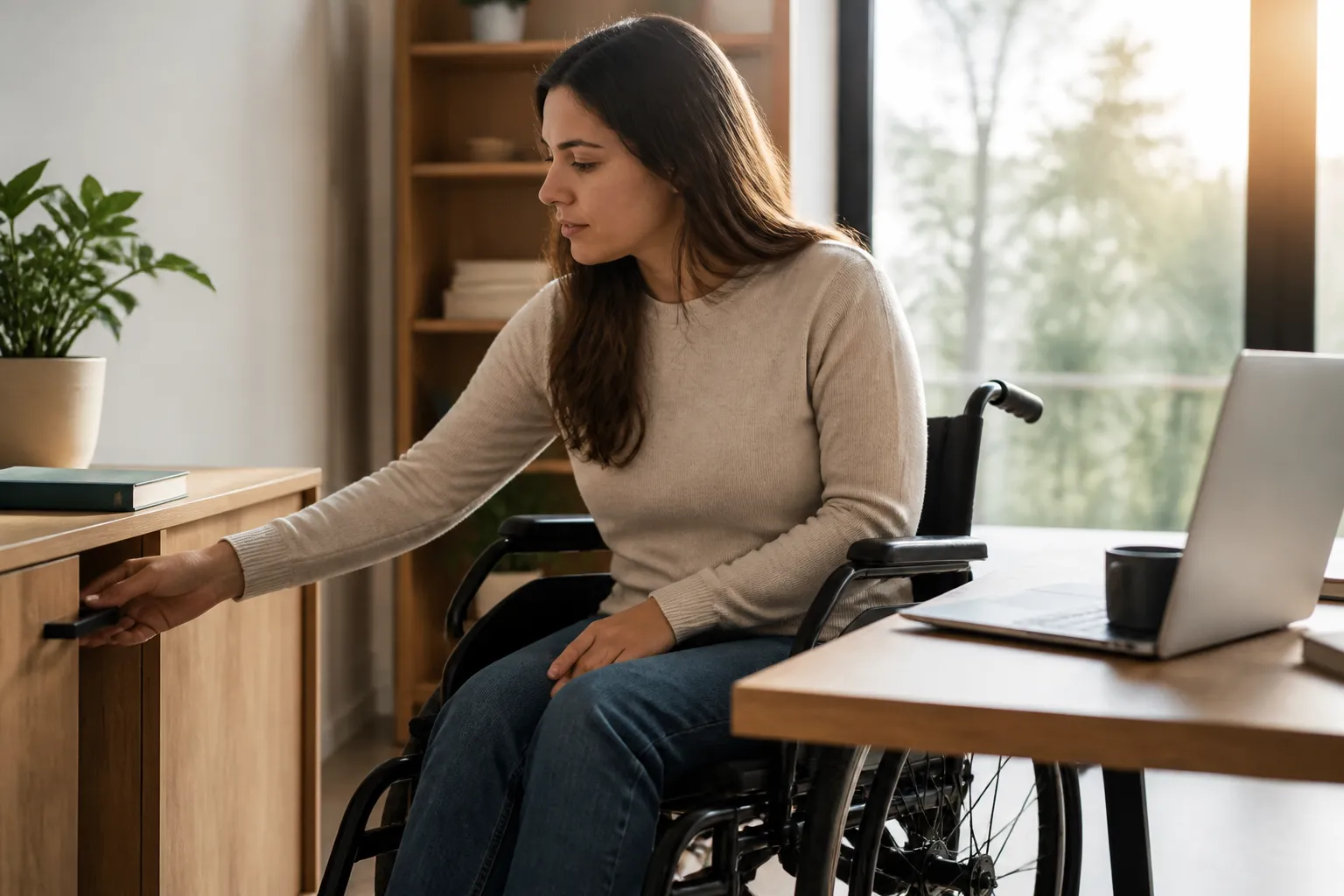
A multidisciplinary team can identify needs that dog trainers alone may miss. Occupational therapists can analyze routines and suggest environmental modifications or assistive technology. Physiotherapists or other rehabilitation professionals may advise on movement and transfer safety. Veterinarians assess health, pain, conditioning, nutrition, and working-load concerns. Experienced assistance-dog trainers translate those requirements into teachable behaviors.
Ask potential trainers about relevant experience, methods, supervision, insurance, welfare policies, continuing support, and outcome measurement. Request a clear explanation of fees and responsibilities without accepting invented guarantees. A trustworthy provider welcomes questions, discusses limitations, and is willing to say that a dog, task, or arrangement is unsuitable.
Equipment, Health, and Welfare
Equipment should support communication without restricting breathing, movement, vision, or normal rest. Harnesses, leashes, mobility handles, coats, pouches, and tugs need correct fit and regular inspection. Remove working equipment when the dog is relaxing unless a professional has a specific reason otherwise. Check for rubbing, pressure, broken fasteners, moisture, and debris.
Conditioning should be gradual. Warm-up, appropriate surfaces, rest, hydration, and weather awareness matter. Heat, cold, slippery flooring, steep stairs, and long periods of standing can increase risk. A dog’s willingness to continue is not proof that continuing is safe; some dogs persist despite discomfort. Changes in gait, appetite, sleep, mood, or task performance warrant veterinary attention.
Nutrition and body condition influence working ability. Avoid using excessive treats without adjusting the overall feeding plan with veterinary advice. Regular grooming protects skin and keeps equipment clean. Dental care, parasite prevention, vaccinations where appropriate, and routine examinations support long-term participation, though exact recommendations depend on the dog and local veterinary guidance.
Retirement should be planned before a crisis. Aging, injury, illness, or changing handler needs may require reduced duties, a successor dog, additional human assistance, or environmental adaptations. Retirement is not failure. It is a responsible transition that respects the dog’s welfare and preserves the handler’s safety.
Common Mistakes to Avoid
A frequent mistake is choosing a dog primarily because it looks friendly or belongs to a commonly used breed. Temperament, health, task fit, and partnership are more meaningful indicators. Another mistake is teaching advanced tasks before establishing calm behavior, clear communication, and safe handling. A flashy behavior cannot compensate for unreliable public manners.
Training too hard can create burnout. Assistance dogs need play, sleep, free movement, and opportunities to behave like dogs. Treating every outing as a work examination may reduce motivation and mask stress. Build rest days and low-demand activities into the routine.
Handlers sometimes add tasks without reviewing risk. A dog that can pull a light drawer may not safely pull a person. A dog that retrieves a soft item may not safely carry a heavy object. Evaluate force, leverage, balance, and consequences before progressing. When doubt exists, consult qualified professionals rather than copying an online demonstration.
Another problem is inconsistent reinforcement. If a dog is allowed to greet strangers one day but corrected for noticing them the next, confusion follows. Household members and support workers should use the same cues and rules. Written instructions can help, especially when several people share care.
Finally, do not assume a vest will solve public challenges. Equipment can signal that the dog is working, but it cannot create training, control, or legal access. Skills must be taught, maintained, and demonstrated through safe behavior.
Evaluating Programs and Costs
Training may be provided by an established nonprofit, a private professional, a program that matches trained dogs with handlers, or a cooperative owner-training arrangement. Each model has advantages and limitations. A program may offer structured expertise but have eligibility criteria, waiting periods, or limited customization. Owner-training may provide flexibility but requires time, reliable support, and careful self-assessment.
Before committing, ask how candidates are selected, how tasks are customized, who owns the dog during training, what happens if placement fails, and what follow-up is available. Clarify veterinary expenses, equipment, travel, replacement policies, and retirement responsibilities. Written agreements protect both the handler and provider.
Cost should be evaluated across the dog’s entire working life, not just initial training. Food, routine care, emergency veterinary treatment, grooming, equipment replacement, transportation, and substitute support can all matter. Financial assistance may exist through local organizations, disability services, charitable programs, or community fundraising, but availability varies. Avoid providers that pressure you to pay immediately or promise guaranteed independence.
Frequently Asked Questions
How long does training take?
There is no universal timetable. A dog with strong foundations may progress faster than a dog recovering from fear or learning complex tasks, but readiness depends on consistent performance, not a calendar. The team should demonstrate skills in realistic settings and maintain them over time.
Can any dog become a mobility assistance dog?
No. Some dogs lack the physical structure, temperament, motivation, health, or adaptability required. A friendly pet may be wonderful at home yet unable to ignore distractions or cope comfortably with public environments. Early professional evaluation can prevent wasted effort and protect the dog.
Can a mobility dog support my full weight?
Do not assume so. Full-weight support, bracing, or pulling during transfers can injure a dog and destabilize a handler. Obtain individualized advice from rehabilitation and veterinary professionals. Environmental supports or equipment may be safer for the primary load.
Should the dog work all day?
No. Dogs need breaks, sleep, exercise, enrichment, and normal social interaction. A working schedule should reflect the dog’s age, health, environment, and signals. If the dog cannot settle, seems distressed, or performs less reliably, reduce demands and seek guidance.
Is owner-training realistic?
It can be, when the handler has suitable support, time, physical capacity, and access to qualified instruction. Owner-training is not simply watching videos and practicing occasional tricks. It includes candidate assessment, task design, public access preparation, welfare monitoring, and ongoing maintenance.
What if my needs change?
Reassess tasks with professionals. A dog may learn new low-risk behaviors, while some tasks may need to stop. Changes in pain, balance, fatigue, vision, cognition, home layout, or transportation can alter what is safe. Adaptation is a normal part of responsible partnership.
How do I respond to public questions?
Use a short, calm statement and keep attention on the dog. You can explain that the dog is working and should not be touched or called. If someone continues, prioritize distance and safety rather than arguing. Local rules and venue procedures can provide additional support.
Conclusion
Effective mobility assistance dog training is a careful partnership built around genuine daily needs. Success depends on suitable temperament, sound health, humane teaching, realistic task design, public access skills, professional collaboration, and lifelong welfare. The strongest program does not promise that a dog will solve every mobility challenge. Instead, it identifies useful tasks, respects physical limits, develops dependable communication, and combines canine assistance with equipment, environmental changes, and human support when appropriate.
Begin by listing the activities that are hardest or least safe. Discuss those needs with a healthcare or rehabilitation professional, then consult qualified assistance-dog trainers and a veterinarian. Evaluate programs for transparency, individualized planning, follow-up, and concern for the dog’s wellbeing. Progress gradually, measure behavior honestly, and treat rest and retirement as essential parts of the plan.
When the match is right, a mobility assistance dog can make practical routines more manageable and help a handler participate with greater confidence. That benefit is earned through thoughtful preparation, not promised by a label, a vest, or a quick course. A patient, evidence-informed approach gives both members of the team the best chance to work safely, respectfully, and successfully.