
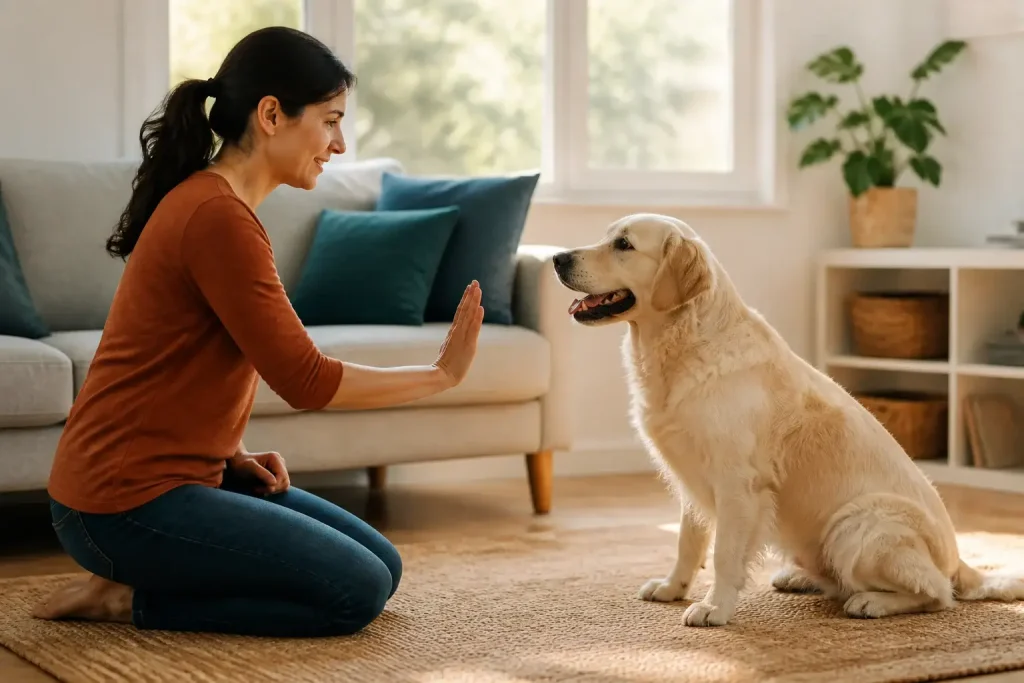
Understanding Behavioral Dog Training
Behavioral dog training helps a dog develop safer, more adaptable responses to everyday situations. It is useful for ordinary challenges such as jumping, pulling, barking, stealing objects, ignoring cues, or struggling to settle. It can also support more serious concerns, including fear, separation distress, guarding, reactivity, and aggression. The goal is not to suppress communication or demand perfect obedience. The goal is to understand why a behavior occurs, change the conditions surrounding it, teach a practical alternative, and improve the relationship between dog and handler.
Every behavior has context. A dog may bark because a visitor feels threatening, because excitement is overwhelming, because the dog has learned that barking makes people move away, or because pain makes handling uncomfortable. The same outward behavior can therefore require different solutions. Effective training begins with observation rather than assumptions. Note what happens immediately before the behavior, what the dog does, and what follows. This simple ABC record means antecedent, behavior, and consequence. Repeated notes reveal patterns that casual observation often misses.
Behavioral training is most successful when it combines humane teaching, realistic management, and patience. Management prevents rehearsal of unwanted behavior while learning develops a better response. For example, a dog that lunges at bicycles may need quieter walking routes, greater distance, and secure equipment while practicing attention and calm movement. Preventing repeated explosions is not avoidance forever; it creates conditions in which learning can occur.
Core Principles That Make Training Work
Reinforcement changes choices
Dogs repeat behaviors that produce worthwhile consequences. Reinforcement may involve food, play, access to a sniffing opportunity, praise, physical contact, or relief from a difficult situation. The reward must matter to the individual dog and must arrive soon enough for the dog to connect it with the desired action. If a dog looks at the handler after hearing a trigger, marking that moment and delivering a treat can gradually make checking in more likely.
Punishment can stop behavior temporarily, but it may also increase fear, damage trust, or hide warning signals without changing the underlying emotion. A dog punished for growling may learn to bite without warning. Reward based training does not mean allowing unsafe behavior. It means using prevention, clear boundaries, environmental control, and reinforcement while avoiding methods that deliberately cause pain or intimidation.
Work below the reaction threshold
A threshold is the point at which a dog can no longer think, eat, respond, or learn normally. Training above that point usually fails because the emotional response has taken over. Increase distance from a trigger, reduce intensity, choose a quieter location, or shorten the session. Signs that the dog is coping may include loose muscles, normal breathing, ability to take food, and willingness to orient toward the handler.

Progress is rarely a straight line. A dog may cope well on one walk and struggle the next because of fatigue, heat, illness, crowded surroundings, or a previous stressful event. Treat setbacks as information. Lower the difficulty and return to successful steps rather than forcing a confrontation.
Reinforce calm behavior before problems begin
Handlers often notice a dog only when it misbehaves. Deliberately reward quiet lying, relaxed observation, gentle greetings, and voluntary attention. Reinforcing these moments builds a larger history of calm choices. A mat, bed, or designated resting area can become a predictable place where the dog receives appropriate chews, food puzzles, or occasional treats.
Assessing the Behavior
Begin with a health and safety review. Sudden irritability, reluctance to move, sensitivity to touch, house-soiling, sleep changes, or unusual vocalization can have medical causes. Arrange a veterinary examination when behavior changes abruptly, worsens quickly, or appears connected to discomfort. A qualified professional can also help distinguish fear, frustration, predatory behavior, resource guarding, compulsive patterns, and separation-related distress.
Describe the behavior precisely. “My dog is aggressive” provides little training information. “My dog stiffens, stares, and snaps when another dog approaches the food bowl” identifies setting, body language, trigger, and risk. Record frequency, distance, duration, intensity, recovery time, and consequences. Include context such as leash use, visitors, children, feeding, sleeping, weather, and exercise.
Safety comes first. Use secure doors, gates, leashes, suitable harnesses, and careful supervision. Separate dogs during meals when guarding is present. Do not allow children to approach a resting, eating, cornered, or injured dog. If a bite has occurred, seek qualified behavior support promptly and follow local requirements. A basket muzzle, introduced gradually with rewards, can add safety when appropriately fitted, but it is not a substitute for training or supervision.

A Practical Training Process
Step one: Define the target
Choose an observable replacement behavior. “Be good” is not teachable, whereas “stand with four paws on the floor,” “move to the mat,” “look at the handler,” or “release the object” is clear. Define success in terms of what the dog should do, not merely what should stop.
Step two: Identify the trigger and starting level
List triggers from easiest to hardest. A visitor viewed through a distant window may be easier than a visitor entering the home. A dog seen across a wide field may be easier than one passing on a narrow pavement. Start where the dog can remain responsive. Begin with short sessions and end while success is still easy.
Step three: Pair the trigger with valuable outcomes
When the trigger appears at a manageable intensity, deliver a reward. Remove or reduce the trigger before the dog becomes overwhelmed. Over time, the trigger can predict good experiences rather than danger or frustration. This process is often called counterconditioning. It works best when combined with gradual desensitization, meaning carefully increasing exposure without crossing the reaction threshold.
Step four: Teach an alternative separately
Practice the replacement behavior in a quiet environment before expecting it around distractions. For example, teach “go to mat” by rewarding movement toward the mat, then standing on it, then lying down, and finally remaining there briefly. Add duration, distance, and distraction one at a time. If difficulty increases too rapidly, return to an easier stage.
Step five: Generalize carefully
Dogs do not automatically transfer learning between rooms, people, surfaces, times, and equipment. Practice a behavior in several safe locations and with different handlers. Change only one major factor at a time. A reliable response in the kitchen does not guarantee the same response outside near traffic.
Step six: Review and adjust
Keep simple records of successful repetitions, failures, trigger distance, reward used, and recovery. If progress stalls, ask whether rewards are valuable enough, sessions are too long, triggers are too intense, or the dog is tired or uncomfortable. Improvement often comes from changing the setup rather than repeating the same exercise more forcefully.

Common Behavioral Challenges
Jumping and mouthing
Jumping is often reinforced by attention. Turn away, remove access to greeting, and reward four paws on the floor. Ask visitors to follow the same plan. For mouthy play, stop interaction briefly, offer an appropriate toy, and reinforce gentle play. Avoid wrestling with hands or punishing normal puppy exploration.
Pulling on walks
Pulling succeeds when it moves the dog toward an interesting destination. Use a comfortable, secure harness or collar, pause when tension appears, and resume movement when the leash slackens. Reward proximity and voluntary attention. Sniffing can be used as a reward because it is naturally valuable. Choose quieter routes while teaching; busy environments may exceed the dog’s current skills.
Barking
First identify the function. A dog barking at the window may be alarmed, excited, or trying to make passersby disappear. Reduce visual access with curtains or privacy film, provide an alternative station, and reward quiet observation. Avoid shouting, which can sound like participation. If barking is linked to fear or territorial concern, professional guidance is especially useful.
Resource guarding
Guarding food, toys, beds, or people should be taken seriously. Do not forcibly remove possessions or test the dog’s tolerance. Prevent unnecessary approaches, trade for something more valuable, and teach exchanges gradually under controlled conditions. Children should never participate in guarding exercises. Stiffness, freezing, growling, snapping, or biting warrants experienced professional assistance.
Separation-related distress
A distressed dog may vocalize, pace, salivate, destroy exits, soil indoors, or panic soon after being left. Punishment can intensify the problem. Begin with absences short enough to remain below panic, increase duration gradually, and provide predictable routines. A camera can reveal when distress starts, but do not use departures that repeatedly trigger severe panic. Veterinary and behavior support may be needed, especially when medication could improve the dog’s ability to learn.

Building a Cooperative Home Routine
Training works better when daily life supports it. Provide suitable exercise, opportunities to sniff, rest, chewing outlets, feeding enrichment, and predictable sleep. Physical activity alone does not solve emotional problems, and excessive high-arousal play may make settling harder. Balance movement with calm exploration and recovery.
Use consistent household rules. If jumping sometimes earns attention, the behavior may persist despite many ignored attempts. Every family member should know which cues, rewards, and management steps to use. Keep training sessions brief and frequent rather than exhausting. End with an easy success.
Teach handling cooperatively. Reward the dog for presenting a paw, accepting gentle ear checks, standing near grooming tools, entering a crate, or wearing equipment. Break procedures into small steps. Never force prolonged restraint when gradual training is possible. Cooperative care reduces conflict and helps reveal discomfort earlier.
Selecting Professional Help
Look for a trainer or behavior consultant who explains the behavior, uses humane methods, welcomes questions, and provides measurable goals. Ask how they handle fear, aggression, guarding, and separation distress. Be cautious of claims promising instant results, dominance-based explanations for every problem, or recommendations involving shock, pain, intimidation, or flooding. A qualified veterinary behaviorist can assess medical factors and prescribe medication when appropriate. Trainers and veterinarians may work together, and complex cases often benefit from that collaboration.
Bring records, videos filmed safely, veterinary information, and a list of triggers. A good plan should state what to do before, during, and after difficult situations, how progress will be measured, and when to revise the approach. Professional help is not a failure. It is a practical investment in safety and clearer communication.
Frequently Asked Questions
Is behavioral training only for difficult dogs?
No. All dogs benefit from learning communication, impulse control, cooperative handling, and calm routines. Early teaching can prevent ordinary problems from becoming established. Behavioral support becomes especially important when fear, distress, aggression, or severe reactivity affects safety or quality of life.
How long will training take?
The timeline depends on the behavior, its history, the dog’s health, the environment, and consistent practice. Simple skills may improve quickly, while emotional responses can require sustained work. Measure progress by smaller changes, such as faster recovery, greater distance tolerance, or more frequent voluntary attention, rather than expecting immediate perfection.
Should treats be used forever?
Rewards may remain part of training, although their frequency can change. Once a behavior is reliable, rewards can be varied and combined with life benefits such as sniffing, play, access, or praise. For difficult environments, continuing valuable reinforcement is sensible. Payment is not a bribe when it follows a behavior and maintains learning.
What should I do during an unexpected outburst?
Create distance without punishment. Use a calm voice, move behind a barrier, cross the street, or guide the dog toward a quieter area if safe. Do not force greetings or demand complex obedience while the dog is overwhelmed. Afterward, allow recovery, record what happened, and make the next training session easier.
Can an older dog learn new behavior?
Yes, although health, sensory changes, established habits, and energy levels may influence the plan. Use shorter sessions, clear rewards, and comfortable surfaces. A veterinary check is wise when a mature dog becomes newly anxious, irritable, confused, or resistant to handling.
Are crates appropriate for behavioral training?
A crate can provide rest and management when the dog has been gradually taught to enter and remain comfortable. It should never be used as punishment or as a way to confine a panicking dog for long periods. Some dogs prefer pens, rooms, or open beds. Choose the arrangement that supports safety and genuine relaxation.
Conclusion
Behavioral dog training is a process of teaching, arranging the environment, and listening carefully to what a dog communicates. Start by checking health and safety, define the behavior clearly, identify triggers, and work below the point of emotional overload. Reinforce useful alternatives, practice gradually, and generalize skills across realistic settings. Manage situations so unwanted behavior is not repeatedly rehearsed, and seek qualified assistance when risk, fear, guarding, aggression, or separation distress is involved.
Progress may look modest at first: a softer body, a quicker recovery, a glance toward the handler, or a successful pause before reacting. These changes matter because they show that the dog is gaining options. With consistency, humane methods, and realistic expectations, training can reduce conflict, strengthen trust, and help both dog and household live with greater safety, calm, and confidence.
Pingback: Puppy Training: Preparing a Training Environment