
Service Dog Training: Essential Skills for Everyday Support
Service dog training prepares a dog to perform specific tasks that reduce the effects of a person’s disability. It is more than teaching obedience, choosing a friendly breed, or taking a dog into public places. A successful service dog must work reliably, remain calm around distractions, understand individual needs, and behave safely in homes, workplaces, stores, transportation, and other public settings.
The best training plan begins with a careful assessment of the handler’s daily challenges. A dog might retrieve dropped objects, provide balance support, interrupt harmful repetitive behavior, alert to changes associated with a medical condition, guide a person with limited vision, or create space during overwhelming situations. These tasks differ, so training should be customized rather than copied from a generic program.
A suitable dog also needs the right temperament, health, physical ability, motivation, and capacity to learn. Training cannot guarantee that every dog will become a service dog. Ethical programs evaluate progress honestly and redirect dogs that are unsafe, excessively fearful, aggressive, medically unsuitable, or unable to work comfortably. That decision protects both the dog and the person who depends on it.
What Service Dog Training Involves
Service dog training usually combines four connected areas: foundation skills, task training, public-access behavior, and partnership work. Each area supports the others. A dog that performs a medical alert beautifully but cannot settle quietly in a waiting room is not ready for broad public work. Likewise, an obedient dog without useful disability-related tasks is not a service dog merely because it wears a vest.
Foundation skills
Foundation training establishes communication and emotional stability. The dog learns its name, attention, loose-leash walking, reliable recalls when appropriate, sit, down, stay, leave it, drop it, and a release cue. It also learns to settle on a mat, accept handling, wait at doors, ignore food, and move away from unsafe objects.
Training should use clear cues, consistent consequences, and rewards that matter to the individual dog. Food may be effective, but toys, praise, movement, access to sniffing, or a chance to perform a favorite behavior can also reinforce learning. Rewards should be delivered promptly so the dog understands which action earned them.
Short sessions are generally more productive than exhausting drills. A trainer should change one variable at a time: distance, duration, distraction, or location. If a dog succeeds at home but fails in a busy station, the difficulty increased too quickly. Returning to an easier level is not failure; it is sound instructional practice.
Socialization and environmental confidence
Socialization means safely introducing the dog to people, surfaces, sounds, vehicles, elevators, equipment, weather, and ordinary activity. It does not mean forcing interaction. A service dog should learn that strangers do not automatically deserve attention and that unusual sights can be observed without panic.
Confidence must be balanced with caution. The dog should not greet every person, investigate every object, or approach other animals. Calm neutrality is usually more valuable than constant friendliness. Trainers should watch body language, including lip licking, yawning, freezing, tucked posture, avoidance, stiff movement, or sudden scanning. These signs may indicate stress and should prompt more distance or an easier exercise.
Designing Tasks Around Real Needs
Task training is the heart of service dog work. Begin by describing a specific problem, its setting, and the assistance required. “Help with anxiety” is too broad to train directly. “Interrupt escalating skin picking by nudging my hand, then guide me toward a prepared calming routine” is more observable and teachable, provided the task is appropriate and safe.
Break each task into small components. For a retrieval task, the dog may learn to target an object, take it gently, hold it without chewing, carry it, and deliver it to a hand or designated location. For an alert, the trainer must define what the dog should notice, what behavior signals the alert, and what the handler should do afterward. A signal without a clear human response may create confusion.
Common task categories
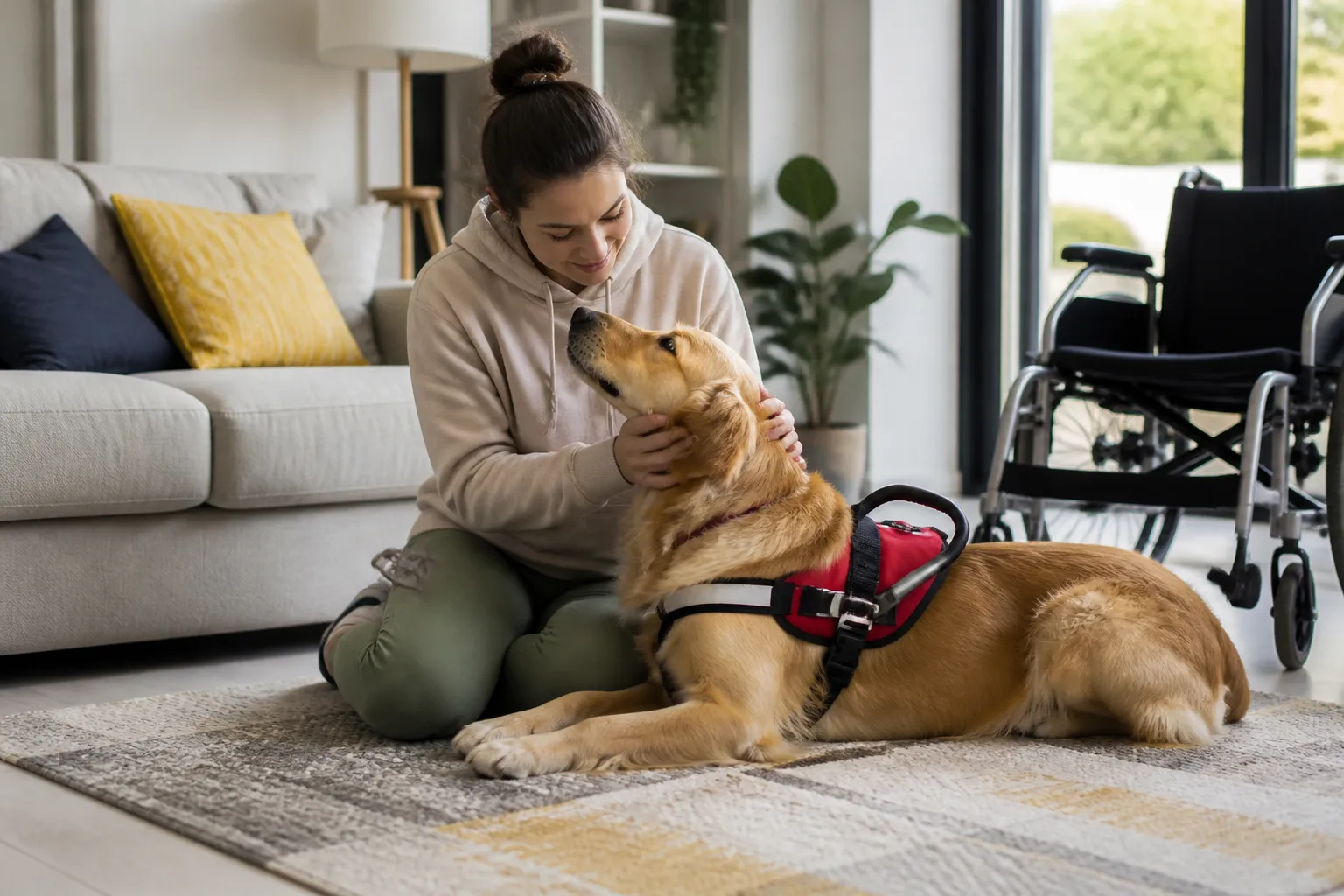
Mobility-related tasks can include retrieving items, opening or closing suitable doors, activating accessible buttons, providing a stable object for support when professionally assessed as safe, or helping with clothing. Not every dog is physically suited to bracing or counterbalance. The dog’s structure, age, health, harness equipment, and veterinary guidance matter.
Medical-response tasks may involve alerting to a change, obtaining medication, finding another person, activating an emergency device, or interrupting a dangerous behavior. An alert should never be treated as infallible medical monitoring. A handler needs a backup plan, especially where missed alerts could create serious risk.
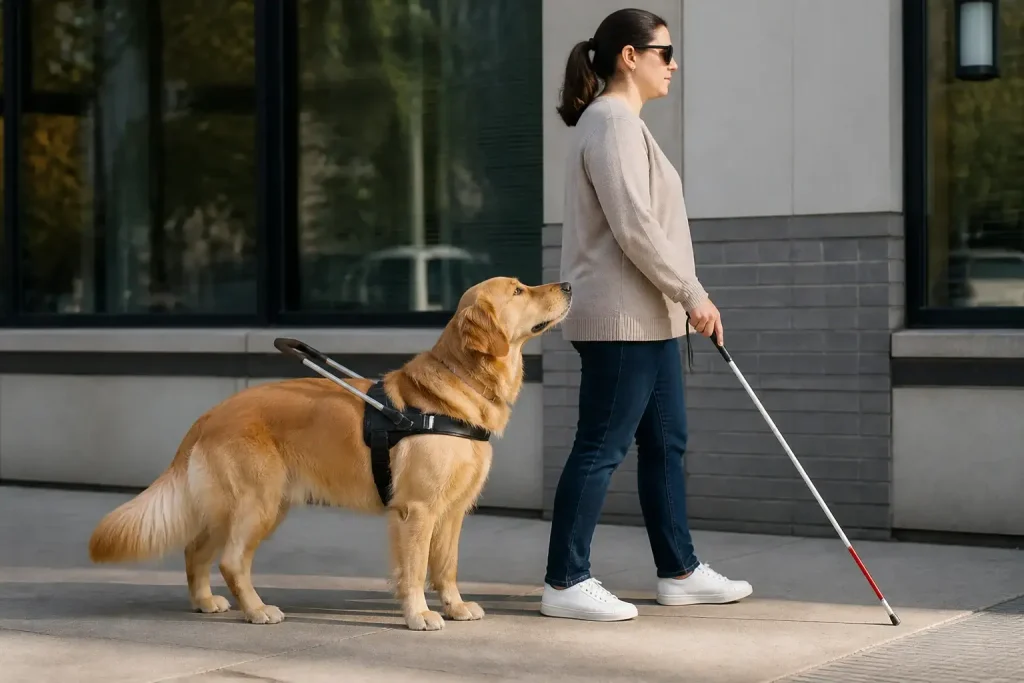
Guide work requires specialized instruction and careful assessment. A dog may learn directional cues, obstacle avoidance, stopping at curbs, and intelligent disobedience when following a command would create danger. This work is complex and should generally involve experienced professionals.
Psychiatric service tasks can include interrupting dissociation, waking a person from a trauma-related episode, creating a buffer in crowds, guiding a handler to an exit, retrieving a phone, or applying trained pressure when that strategy is appropriate. The dog must not be placed in situations that intensify fear or encourage unsafe dependence.
Public-Access Training
Public-access training teaches a dog to function safely and unobtrusively outside the home. Begin in quiet, familiar locations and increase difficulty gradually. Practice entering through controlled doors, riding elevators, walking past food, settling beneath a table, ignoring greetings, navigating narrow aisles, and remaining composed around carts, children, alarms, and mobility equipment.
A dog should be clean, groomed, house-trained, and free from disruptive behavior. Barking, lunging, repeated sniffing, soliciting food, wandering, blocking pathways, and jumping on people require attention before demanding environments are attempted. Equipment should be comfortable and functional; a vest does not replace training, and it does not make an unprepared dog ready for public access.
Proof skills across different locations, times, surfaces, and distractions. A dog may perform well in a quiet café but struggle in a crowded clinic. Record what happened, identify the trigger, and design an easier repetition. Progress is measured by reliable behavior and recovery, not by how quickly a dog enters challenging places.
Handlers also need public-access skills. They should know how to manage the leash, reinforce quietly, prevent unwanted contact, explain boundaries briefly, and remove the dog when it is stressed or ill. A working dog is not public property. People should ask before touching or distracting it, and handlers may decline interaction.
Choosing a Training Route
People typically choose owner training, professional private instruction, a specialized program, or a combination. Owner training can provide deep partnership and may be practical when the handler has time, physical capacity, and access to knowledgeable support. However, it requires careful planning, objective feedback, and a willingness to change course.
Private trainers can tailor tasks and environments to the handler’s needs. Ask about relevant experience, humane methods, assessment procedures, follow-up support, and how they handle dogs that are unsuitable. Avoid guarantees of certification, instant results, perfect alerts, or unrestricted access based solely on equipment. A responsible professional explains limitations instead of selling certainty.
A program-trained dog may offer structured preparation and ongoing guidance, but availability, cost, waiting periods, and matching policies vary. The handler should understand what behaviors and tasks are included, what happens if the match is unsuccessful, and which responsibilities remain after placement.

Training should be collaborative. The handler knows the disability and daily routines; the trainer contributes behavior expertise; veterinarians address health, pain, nutrition, and physical suitability; and other professionals may clarify safety or rehabilitation goals. No single person should make unsupported medical or mobility decisions.
Evaluating a dog
Before investing heavily, assess health, temperament, recovery from surprise, response to guidance, motivation, and ability to relax. A dog that is affectionate at home may still be unsuitable for prolonged public work. Excessive fear, persistent reactivity, intense prey drive, inability to settle, or physical discomfort can make service work unfair or unsafe.
Age matters because puppies require developmental support and may not have the maturity needed for complex work. Adult dogs can sometimes be evaluated more accurately, although their previous habits may require modification. Breed tendencies are not guarantees. Individual behavior and health should guide decisions more than appearance or popularity.
A Practical Training Plan
Start with a written working profile. Describe the handler’s needs, proposed tasks, environments, equipment, safety concerns, and signs of stress. Define success in observable terms. “Calm in a shop” might mean four paws on the floor, a loose leash, no unsolicited contact, and the ability to settle for a stated period while the handler completes an activity.
Train daily in brief sessions, but allow rest. Use a progression from quiet practice to realistic situations. One useful sequence is home, yard or hallway, quiet outdoor area, low-traffic store, busier store, and complex public environment. Move backward whenever reliability falls. Rehearse emergency procedures separately, including how the handler will exit, contact support, secure the dog, and obtain help.
Keep records. Note the date, location, task, distraction, cue, response, reward, and recovery time. Patterns reveal whether the dog is tired, worried, confused, physically uncomfortable, or simply being asked for too much. Video, when appropriate and respectful, can help a trainer evaluate timing and body language.
Use maintenance training after the dog appears finished. Skills fade when they are never practiced, particularly in unfamiliar settings. Rotate rewards, refresh settling behavior, and occasionally rehearse tasks under modest distraction. Schedule veterinary examinations and monitor weight, paws, joints, hearing, vision, and emotional wellbeing.

Safety, Ethics, and Legal Awareness
Service dog work carries responsibilities. Never train a dog to pull a person who cannot safely tolerate the force, brace against unstable movement, or retrieve dangerous objects without professional assessment. Avoid tasks that require the dog to detect a medical change unless the training process and limitations are clearly understood. A dog should not replace prescribed treatment, emergency planning, human assistance, or clinical care.
Public-access rules differ by jurisdiction and by the type of setting. Laws may define service animals, qualifying tasks, access rights, identification expectations, and exceptions. Requirements can change, and transportation, housing, employment, schools, hospitals, and international travel may have additional procedures. Consult current official guidance relevant to your location rather than relying on internet claims or informal certificates.
Be honest about the dog’s status and behavior. Misrepresenting a pet as a service animal can harm disabled people, working teams, and businesses. Online registration cards, certificates, and vests may be useful for organization or communication, but they do not create training, legal rights, or reliability by themselves.
The dog’s welfare remains central. Provide sleep, play, exercise appropriate to health, access to water, veterinary care, decompression, and retirement planning. A dog may need time completely off duty. Signs such as persistent avoidance, irritability, shutdown, digestive changes, or unwillingness to work deserve attention, not punishment.
Troubleshooting Common Problems
If a dog ignores a cue, first ask whether it understands the behavior, whether the reward is valuable, and whether the environment is too difficult. Repeating a cue louder usually does not solve unclear learning. Lower the distraction, improve timing, and rebuild the behavior in smaller steps.
If the dog is distracted by people, prevent rehearsal by increasing distance and rewarding orientation toward the handler. If the dog reacts to other animals, prioritize safety and seek qualified behavior support. If an alert is inconsistent, examine the target, scent or context, reinforcement history, health, and whether the proposed alert is actually observable by the dog.
If public work causes stress, stop treating exposure as a test of endurance. Leave calmly, identify the earliest warning signs, and create a graduated plan. Punishment may suppress communication while increasing fear. Humane training protects trust and produces more dependable behavior.
Frequently Asked Questions
Is every well-trained dog a service dog?
No. A service dog must be individually trained to perform tasks directly related to a person’s disability, in addition to behaving safely and appropriately. Obedience, therapy work, emotional comfort, or good manners alone do not establish that role.
How long does training take?
There is no universal timetable. Duration depends on the dog’s age, starting skills, task complexity, health, handler needs, training frequency, and access to expert guidance. Reliable performance matters more than a promised calendar.
Can I train my own service dog?
In some places, owner training is permitted, but rules differ. Success requires time, realistic assessment, suitable support, and careful attention to task and public-access standards. A qualified trainer can help identify problems early.
Does a service dog need a vest or certificate?
Equipment and documentation requirements vary. A vest does not train a dog, and a certificate from an online seller does not necessarily establish legal status. Check official local guidance and focus on behavior and legitimate tasks.
What if my dog is friendly but cannot work?
Retirement or career change can be a responsible outcome. A dog may become a companion, therapy prospect, or family pet if its needs and temperament fit that role. Continuing unsuitable work can create stress and risk.
Can tasks involve comfort?
Comfort may be valuable, but a service task should be specific, trained, and directly connected to disability-related functional support. Clarify what the dog does, when it does it, and how the handler responds.
Conclusion
Effective service dog training is individualized, gradual, evidence-based, and humane. Start with the person’s practical needs, select a dog for temperament and health rather than appearance, teach dependable foundations, and shape tasks in small steps. Then proof those skills across realistic environments while protecting the dog’s welfare.
The strongest partnership is not defined by a vest or a label. It is demonstrated through safe behavior, useful tasks, honest evaluation, and teamwork between handler, dog, trainer, and relevant professionals. When a dog cannot meet the demands, changing the plan is responsible—not disappointing. When training is approached with patience and clear standards, it can provide meaningful everyday support while preserving dignity, safety, and trust for both members of the team.