Understanding Service Dog Training
Service dog training is a structured process that prepares a dog to perform specific tasks for a person with a disability. It is more than teaching obedience, and it is not simply a method for producing a calm companion. A successful service dog must work reliably in public, respond safely under pressure, and assist with needs that meaningfully reduce the handler’s disability-related limitations.
Training should therefore begin with the individual’s goals, daily environment, health needs, and practical routines. A dog may retrieve medication, interrupt harmful repetitive behavior, provide mobility support when appropriately built and physically suited, alert to a change, guide a person around obstacles, or create space during overwhelming situations. The correct tasks depend on the handler, and no single training plan fits every team.
A carefully trained dog can increase independence, confidence, and participation in work, education, travel, and community life. However, success requires honest assessment. Not every dog has the temperament, structure, or stamina for this role, and not every challenge can be solved through training alone. Responsible programs prioritize welfare, safety, clear goals, and gradual progress.
What Makes a Service Dog Different
A service dog is distinguished by function, not appearance, breed, color, or equipment. The dog must be trained to perform specific work or tasks related to a person’s disability. General comfort, companionship, and emotional support may be valuable, but they are not the same as trained disability assistance.
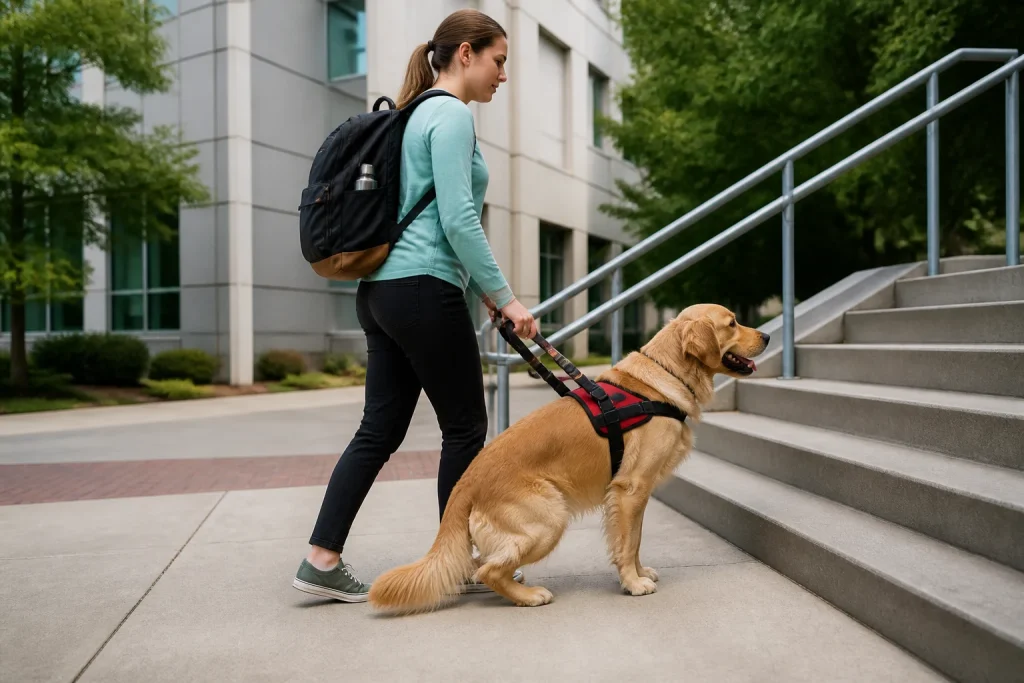
Public behavior is another essential distinction. A working dog should remain unobtrusive in stores, offices, classrooms, transportation areas, and medical settings. It should ignore food, strangers, other animals, loud sounds, and tempting scents unless a task requires engagement. It should settle quietly, walk without pulling, relieve itself appropriately, and recover from unexpected events.
These standards are demanding because mistakes can create genuine risks. A dog that lunges, solicits attention, wanders, or reacts unpredictably may distract its handler, endanger others, or lose access to important environments. Training must address both task performance and the broader skill of being a dependable public partner.
Choosing a Suitable Dog
Temperament and Health
Selection is often the most important decision. Look for a dog that is confident without being pushy, attentive without being frantic, and willing to recover after a startling experience. Excessive fear, persistent aggression, extreme environmental sensitivity, or inability to relax can make service work unsuitable.
A veterinary evaluation should address joints, movement, vision, hearing, skin, digestion, and other conditions relevant to the intended tasks. Physical assistance tasks deserve particular caution because repetitive pulling, bracing, or weight bearing can injure a dog whose body is not suited to that work. A qualified veterinarian and training professional can help evaluate risk.
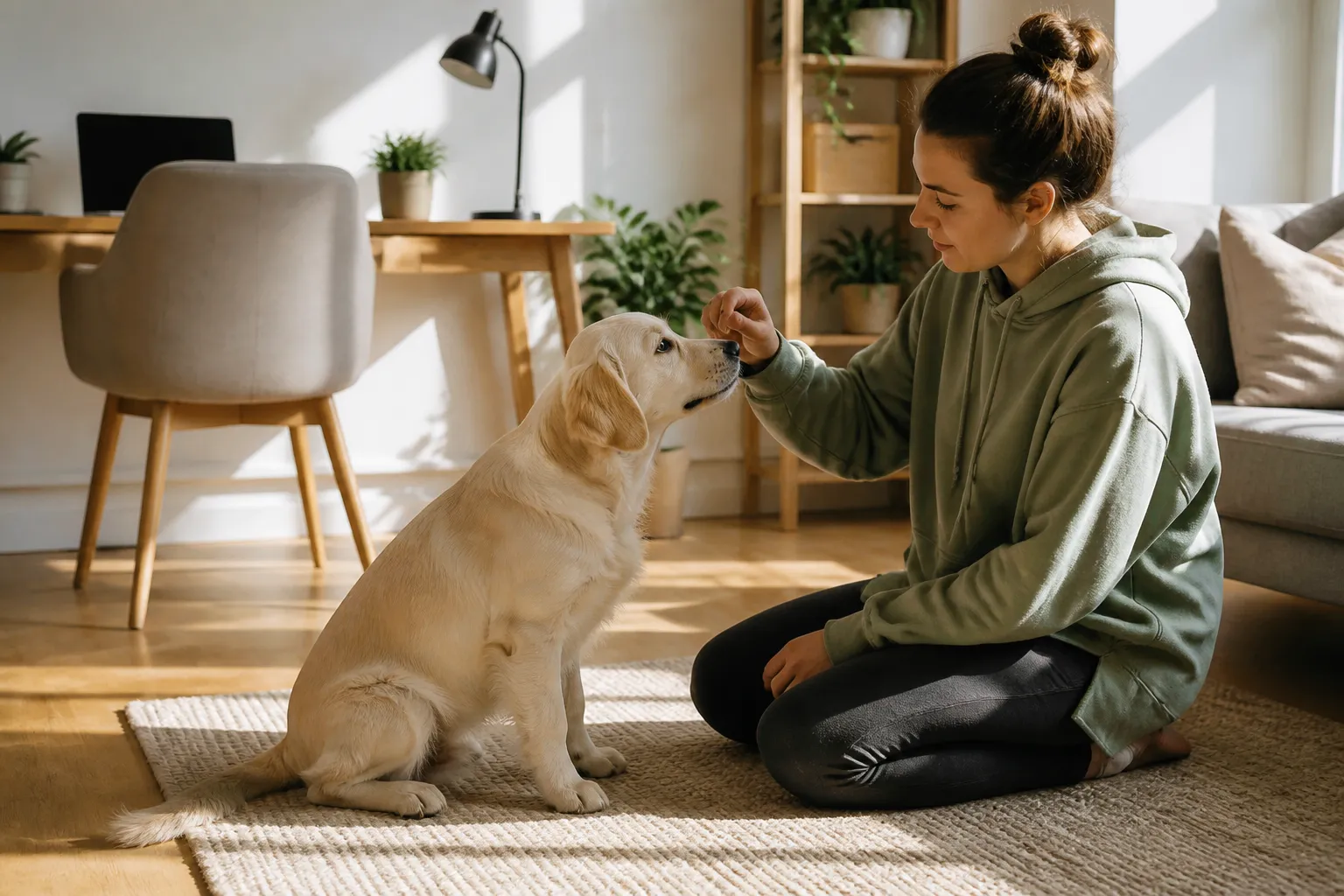
Age also matters. Puppies may offer more background flexibility, but their final temperament and physical development are not yet fully known. An adult dog can provide clearer information about behavior, although previous habits may require careful modification. Choose for suitability rather than convenience, popularity, or appearance.
Setting Realistic Expectations
Training may take months or longer, depending on the dog, tasks, handler, and starting skills. Progress is rarely linear. A dog may perform beautifully in a quiet room and struggle in a busy market. That does not mean training has failed; it indicates that the environment has become more difficult than the current skill level.
Building the Training Foundation
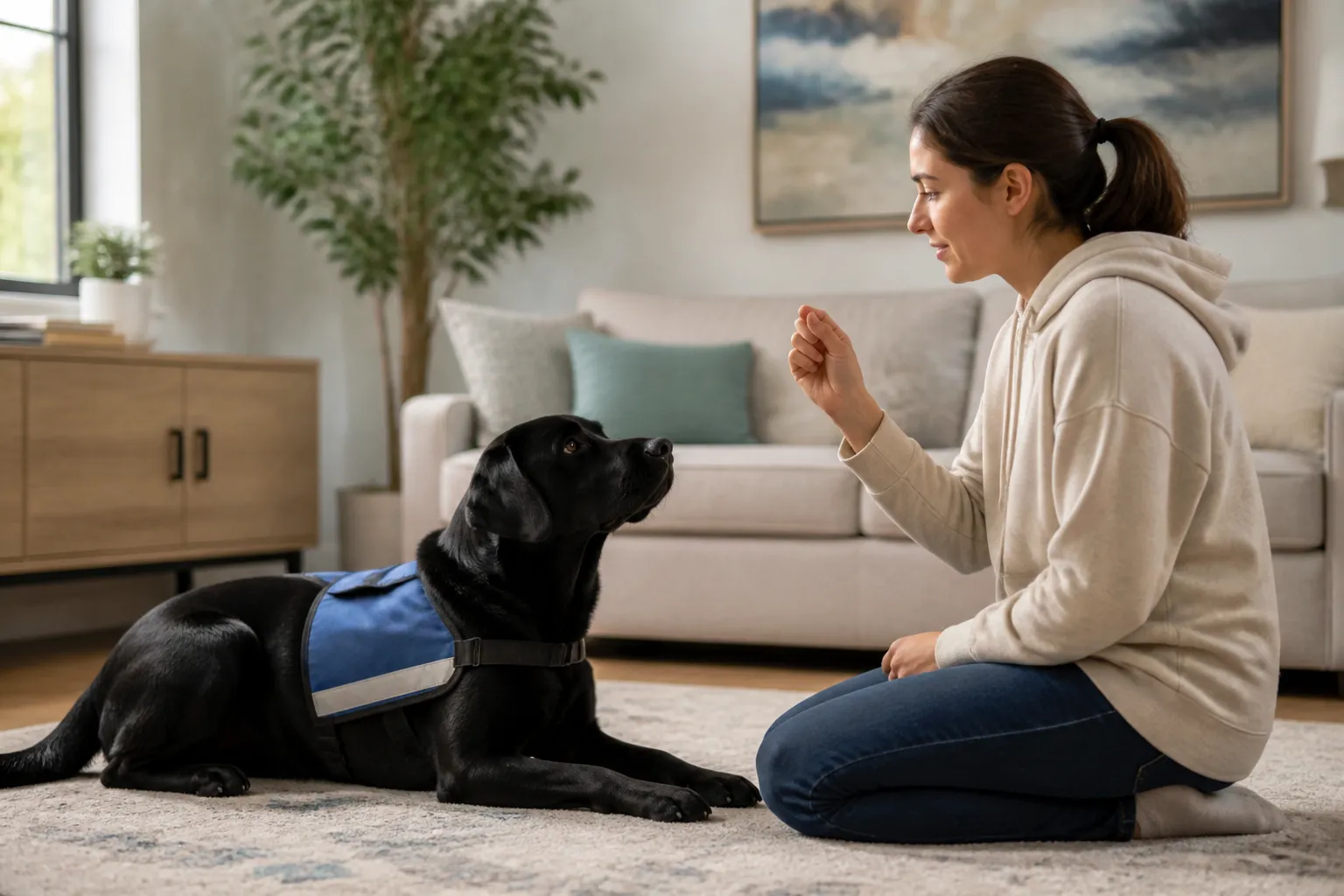
Begin with reinforcement-based learning. Reward the behaviors you want, manage situations that invite mistakes, and teach the dog how to succeed before increasing difficulty. Food, toys, praise, play, access to movement, and rest can all be useful reinforcers, depending on the individual dog.
The foundation should include name response, attention, loose-leash walking, reliable recall where appropriate, sit, down, stay, leave it, drop it, settling, stationing, and calm handling. Teach each behavior in small steps. For example, a settle exercise might begin with rewarding one quiet second on a mat, then gradually extend duration, add distance, and introduce distractions.
Use clear cues and consistent consequences. Everyone involved should understand what a cue means, how to reward it, and what to do when the dog is confused. Avoid punishing warning signals such as growling or avoidance. Suppressing communication can increase danger while leaving the underlying discomfort unresolved.
Socialization and Environmental Skills
Socialization means teaching a dog to remain composed around different sights, sounds, surfaces, people, animals, vehicles, doors, elevators, and crowded spaces. It does not mean forcing interaction. A dog can observe a wheelchair, hear a bus, or walk past a stranger while receiving rewards for calm behavior.
Exposure should be gradual and voluntary. If the dog stops eating, freezes, hides, scans constantly, or tries to escape, the challenge is too intense. Increase distance, reduce duration, or return to an easier setting. Confidence grows through repeated safe experiences, not through flooding.
Teaching Disability-Related Tasks
Define the Task Precisely
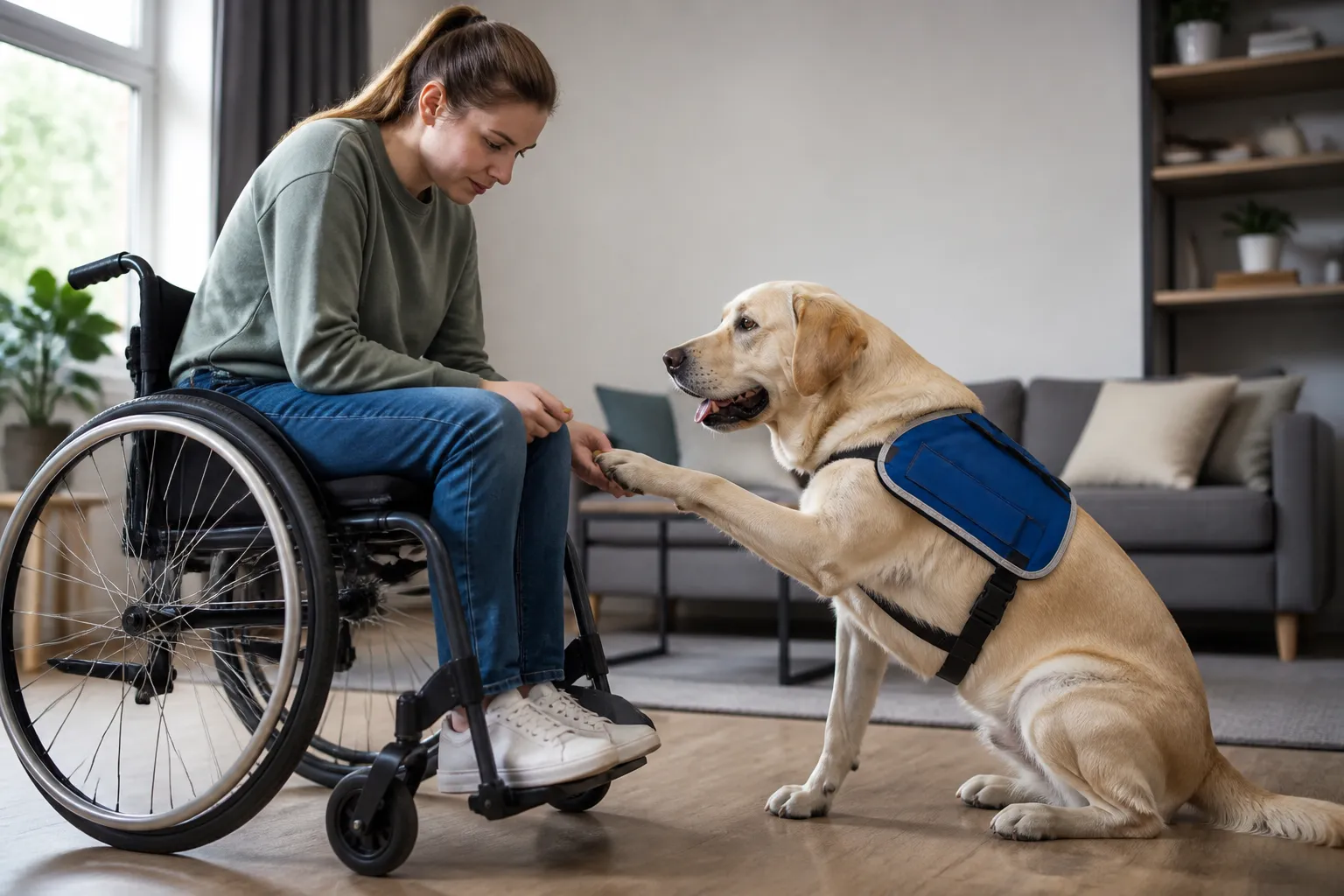
A useful task has a clear beginning, action, and outcome. “Help me” is too vague to train effectively. “Pick up a dropped phone and place it in my hand” is observable and measurable. “Alert me when a specific change occurs, then lead me to a safe location” also provides a sequence that can be practiced.
Break complex assistance into components. First teach the dog to target an object, then hold it gently, carry it, release it into a hand, and repeat the sequence in different rooms. If the task involves an alert, establish the desired signal, identify the relevant trigger, reward accurate responses, and teach a follow-up behavior that provides practical assistance.
Avoid creating accidental alerts. Dogs notice patterns humans may miss, and handlers can unintentionally reward guesses. Record situations, compare responses, and seek professional guidance when the task involves medical safety. A dog should not replace prescribed treatment, emergency planning, professional care, or assistive technology.
Common Task Categories
Retrieval tasks can help with dropped objects, medication containers, phones, clothing, or emergency items, provided the dog can handle them safely. Interruption tasks may redirect harmful repetitive actions through nudging, pawing, positioning, or retrieving a designated object. Alert and response tasks can signal changes, locate another person, or activate a communication plan.
Guide-style tasks require exceptional environmental judgment and should be developed with specialized expertise. Mobility-related work demands careful assessment of equipment, force, body size, joint health, and handler technique. Pressure or grounding tasks must be individualized, because weight or restricted movement can create risk for some people.
Always ask whether a task is necessary, safe, reliable, and genuinely useful. A visually impressive behavior is not automatically a meaningful accommodation.
Public Access Preparation
Public access training should progress from easy places to challenging ones. Begin in a quiet area where the dog can practice walking, settling, ignoring distractions, and responding to cues. Then add longer sessions, tighter spaces, more people, food smells, transportation sounds, and unexpected movement.

Train the handler as carefully as the dog. The person should know how to reinforce quietly, recognize early stress, maintain equipment, protect personal space, and end an outing before the dog becomes overwhelmed. Carry appropriate supplies, including water, waste bags, identification required by local rules, rewards, and emergency contact information.
Do not use public spaces as a test before the dog is ready. Arrange controlled practice with permission whenever possible. If an outing deteriorates, leave calmly and review what happened. Was the location too busy, the session too long, the dog tired, or the cue unclear? A practical adjustment is more productive than blame.
Handlers should also understand applicable laws and policies. Access rights, identification expectations, housing rules, transportation regulations, and task definitions can vary by jurisdiction. Consult current official guidance rather than relying on internet claims or assumptions.
A Practical Training Plan
Create a written plan with five elements: the target behavior, the cue, the reward, the current difficulty, and the next small progression. Train in brief sessions that end while the dog is still successful. Repetition matters, but excessive drilling can reduce enthusiasm and concentration.
Practice skills in varied contexts. A dog that retrieves only one familiar object in one room has learned a narrow routine. Change the object, surface, lighting, handler position, and background noise gradually. Generalization should be deliberate rather than expected automatically.
Keep records. Note date, location, distraction level, successful repetitions, mistakes, and signs of stress. Records reveal patterns that memory often misses. They also help a professional adjust the plan efficiently.
Use maintenance training after the dog appears finished. Reinforce important behaviors periodically, refresh tasks, and practice emergency routines. Aging, illness, schedule changes, and new environments can affect performance. Ongoing education protects reliability and preserves the partnership.
Solving Common Problems
If the dog pulls, reduce distractions, reward a slack leash, and reinforce frequent check-ins. If attention seeking occurs, prevent strangers from greeting the dog and reward calm neutrality. If the dog reacts to another animal, create distance before tension escalates, then rebuild the behavior below threshold.
If task performance is inconsistent, examine the trigger, cue, reinforcement, environment, and handler timing. The dog may not understand the behavior, may be physically uncomfortable, or may be too distracted. Return to a simpler version and rebuild systematically.
Stress signs deserve immediate attention. Panting unrelated to heat, lip licking, yawning, tucked posture, scanning, avoidance, trembling, or sudden loss of responsiveness can indicate that the dog needs relief. Continuing through distress may damage confidence and welfare. Pause, create space, and consult a qualified professional if the pattern persists.
Never rely on harsh corrections to force public behavior or task responses. Fear may suppress visible movement while increasing emotional risk. Ethical training seeks cooperation, clarity, and resilience.
Working With Professionals
A skilled service dog trainer should be able to explain methods, task goals, progress criteria, welfare safeguards, and realistic limitations. Ask how they evaluate temperament, handle setbacks, involve the handler, and transition training into ordinary routines. Observe a session when possible and request references that can be independently considered.
Be cautious of guaranteed timelines, claims that every dog can become a service dog, pressure to buy equipment immediately, or advice centered on appearances rather than function. A professional should welcome questions and discuss when a dog may need a different role.
Medical and disability-related tasks may require collaboration with healthcare providers, occupational therapists, behavior professionals, veterinarians, or equipment specialists. Coordinated planning reduces contradictions and helps ensure that the dog’s work complements, rather than replaces, other support.
Frequently Asked Questions
Can any dog become a service dog?
No. Many dogs can learn useful behaviors, but service work requires suitable temperament, health, motivation, focus, and recovery from stress. Screening is essential, and a dog that is wonderful at home may still be unsuitable for public work.
How long does training take?
There is no universal schedule. Foundation skills, task complexity, public environments, the handler’s experience, and the dog’s development all affect the timeline. Progress should be judged by reliable performance and welfare, not by a promised deadline.
Should I train alone or hire help?
Owners can teach many foundations, but professional guidance is valuable for task design, public access, mobility concerns, alerts, reactivity, and safety. Choose help based on humane methods, relevant experience, transparency, and willingness to include the handler.
Can a service dog play and behave like a pet?
Yes. Rest, play, exercise, social contact, and enrichment support welfare. A service dog needs clear working and off-duty cues, along with opportunities to relax without being expected to perform.
What if my dog fails a training exercise?
Treat failure as information. Lower the difficulty, clarify the cue, improve timing, check physical comfort, and try again later. Repeated difficulty may indicate that the behavior, environment, or task is not appropriate as currently designed.
Is certification always required?
Requirements differ according to location and context. Do not assume that online certificates create legal rights or prove functional ability. Check current official rules and focus primarily on safe, reliable task performance.
Conclusion
Service dog training succeeds when it combines purposeful tasks, dependable public behavior, humane teaching, and honest evaluation. Start with the handler’s real needs, select a dog for health and temperament, build foundations gradually, and define every task in observable terms. Practice across environments, protect the dog from excessive stress, and maintain skills throughout the partnership.
The strongest teams are not created by shortcuts or impressive equipment. They develop through careful observation, consistent reinforcement, professional collaboration, and respect for the dog as a working partner with physical and emotional limits. When training is individualized and welfare-centered, a service dog can provide practical assistance while helping its handler participate more safely and independently in everyday life.