
Why Body Condition Matters More Than the Bowl
The most accurate way to measure a dog’s food portion is to begin with body condition, then adjust the amount according to weight trend, activity, life stage, health, and the food’s calorie density. Feeding directions on a package are useful starting points, but they cannot account for every dog. Two dogs of the same weight may need noticeably different portions because one is muscular and active while the other is sedentary or prone to weight gain.
Body condition describes how much fat covers the ribs, spine, hips, and abdomen. It is different from body weight. A dog can weigh an appropriate amount yet carry too much fat, or appear slim while having substantial muscle. Learning to assess condition helps you make measured, gradual changes instead of guessing.
A practical goal for most dogs is a body condition score near the middle of a nine-point scale. At that level, the ribs are easy to feel under a thin layer of fat, the waist is visible from above, and the abdomen rises toward the hind legs when viewed from the side. Breed differences matter, but these basic landmarks are useful across many dogs.
Assess Your Dog Before Measuring Food
Evaluate your dog in good lighting, while the dog is standing naturally. Do not judge condition immediately after a large meal, vigorous exercise, or grooming that changes the apparent outline.
Feel the ribs
Place your hands on both sides of the chest and move gently over the ribs. You should be able to feel each rib without pressing hard. The ribs should not be sharply visible in a healthy, moderate-condition dog, except that some lean breeds may naturally show more definition. If you must press through a thick layer to locate them, excess fat is likely present. If the ribs, spine, or pelvic bones are prominent and lack a soft covering, the dog may be underconditioned.
Look at the waist and abdomen
View the dog from above. A moderate dog should have a discernible waist behind the rib cage. From the side, the belly should slope upward toward the groin rather than forming a level or sagging line. A hanging abdominal flap can occur in some breeds and after weight loss, so combine the visual check with a hands-on rib assessment.
Consider muscle separately
Muscle can make a dog look heavier without indicating excess fat. Working dogs may have broad chests and powerful thighs, while older dogs can lose muscle even when their body weight remains stable. Record both body weight and condition, and ask a veterinarian to assess unexplained muscle loss, sudden weight change, persistent hunger, or changes in thirst and urination.
Understand Food Labels and Calories
Package feeding charts generally use body weight and may divide dogs into activity categories. They are not individualized prescriptions. Start with the label’s recommendation for the dog’s current weight, then compare the result with the dog’s body condition and weekly weight trend.
The crucial number is calories, usually listed as kilocalories per cup, can, pouch, or kilogram. A cup of one food may contain far more energy than a cup of another. Measuring equal volumes therefore does not guarantee equal calories. If the label provides calories per kilogram but not per cup, the manufacturer or veterinarian can help convert the quantity.
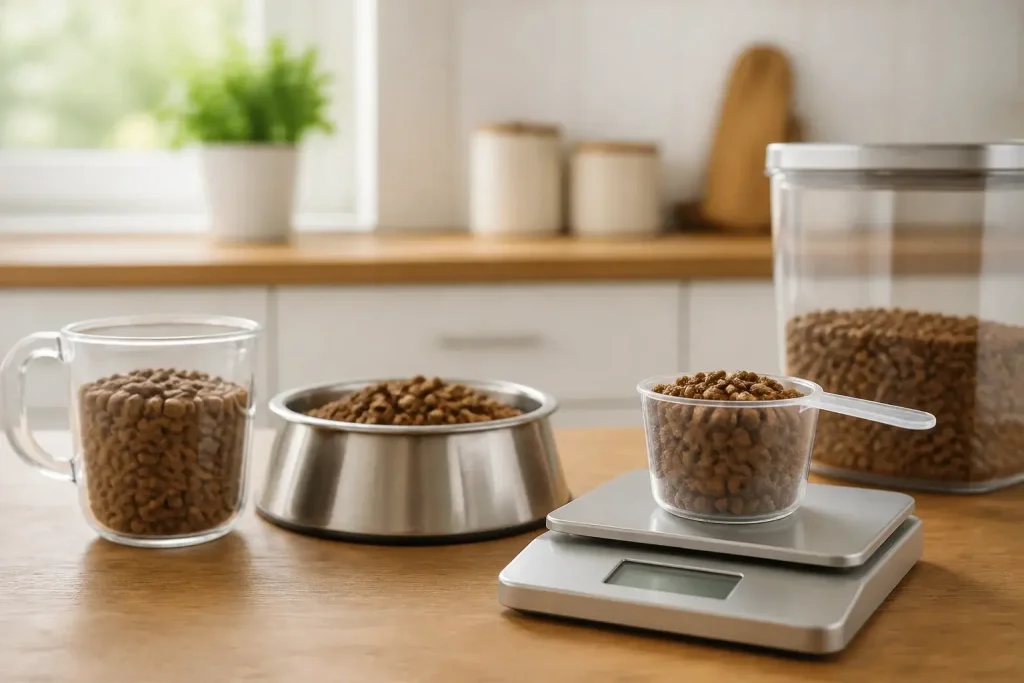
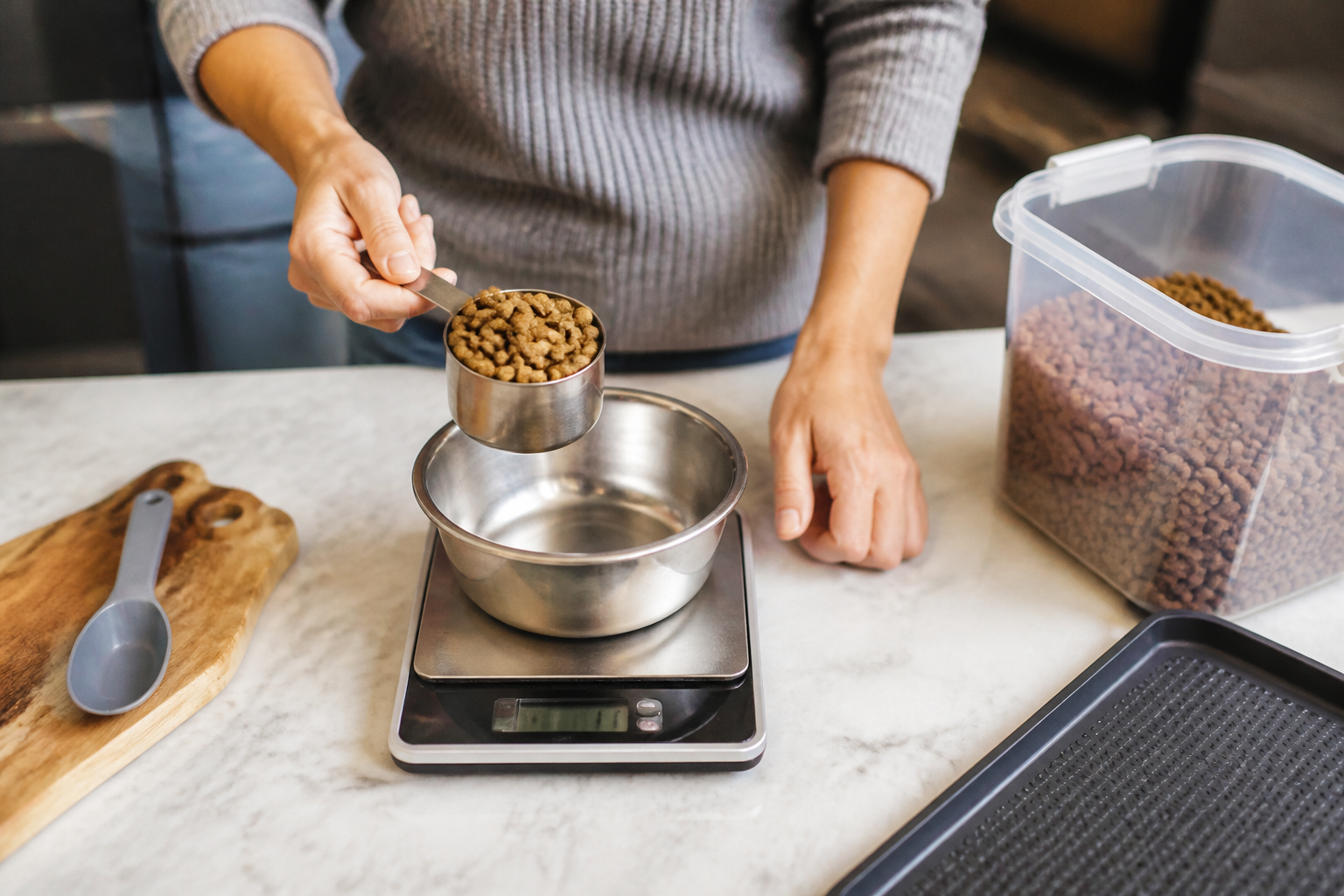
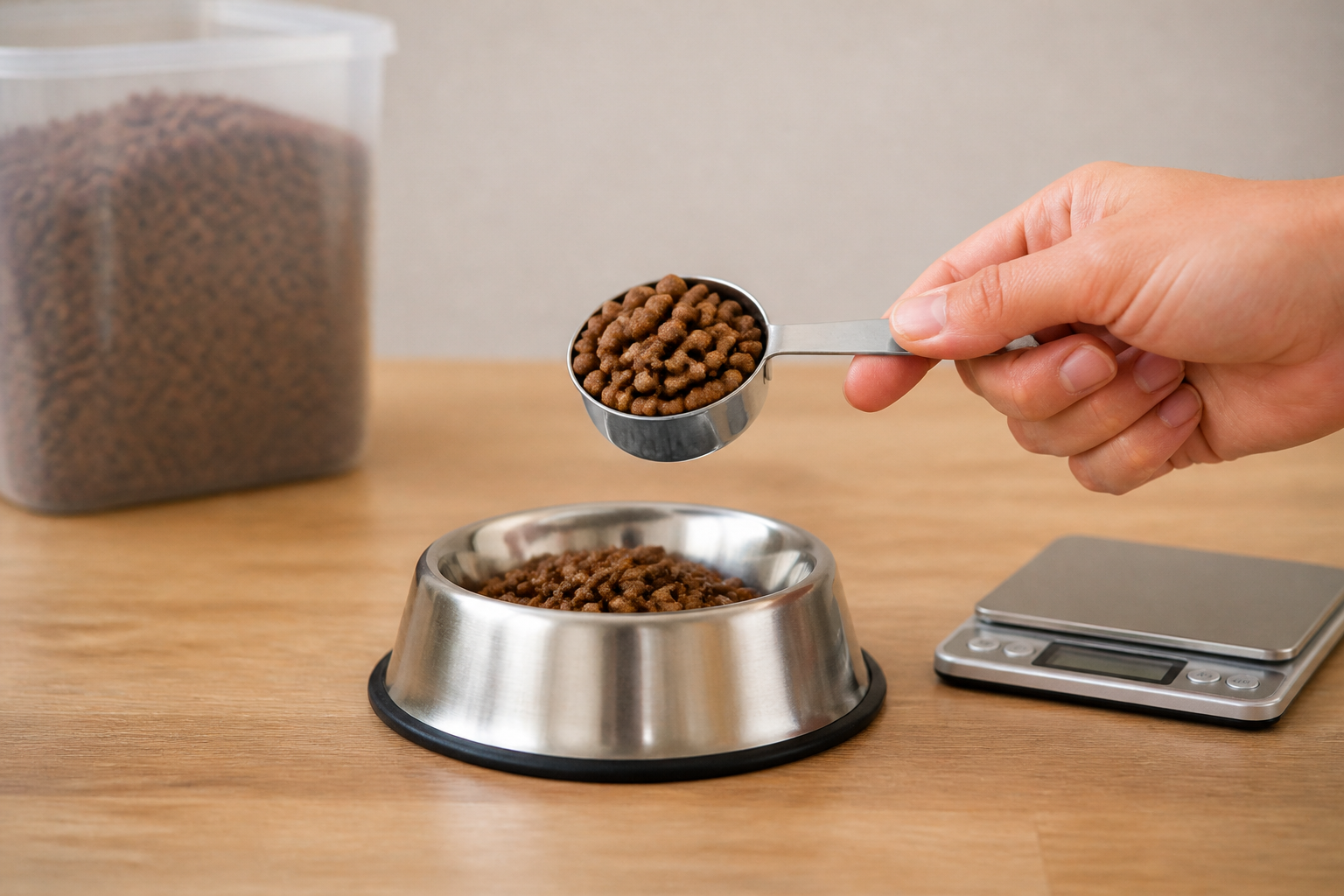
Use a kitchen scale when possible. Weighing grams is more consistent than using a scoop, especially for small dogs, calorie-dense kibble, or foods with irregular pieces. If the label states that one cup weighs a particular number of grams, weigh that amount. Otherwise, weigh a level cup several times and use the average, recognizing that this is an estimate.
Treats, dental chews, table scraps, toppers, and supplements contribute calories. They must be included in the daily allowance rather than added without adjustment. Treat calories are not always printed clearly, so ask the manufacturer or choose small, simple rewards. Water, plain low-calorie vegetables, and play can sometimes replace calorie-rich rewards, but dietary changes should suit the individual dog.
Calculate a Starting Daily Portion
Begin by identifying the dog’s current body weight, target body weight if a veterinarian has recommended one, food calories, and typical activity. The food label gives a starting amount; a veterinary professional can provide a more appropriate calorie target when obesity, underweight, disease, pregnancy, growth, or medication complicates feeding.
If a label recommends two cups daily, divide that total between meals. For a twice-daily schedule, one cup per meal is a starting point. If treats provide a meaningful amount of energy, remove some food from the meals. Do not assume that a filled scoop is one cup; many scoops hold more.
For weight loss, avoid drastic restriction unless a veterinarian directs it. A dog that receives too little food may lose muscle, feel persistently hungry, or develop nutritional problems. A clinician can select a safe target and may recommend a therapeutic weight-management diet, which is formulated to provide appropriate nutrients at a reduced calorie density.
For a thin dog, simply adding unlimited food is also unwise. Underweight may reflect dental pain, parasites, digestive disease, endocrine problems, cancer, or inadequate access to food. A veterinary examination is especially important when weight loss is unplanned.
Adjust Portions Using Observable Changes
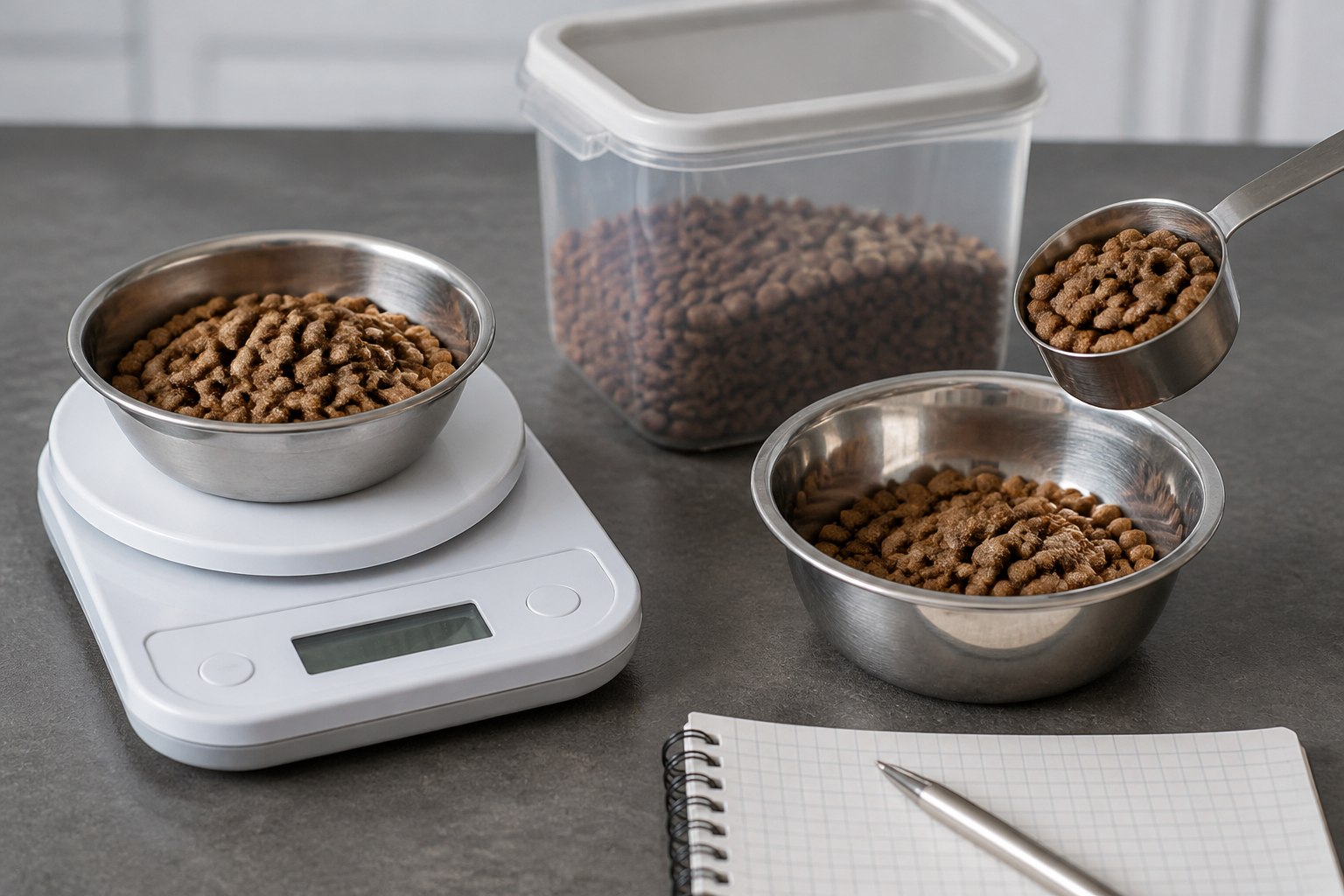
Body condition and weight trend are the checkpoints that tell you whether the starting portion works. Weigh the dog on the same scale, at a similar time, preferably before a meal. For a large dog, a veterinary scale may be easier. Record the date, weight, food amount, treats, exercise, and any relevant symptoms.
Healthy change is usually gradual. If the dog is gaining fat, first confirm that every calorie source has been counted and that the measuring method is consistent. Then make a modest reduction in the daily portion, or ask your veterinarian for a plan. Maintain the new amount long enough to observe a trend rather than changing it every few days.
If the dog is losing weight unintentionally, increase attention rather than automatically adding food. Check for vomiting, diarrhea, dental difficulty, reduced appetite, increased drinking, or changes in energy. Contact a veterinarian promptly when weight loss is unexplained, rapid, or accompanied by illness.
A dog at a good condition score may still need a small adjustment if weight steadily rises or falls. The correct quantity is the amount that maintains stable, healthy condition, not the amount that exactly matches a printed chart. Reassess after changes and keep the smallest effective adjustment.
Account for Life Stage and Lifestyle
Puppies need food that supports growth, but their requirements vary with age, expected adult size, breed, and growth rate. Use a complete, balanced diet labeled for the appropriate growth stage, and follow veterinary guidance for large-breed puppies. Rapid growth is not automatically healthier. Monitor body condition so a puppy remains lean rather than round.
Adult dogs differ in activity. A sedentary companion may need fewer calories than a dog that runs, hunts, herds, or trains regularly. Exercise can increase energy needs, but do not automatically reward every workout with a large snack. Measure training treats from the daily allowance and observe whether the dog maintains condition.
Neutering, aging, illness, and reduced activity can alter calorie needs. Older dogs may require fewer calories, while some lose muscle and need a diet with suitable protein and veterinary oversight. Pregnant or nursing dogs have specialized requirements and should not be managed with ordinary weight-loss rules. Ask a veterinarian for individualized instructions.
Weather can affect activity, but avoid assuming that every cold day requires much more food. Housing, coat, outdoor exposure, workload, and body condition all matter. Make changes based on observed trend and professional advice when conditions are unusual.
Measure meals consistently
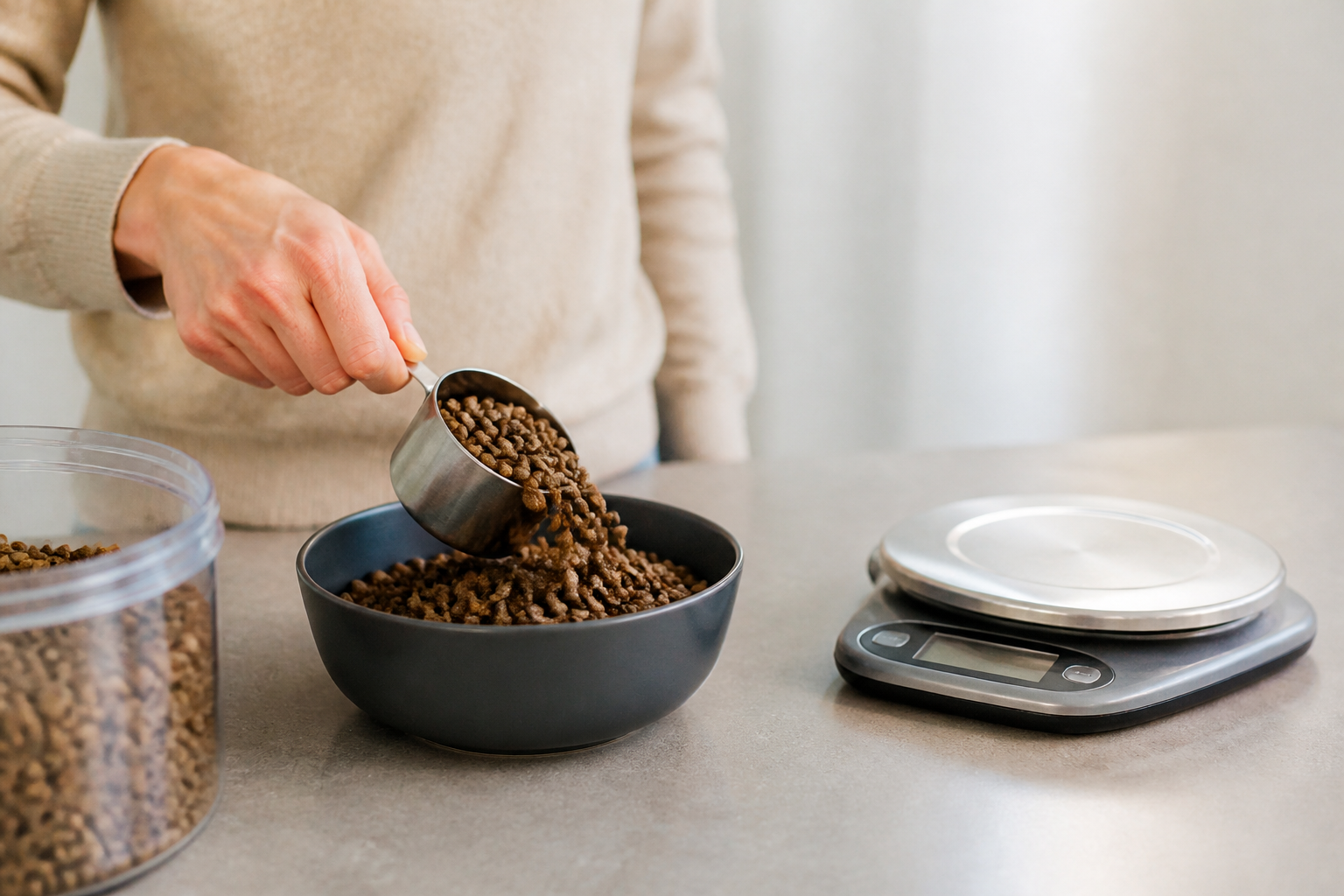
Choose a fixed feeding routine. Use the same scale or level measuring cup, divide the daily quantity into planned meals, and store the remaining food separately. Free-feeding makes intake difficult to track and may encourage overeating, particularly in dogs that eat quickly or live with other pets.
If several people feed the dog, write the daily amount on a container or feeding chart. Count chews and leftovers. Automatic feeders can improve consistency, but verify their output because dispensing mechanisms may vary with kibble size and shape.
Manage Multi-Dog and Special Feeding Situations
In a multi-dog household, feed dogs separately when one steals food or when their diets differ. Watch each meal, pick up bowls after a reasonable feeding period, and prevent access to another dog’s leftovers. Separation also makes it easier to identify appetite changes.
Fast eaters may benefit from a slow-feeding bowl, food puzzle, or divided meals, provided the device is safe and easy to clean. Dogs with swallowing difficulty, dental disease, or a history of guarding need a plan suited to their needs. Do not use a puzzle that creates frustration or conflict.
Wet and dry food can be combined, but calculate their calories together. Replacing part of a dry meal with canned food is not automatically a calorie reduction. Follow the calorie information for each product, and ensure the combined diet remains complete and balanced. Home-prepared diets require careful formulation; meat, rice, or vegetables alone may not supply essential nutrients.
Common Portioning Mistakes
One common mistake is treating the package chart as an exact prescription. Charts cannot observe body condition, activity, treats, or medical history. Another is changing brands by volume rather than calories. Compare energy density whenever food changes.
A third mistake is measuring only on convenient days. A generous weekend, frequent training rewards, or children sharing snacks can erase a careful weekday plan. Consistency matters more than a perfect single meal.
Do not reduce portions solely because a dog begs. Begging is behavior, and it may reflect habit, attention seeking, boredom, or access to food rather than true energy need. Increase walks, play, sniffing opportunities, and nonfood interaction when appropriate. Never withhold water.
Avoid crash diets, human weight-loss products, and unapproved supplements. Some human foods are toxic to dogs, and supplements can provide excess nutrients or interact with medication. A veterinarian can distinguish a feeding issue from a medical condition.
When Professional Guidance Is Essential
Seek veterinary advice before placing a puppy, pregnant dog, nursing dog, senior with muscle loss, or dog with a chronic condition on a major feeding change. Professional input is also important for severe obesity, marked thinness, rapid weight change, persistent vomiting or diarrhea, reduced appetite, or unusual thirst.
A veterinarian may calculate an energy target, estimate ideal weight, assess muscle and fat separately, and recommend a diet with suitable nutrient density. Body condition scoring is useful, but it does not replace an examination when health concerns exist. Ask for a written feeding plan if multiple caregivers are involved.
FAQ
How often should I check body condition?
Make a hands-on check at least monthly and whenever food, activity, medication, or health changes. Weighing frequency depends on the dog. Weekly checks can reveal a trend, but daily fluctuations from hydration, meals, and bowel movements are not meaningful by themselves.
Should I feed by cups or grams?
Grams are generally more precise because kibble size, shape, and settling affect volume. A level measuring cup is acceptable when a scale is unavailable, but use the same method every time. For small dogs, a small measuring error can represent a substantial share of daily calories.
What if my dog has an ideal weight but looks different from breed charts?
Breed charts and photographs are broad references, not individual diagnoses. Focus on palpable ribs, waist, abdominal tuck, muscle, and trend. Some breeds naturally have deeper chests, heavier coats, or leaner outlines. Ask a veterinarian to score your dog if you are uncertain.
Should treats be eliminated?
Not necessarily. Treats can support training and enrichment, but include them in the daily calorie plan. Choose small pieces, reserve part of the meal for rewards, and use praise, play, or access to a favorite activity when food is not needed.
How quickly should a portion change work?
The timing varies with the dog, food, starting condition, and adjustment size. Look for a consistent trend over several weeks rather than expecting an immediate visual difference. If there is no response despite accurate measurement, consult a veterinarian before making repeated large reductions.
Is begging proof that my dog needs more food?
No. Begging can be learned behavior. First review body condition, weight trend, meal timing, treat intake, and possible illness. If the dog is losing weight or showing other symptoms, seek professional advice rather than interpreting hunger behavior alone.
Can I use the same portion year-round?
Probably not always. Activity, age, reproductive status, health, food formula, and weight trend may change. Recheck condition regularly and adjust the measured daily amount when evidence shows that needs have changed.
Conclusion
Measuring dog food well is an ongoing process, not a one-time scoop. Start with the label and calorie information, assess ribs and body shape, weigh portions consistently, count every extra, and monitor weight and condition over time. Adjust gradually when the dog becomes too lean or too heavy, while treating sudden changes as possible health signals.
The strongest plan is simple enough for every caregiver to follow: a defined daily allowance, reliable measuring equipment, planned treats, regular checkpoints, and veterinary support when circumstances are complicated. Body condition turns feeding from guesswork into an observable routine. By responding to evidence rather than appetite alone, you can help your dog maintain appropriate fat, preserve muscle, and receive nutrition suited to its changing needs.