
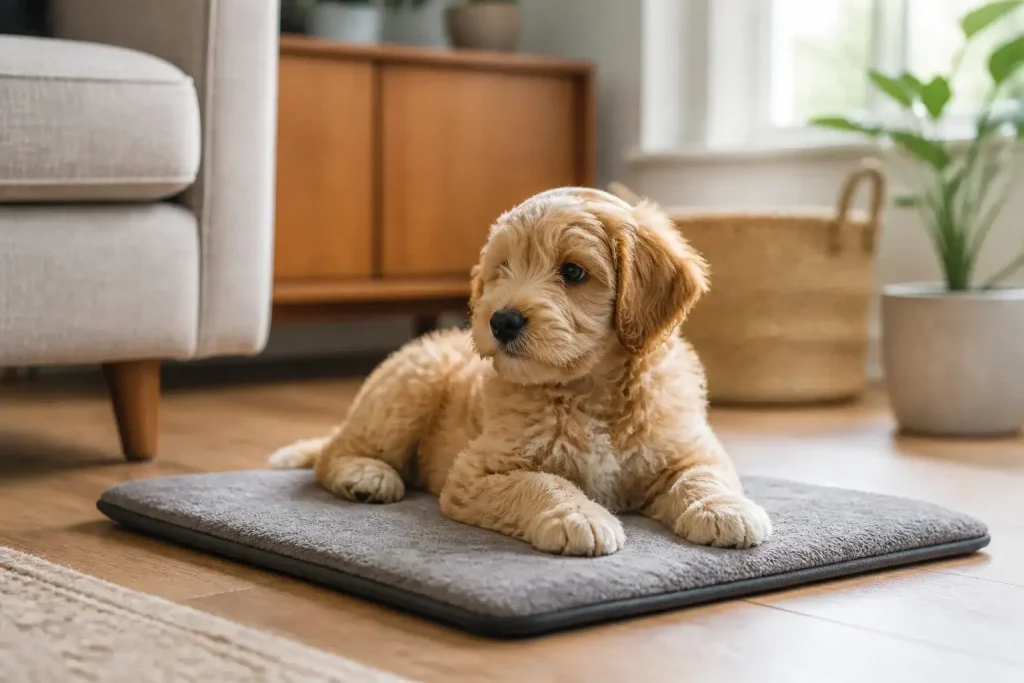
Why Mat Training Matters
Teaching a puppy to settle on a mat gives you a practical way to encourage calm behavior without expecting the puppy to remain still everywhere immediately. The mat becomes a clear, portable cue: when it appears, the puppy has a predictable place to rest, chew safely, and observe household activity. This skill can support polite mealtimes, remote work, visitors, grooming preparation, and relaxation after exercise.
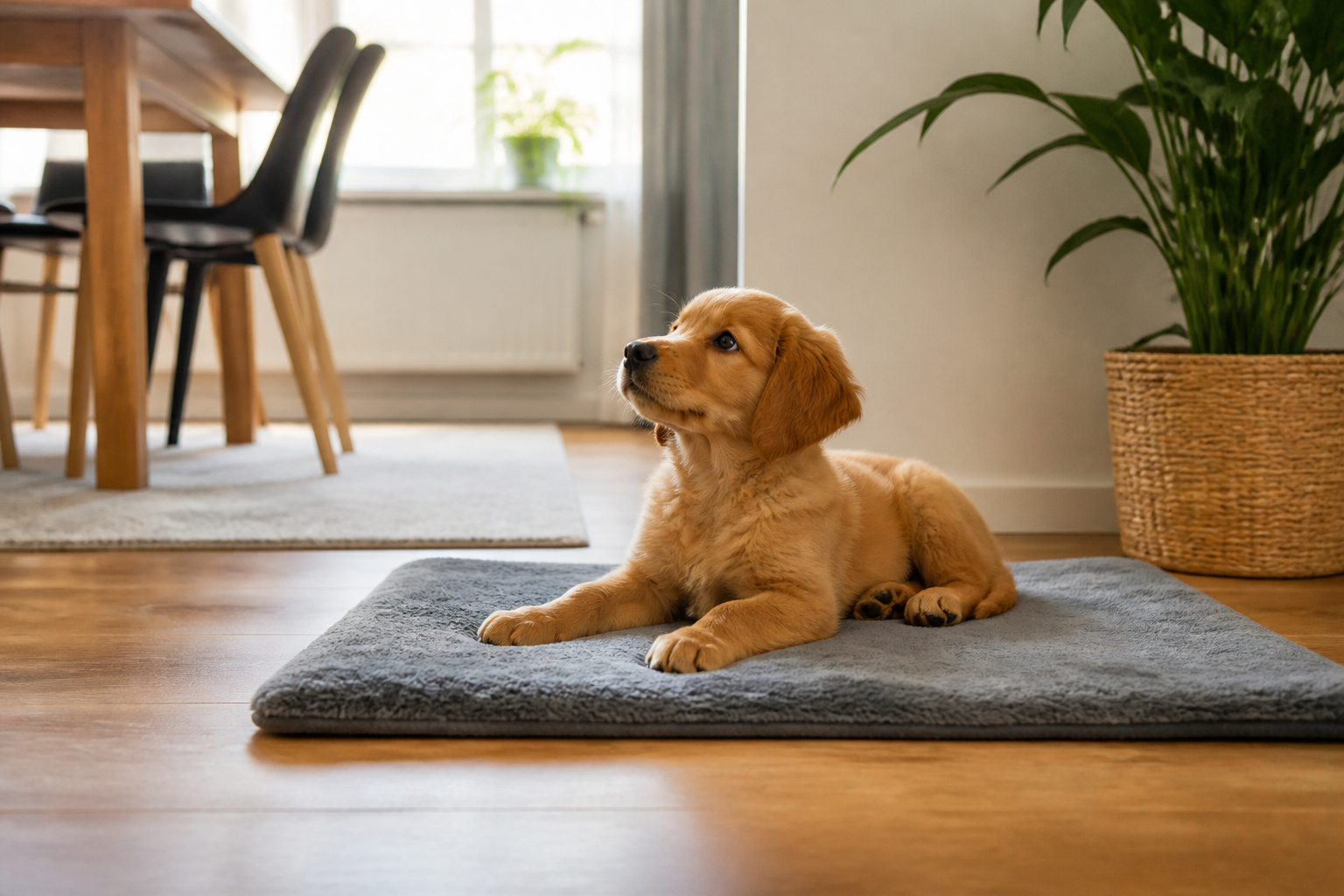
Settling is different from forcing a puppy to stay frozen. A young dog may shift position, look around, or briefly lift its head while remaining comfortably on the mat. The goal is emotional calm and voluntary relaxation, not rigid obedience. Begin when your puppy is rested enough to learn but not so tired, hungry, or excited that concentration is difficult.
Choose a mat with a nonslip base and a washable surface. It should be large enough for the puppy to lie down fully, yet easy to carry. Avoid loose strings, stuffing, or materials the puppy might swallow. Place it first in a quiet area with minimal distractions. Keep tiny, soft treats ready, and remove the mat if chewing becomes unsafe.
Build a Positive Association
Reward Investigation
Put the mat on the floor and allow your puppy to investigate. Do not lure the puppy onto it repeatedly or push its body into position. The moment the puppy looks at, approaches, sniffs, or touches the mat, mark the behavior with a calm word such as “yes,” then deliver a treat beside the mat or directly on it.
At this stage, the puppy does not need to lie down. You are teaching that the mat predicts good outcomes. Deliver rewards calmly rather than waving food excitedly. If the puppy walks away, pause and wait. You can reward another approach later. Several brief sessions are more useful than one prolonged session.
Reward Each Paw
Once your puppy willingly approaches, reward a paw touching the mat. Then wait for two paws, three paws, and finally four paws. Do not rush through these stages if the puppy is uncertain. Keep your hand quiet and place each treat low, so the puppy remains oriented toward the mat instead of jumping upward.
An observable checkpoint is that your puppy repeatedly steps onto the mat without following a food lure. When this happens, say your chosen cue, such as “mat,” just before the puppy moves toward it. The cue should describe an action the puppy already understands, not a demand attached to confusion.
If the puppy hesitates after you add the cue, return to rewarding approaches for a few repetitions. The adjustment is simple: make the task easier, then rebuild gradually. Avoid repeating “mat” several times, because repetition can teach the puppy that the first cue is optional.
Shape a Down Position
Capture Calm Movement
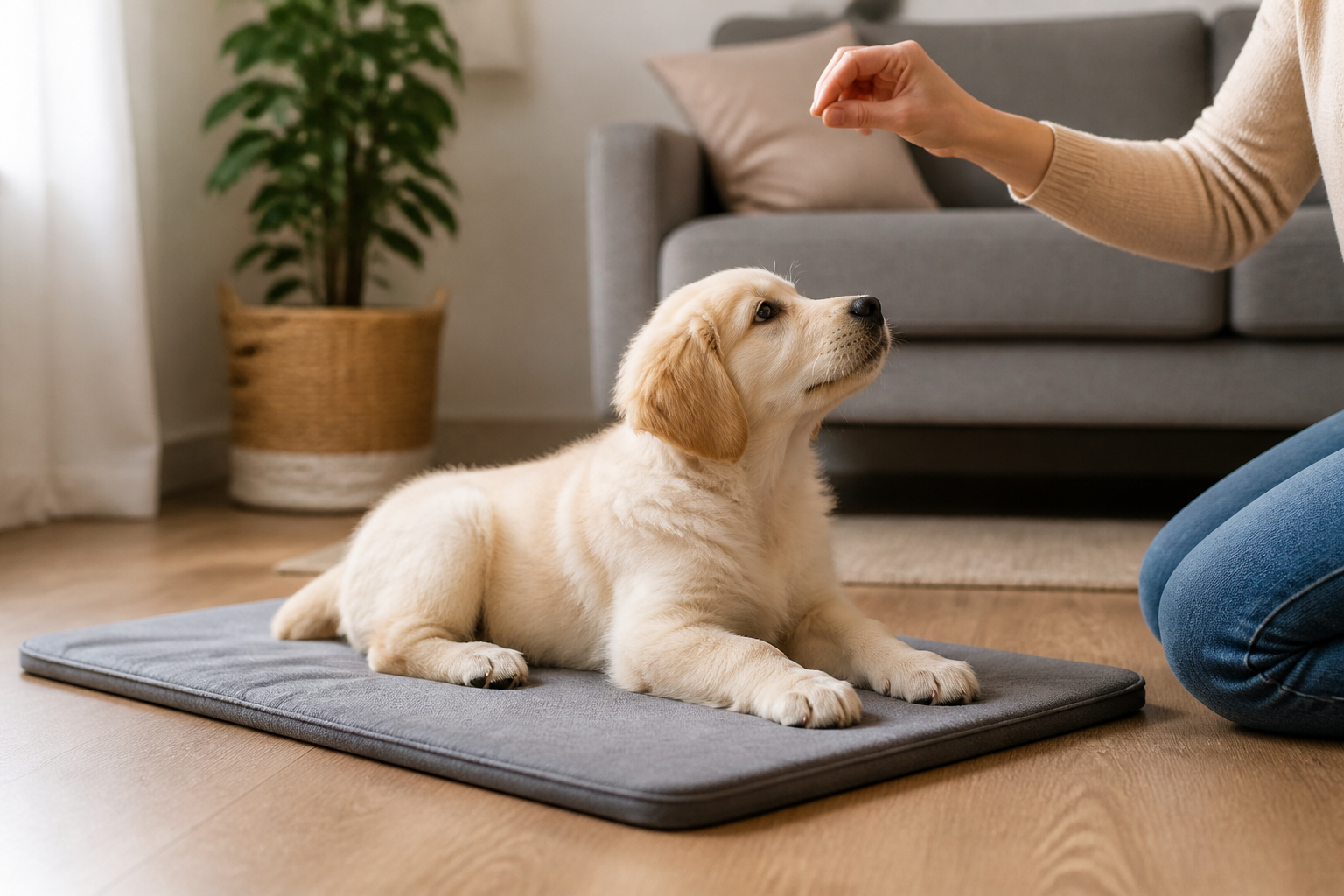
When all four paws are comfortable on the mat, look for natural lowering behavior. Puppies often sit, shift weight, or bend an elbow before lying down. Mark and reward these small signs of relaxation. You may place the treat between the puppy’s front paws to encourage the head and shoulders to lower, but do not force the position.
If your puppy already knows “down,” you can say it once after the puppy reaches the mat. However, mat training should not depend entirely on a formal down cue. The deeper objective is learning that the mat is a place where calm behavior pays.
Reward the completed down generously, using several small treats delivered one at a time. Keep your voice quiet and your movements slow. A large celebration may cause the puppy to spring up, which makes it harder to practice remaining settled.
Extend Time Carefully
At first, reward after only one or two seconds of lying down. Then vary the interval: one second, three seconds, two seconds, and five seconds. Variable timing prevents the puppy from predicting exactly when it may leave. Increase duration in small steps, and reward before restlessness appears.
A useful checkpoint is a puppy that can remain lying down for about ten seconds while you stand nearby, with a relaxed body and occasional soft attention. If the puppy repeatedly stands, the interval is too long, the environment is too stimulating, or the rewards are not valuable enough. Shorten the time immediately and succeed again.
Do not measure progress only by the clock. A puppy that lies quietly for five seconds is learning more than one that remains down for thirty seconds while trembling, staring, or waiting anxiously. Relaxed breathing, a loose posture, lowered hips, and the ability to look away from you are meaningful signs.
Add a Release Cue
A release cue tells the puppy when the exercise ends. Choose a word such as “free” or “all done.” Say it once, then encourage the puppy to leave by tossing a treat away from the mat or moving toward a toy. When the puppy exits, calmly reset the mat and begin again.
The release cue prevents accidental teaching. Without one, a puppy may learn that standing up is how rewards arrive, or that the handler must constantly manage every movement. With a clear ending, the puppy can understand both parts of the exercise: remain settled until released, then move freely.
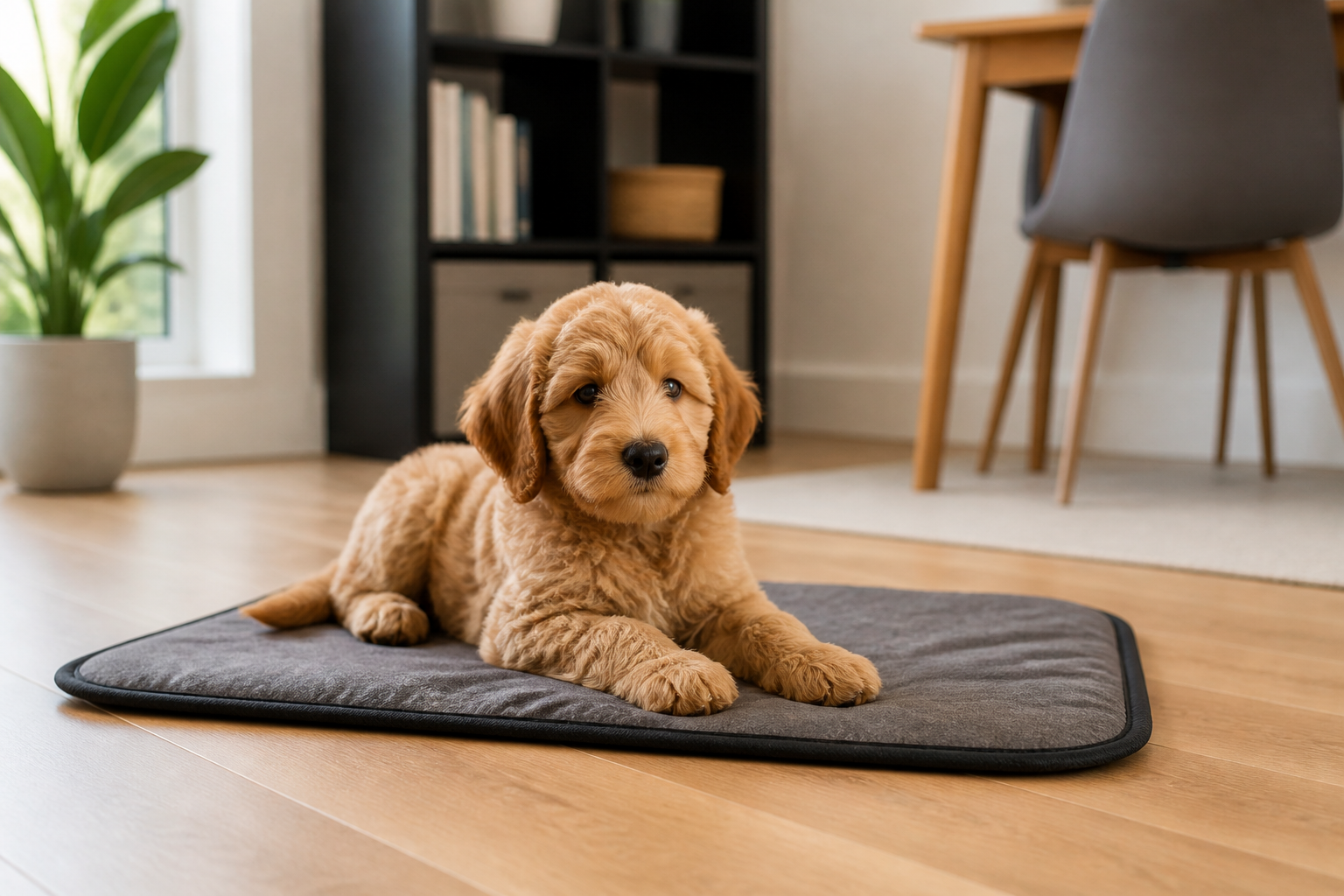
Practice very short repetitions. Ask for the mat, reward a down, wait briefly, release, and pause. Repeat several times. Sometimes release after a few seconds; sometimes continue longer. Always release while the puppy is successful rather than waiting for an unwanted departure.
If your puppy leaves before the release, do not scold. Calmly reduce the duration, improve the reward schedule, or remove a distraction. If the puppy immediately returns to the mat, reward that choice. Your response should make calm reengagement easier than frantic behavior.
Increase Distance and Distractions
Change One Variable
After your puppy can settle beside you, change only one difficulty at a time. You might take one step away, sit in a chair, turn your body, or place a toy nearby. Return and reward before the puppy gets up. Later, practice opening a cupboard, carrying a bowl, or walking past.
Distance, duration, and distraction are separate challenges. Increasing all three together often produces failure. If the puppy can remain settled for one minute beside you, that does not mean it can manage one minute while you leave the room. Build each skill independently.
Use a simple progression. First, move one step away and return. Next, take two steps. Then turn briefly. Later, walk several feet, always coming back before the puppy becomes worried or excited. If the puppy follows, reduce the distance and reward more frequently.
Practice in Real Situations
Transfer the skill to ordinary life. Put the mat near the kitchen while you prepare food, beside your desk during a short work period, or several feet from the sofa while you watch television. Begin with easy moments, not the busiest activity of the day.
For visitors, place the mat away from the doorway. Give the puppy a chance to settle before the doorbell rings. A chew approved for your puppy can make the mat more rewarding, but supervise chewing and choose an item appropriate for the puppy’s size and chewing habits.
For meals, do not expect perfect stillness immediately. Feed occasional treats to the puppy on the mat, then release after a manageable interval. If begging escalates, the session has become too difficult. Put the bowl away, reset calmly, and practice at an easier time.
Use Food, Toys, and Chews Wisely
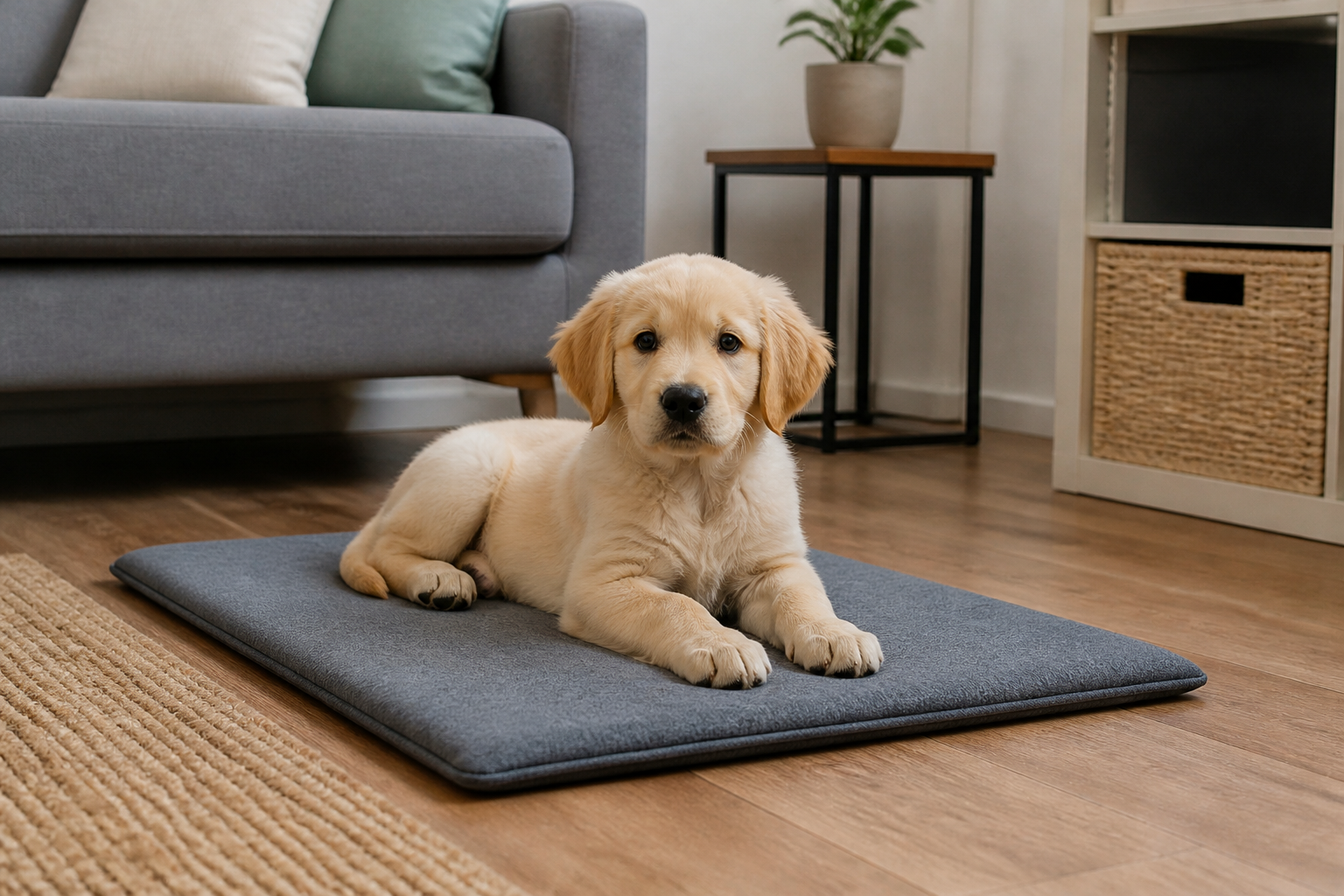
Food is often the clearest early reinforcer, but it should not be the only reason the puppy stays. As the behavior becomes reliable, vary rewards. Deliver treats, offer a chew, provide gentle praise, or release the puppy to sniff and explore. Reinforcement should remain meaningful, especially around distractions.
Place rewards on the mat rather than reaching over the puppy’s head. Overhead hands can encourage jumping or grabbing. Delivering food between the paws supports a lowered posture. If the puppy becomes frantic when treats appear, use smaller pieces, slow your movements, and lengthen the interval only after calm behavior returns.
A chew may promote longer relaxation, but it can also increase guarding or intense excitement in some puppies. Watch body language. Stiffening, freezing, hard staring, growling, or snapping around food requires caution. Do not take valuable items by force. Separate the puppy safely and consult a qualified behavior professional if guarding appears.
Prevent Common Training Errors
One frequent mistake is using the mat only when the puppy is in trouble. If the mat predicts isolation, scolding, or the end of all fun, the puppy may avoid it. Continue rewarding mat behavior during pleasant, low-pressure moments.
Another error is asking for too much too soon. Puppies have developing attention spans and limited emotional regulation. Five successful repetitions of a short settle are usually more productive than one exhausting struggle. Stop while the puppy is still succeeding.
Do not physically place the puppy on the mat and hold it there. Restraint may suppress movement temporarily without teaching relaxation. It can also create resistance or fear. Guide with rewards, shape voluntary choices, and adjust the environment.
Avoid rewarding only perfect stillness. Looking away, sighing, lowering the head, shifting into a hip-down position, or choosing to remain after a mild distraction are valuable behaviors. Mark them quietly. The puppy needs to learn what calm looks and feels like.
Troubleshoot Setbacks
If the puppy will not approach the mat, examine the surface. It may slide, feel hot, trap claws, or carry an unpleasant odor. Try a different texture and place it on stable flooring. Reward near the mat before expecting contact.
If the puppy grabs and shakes the mat, interrupt without anger. Trade for a treat or suitable toy, then remove the mat briefly. Resume with rewards for standing calmly near it. More exercise is not always the answer; overtired puppies often become more mouthy and restless.
If the puppy settles only when food is visible, hide treats in your hand or pocket while continuing to reward from elsewhere. Gradually increase the number of calm seconds between rewards. Do not eliminate food suddenly, especially when distractions are increasing.
If the puppy whines, pants heavily, scans constantly, or repeatedly tries to escape, the task may be causing distress rather than teaching calmness. Lower the difficulty. Use a familiar room, shorten the session, and remain closer. If distress persists in many settings, seek advice from a veterinarian or qualified force-free behavior professional.
Build Reliable Daily Practice
Train for one to three minutes at a time, several times daily. Begin with a few easy repetitions, add one modest challenge, then finish with an easy success. Keep a simple record of duration, distance, distractions, and the puppy’s body language. This helps you identify patterns instead of guessing.
Practice after toileting and a suitable amount of movement, but before the puppy becomes exhausted. Puppies need substantial sleep, and a settling exercise should not replace rest, play, social learning, or exploration. Mat work is one part of a balanced routine.
Everyone in the household should use the same cue and release word. Agree on whether the puppy may leave for water, toileting, or safety without waiting. Consistency matters, but flexibility matters too. A mat is a training aid, not a substitute for responding to genuine needs.
Take the mat to different safe locations once the behavior is established. Use it in another room, on a quiet patio, or near a familiar outdoor area. New places require easier expectations. A puppy may understand the cue at home yet need fresh teaching elsewhere.
Frequently Asked Questions
How old should a puppy be?
You can introduce a mat as soon as the puppy joins your household and can eat treats safely. Early sessions should be brief and playful. Age affects stamina and impulse control, so younger puppies usually need shorter intervals and more frequent movement breaks.
How long should settling take?
There is no universal timetable. Some puppies learn the basic association quickly, while reliable relaxation around distractions takes repeated practice. Progress depends on temperament, sleep, health, environment, reinforcement, and the handler’s timing. Measure gradual improvement rather than comparing your puppy with another dog.
Should I use a crate instead?
A crate and a mat serve different purposes. A crate provides a secure, enclosed management space, while a mat teaches calm behavior in an open area. Many puppies benefit from learning both. Never use either place as punishment, and follow appropriate safety guidance for confinement.
What if my puppy keeps leaving?
Make the exercise easier. Shorten the duration, move closer, reduce distractions, and reward more often. Check that the puppy does not need to toilet, drink, sleep, play, or investigate something important. If leaving continues, avoid repeatedly cueing; reset the environment and rebuild smaller steps.
Can I use the mat for visitors?
Yes, but introduce visitors gradually. Practice the mat routine without guests first, then add quiet movement at a distance. During an actual visit, use barriers or a lead if needed for safety, and release the puppy for calm greetings only when its body language is relaxed.
Should I say “stay”?
You may, but it is not essential. A mat cue plus a release cue can communicate the behavior clearly. If you use “stay,” teach it separately and avoid repeating it. The important result is voluntary settling, not the number of commands spoken.
Conclusion
Mat training works best when it is built through small choices, clear rewards, and careful adjustments. Start by making the mat valuable, shape four paws and then a comfortable down, introduce a release cue, and increase duration, distance, and distractions separately. Reward relaxed body language, protect the puppy from overwhelming situations, and treat setbacks as information about difficulty rather than disobedience.
With regular, brief practice, the mat can become a familiar signal for rest in many parts of daily life. Continue meeting the puppy’s needs for sleep, movement, play, toileting, companionship, and safe exploration. Calm behavior grows most reliably when training supports the whole puppy, not when stillness is demanded in isolation.