Why “Leave It” Matters
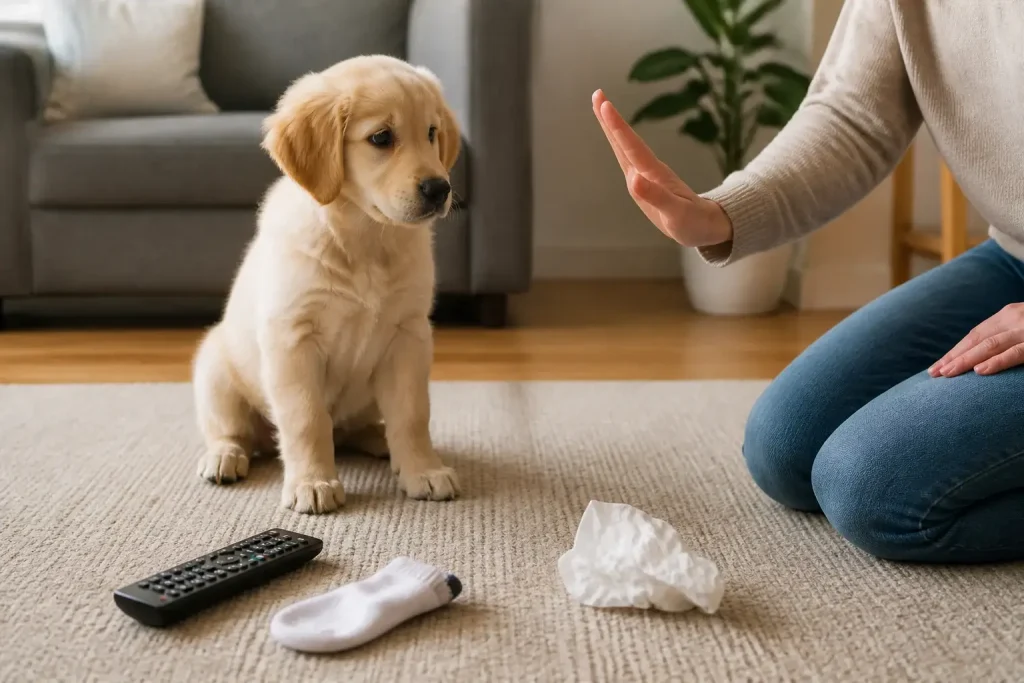
Teaching a puppy to leave items alone is more than an obedience exercise. It helps prevent choking, poisoning, damaged belongings, and tense confrontations over objects. The goal is not to frighten a puppy away from interesting things. It is to teach a reliable choice: notice an item, pause, and turn toward you for something better.
Begin with safe, ordinary objects and highly rewarding treats. Keep sessions brief, calm, and frequent. Puppies learn through repetition, but their attention span is limited, so several one- or two-minute practices usually work better than one long lesson. Use the same cue, reward generously, and manage the environment while the behavior develops.
“Leave it” means do not approach or touch an item. It differs from “drop it,” which means release something already held in the mouth. Both cues are useful, but teaching them separately makes each instruction clearer.
Prepare for Successful Training
Choose rewards carefully
Use small, soft treats that your puppy can eat quickly. The reward should matter more than the low-value item you are asking the puppy to ignore. If your puppy is distracted by food, a favorite toy, praise, or a brief game may work better. Rewards should be appropriate for the puppy’s diet, and treats should be included within the daily feeding plan.
Control the setting
Start indoors in a quiet room with few distractions. Place the puppy on a comfortable surface and remove dangerous objects before practice. Have treats ready in a pocket or container, but avoid waving them around constantly. Training should feel predictable rather than frantic.
Select an object that is safe, boring, and easy for you to control. A plain toy or folded cloth is preferable to a sock, medication package, electrical cord, or anything that could create an emergency. Never use a harmful object as a training prop.
Observe the puppy’s state
A tired, hungry, or overstimulated puppy may struggle to respond. Practice after a short rest, not when the puppy is racing around or becoming nippy. Watch for signs that the lesson is too difficult, including repeated lunging, whining, frantic movement, or inability to eat. End calmly and try an easier version later.
Teach the Basic Leave-It Exercise
Step one: reward disengagement
Hold a treat inside a closed fist. Let your puppy sniff, lick, or investigate without scolding. Say nothing at first. The instant the puppy moves the nose away, even briefly, mark the moment with “yes” or another consistent marker, then give a different treat from your other hand.
The important sequence is: investigate, disengage, marker, reward. Do not open the fist while the puppy is pushing against it, because that can teach persistence. Repeat until the puppy quickly backs away or looks at you after noticing the closed hand.
Step two: add the cue
When disengagement happens reliably, present the closed fist and say “leave it” once. Wait. As soon as the puppy withdraws, mark and reward. The cue should come before the behavior, not after the puppy has already turned away.
If the puppy continues investigating, remain still. Do not repeat the cue rapidly. A repeated command can become background noise. Instead, wait a few seconds, make the exercise easier, or reset without frustration.
Step three: open your hand
Place a treat on your open palm and cover it quickly if the puppy tries to take it. Say “leave it” once. When the puppy pauses or looks away, mark and reward from the opposite hand. Gradually increase the time your palm remains open.
This stage teaches that the visible treat is not automatically available. It also teaches the puppy that the reward comes from you, rather than from grabbing the forbidden item. Progress in tiny increments. A puppy that succeeds for one second is ready for perhaps two seconds, not necessarily ten.
Step four: place the item on the floor
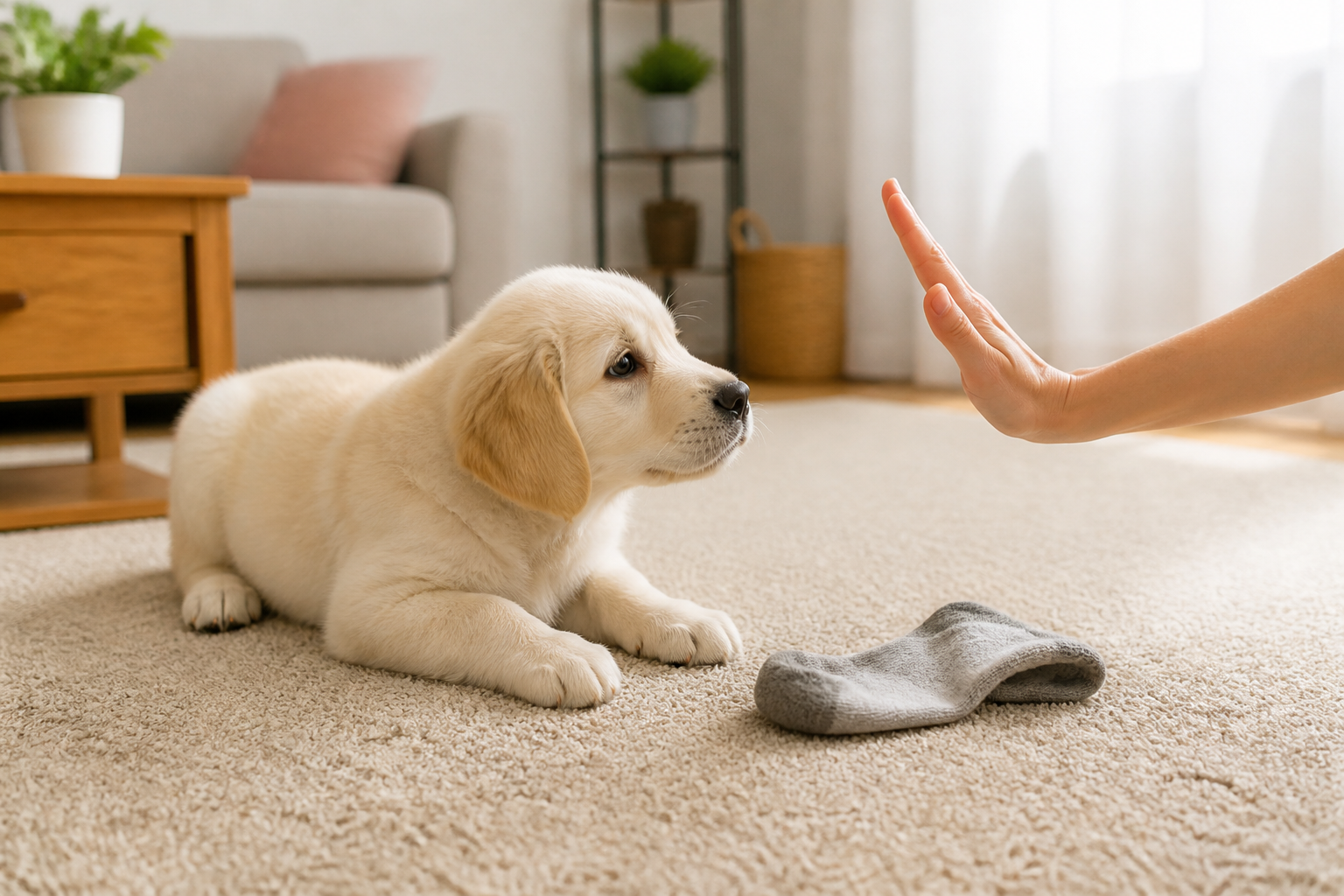
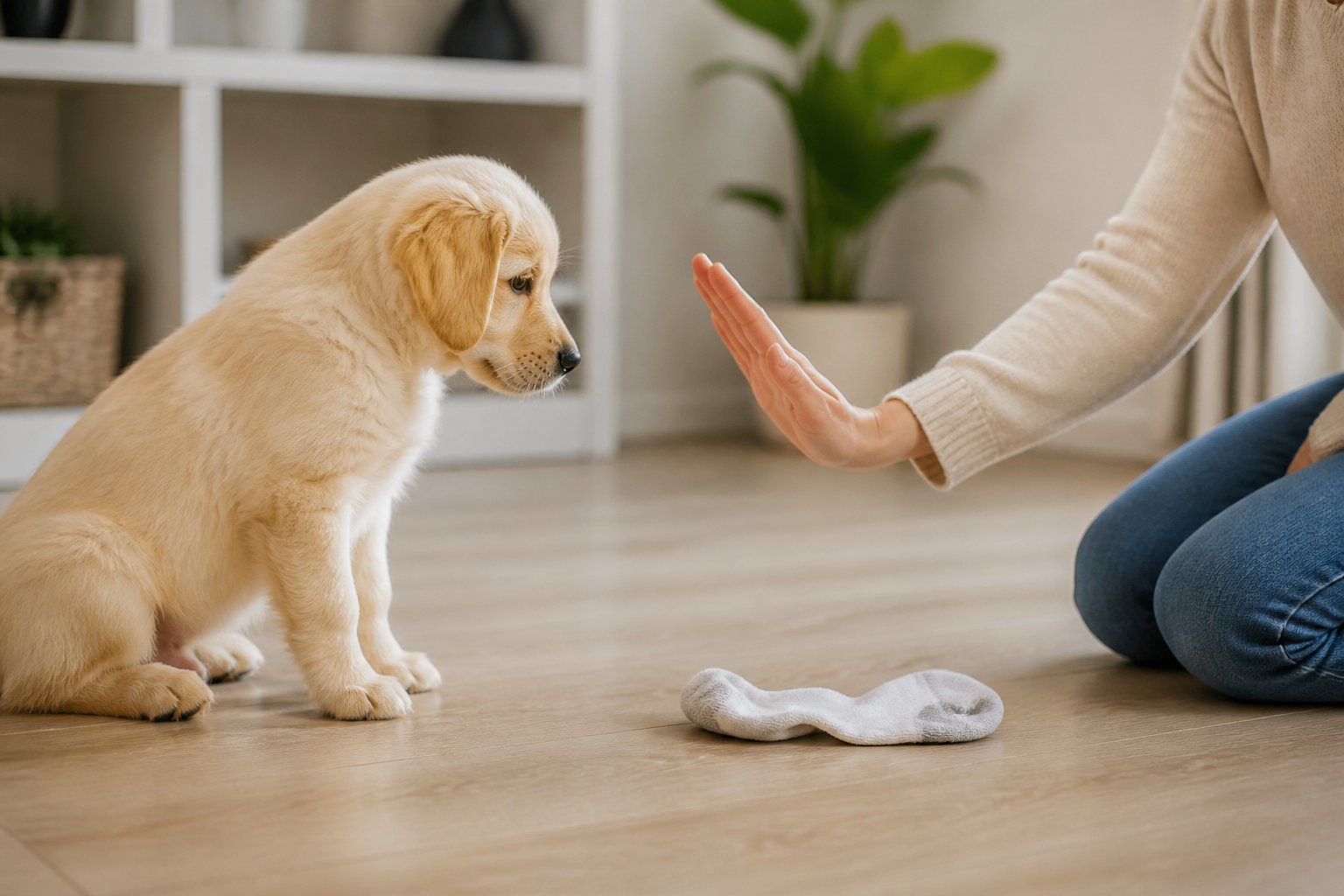
Put a low-value object on the floor and keep your hand near it. Give the cue once. If the puppy moves toward the object, calmly cover it with your hand or use a leash to prevent contact without jerking. The instant the puppy turns away, mark and reward.
When this is easy, stand upright, increase distance, and practice from different angles. Change only one difficulty at a time. You might first increase distance, then add movement, and only later introduce mild distractions.
Build Reliability in Daily Life
A cue learned beside a quiet kitchen table may not work in a garden, hallway, or busy park. Dogs do not automatically generalize a behavior to every location. Practice in several rooms, then in controlled outdoor areas. Keep the first repetitions in each new setting simple.
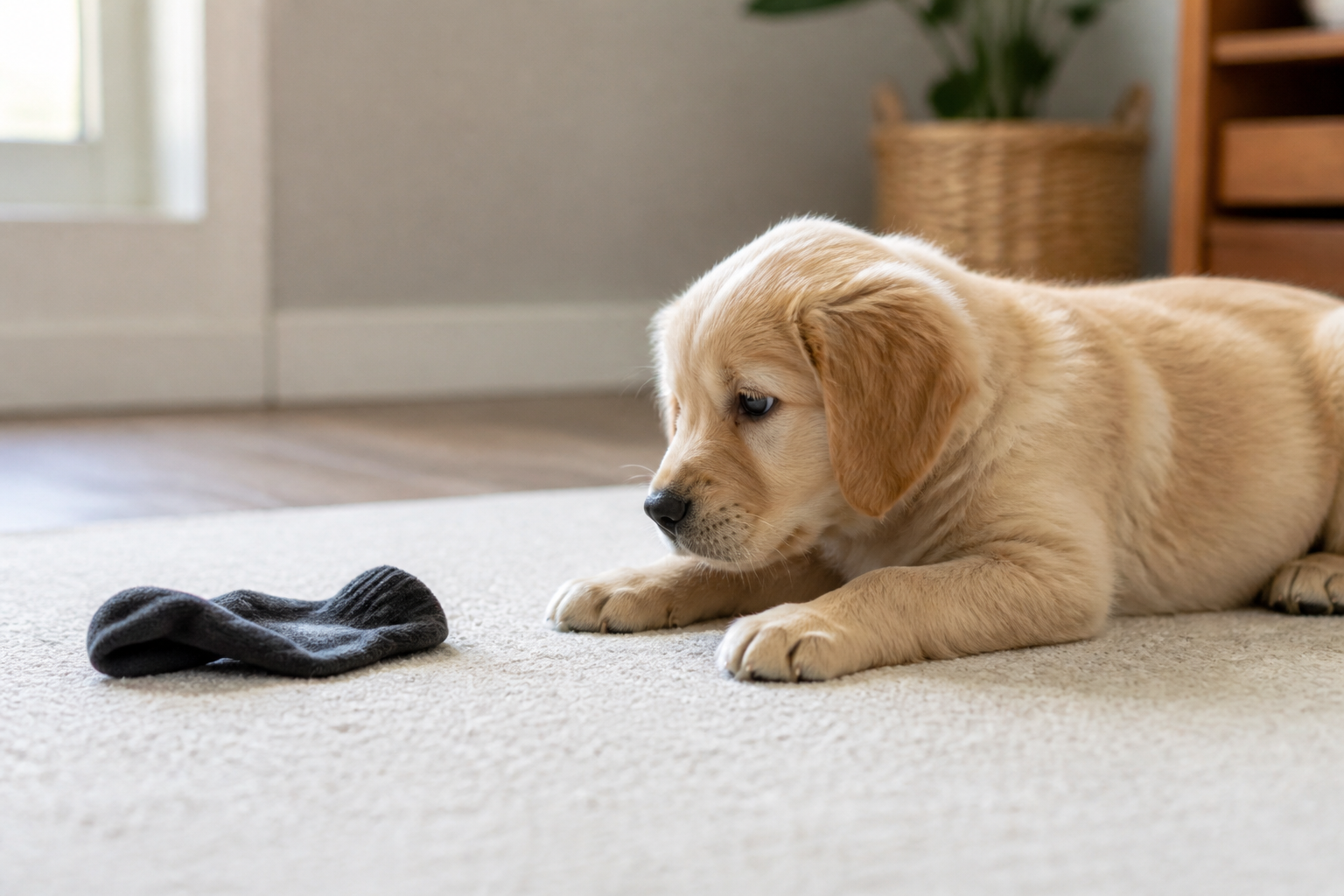
Use real-life opportunities carefully. If a puppy notices a leaf, paper scrap, or safe toy, say “leave it” before the puppy reaches it. When the puppy chooses to turn toward you, reward immediately. Avoid testing the cue around dangerous objects until the response is strong and you can safely control access.
Add movement gradually
Many puppies can ignore a stationary object but chase a moving one. Begin by sliding a toy a short distance while holding the leash or maintaining a safe barrier. Cue the puppy before movement, then reward stillness or orientation toward you. Later, increase speed and distance in small steps.
Do not wave an exciting toy directly in the puppy’s face and expect self-control immediately. If the puppy repeatedly fails, reduce movement, use a less exciting object, or increase the reward value for turning away.
Practice with food
Food on the floor is especially difficult. Start with a treat covered by your hand. Progress to an uncovered treat while your foot is ready to block access. Eventually, place food farther away and reward the puppy for looking at you.
Never allow practice to become a race in which the puppy repeatedly reaches the food first. Management is part of teaching. Use a barrier, leash, or closed room whenever necessary.
Reward generously, then vary rewards
At first, reward every correct response. Once the puppy is dependable, continue rewarding often but vary the reward: a treat, praise, a toy, permission to sniff, or movement away from the distraction. Do not reduce rewards abruptly. Intermittent reinforcement can maintain a learned behavior, but a young puppy still needs frequent feedback while developing accuracy.
Teach “Drop It” Separately
“Leave it” prevents contact; “drop it” ends contact. To teach the second cue, offer a toy that is safe to hold. When the puppy has it, place a valuable treat near the nose. As the mouth opens, say “drop it,” mark the release, and give the treat. Then return the toy when appropriate.
Returning the toy prevents the puppy from learning that releasing always ends fun. It also makes cooperation more valuable than clinging. Do not pull forcefully against the puppy’s grip. Tugging can turn a teaching moment into a contest, and some puppies may swallow or guard the object.
Once the exchange is familiar, present the cue before showing the treat, then reward after release. Keep the trade fair. If the puppy has stolen a valuable item, use a better reward and calmly retrieve it rather than chasing. Chasing often encourages running away.
Prevent Problems Before They Start
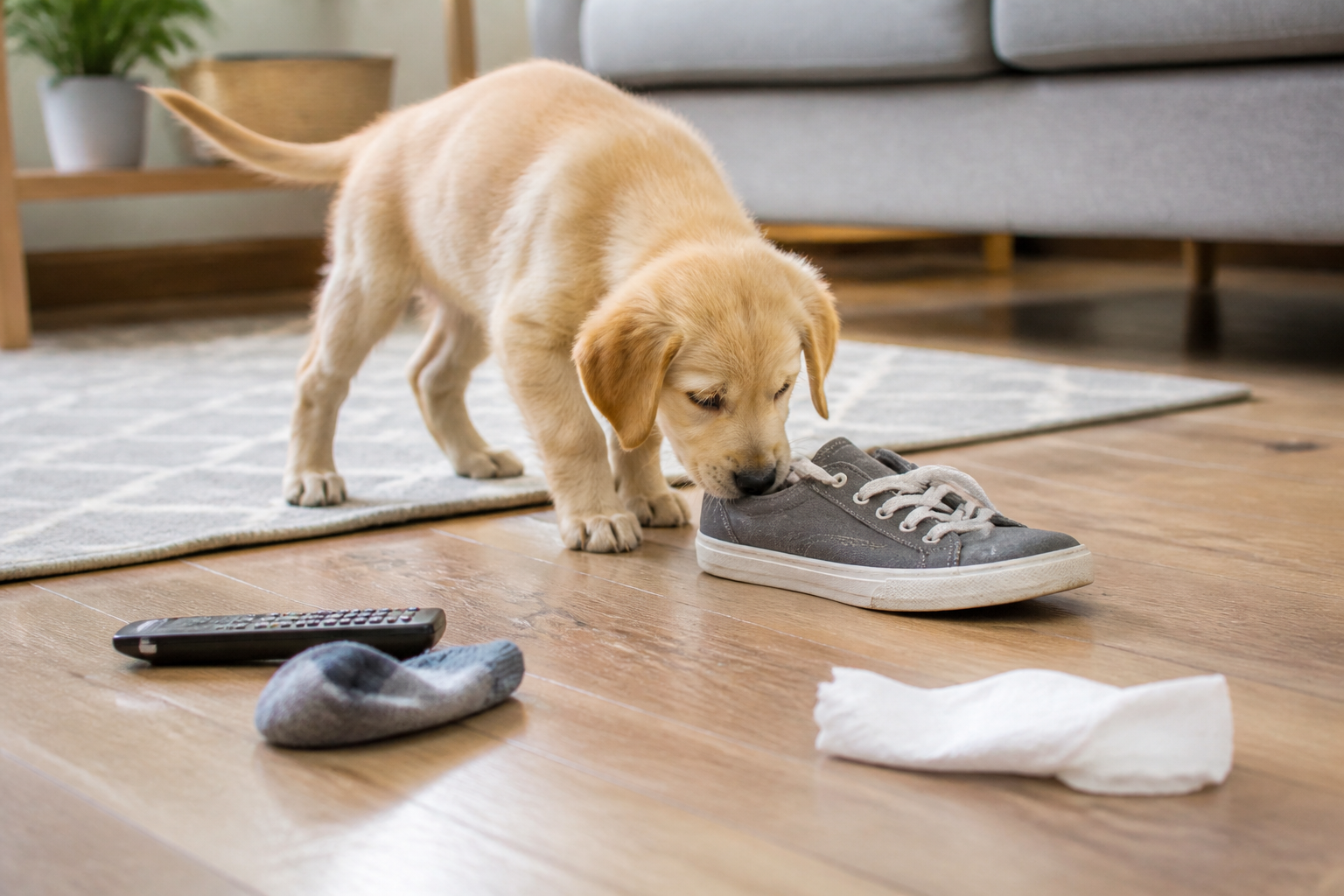
Training works best alongside management. Store shoes, laundry, children’s toys, medications, batteries, cleaning products, and small objects behind closed doors or barriers. Secure electrical cords and inspect the floor at the puppy’s level. Use puppy gates or a pen when direct supervision is impossible.
Provide legal outlets for exploration and chewing. Age-appropriate chew items, food puzzles, and sturdy toys can reduce the appeal of household objects. Rotate available toys so they remain interesting, but check them regularly for loose pieces, sharp edges, or damage.
Supervision does not mean staring at the puppy every second. It means arranging the environment so you can respond promptly. When attention must shift, use a safe confined area with suitable enrichment. Prevention is particularly important during teething, when chewing may increase.
Respond to Mistakes Safely
If the puppy reaches for something harmless, avoid shouting. Block access calmly, cue “leave it” if the puppy can respond, and reward movement away. If the puppy already has the object, trade for food or a permitted toy. Once the puppy releases it, praise the cooperation.
If the item is dangerous, act promptly but avoid creating a chase. Use the highest-value available reward, guide the puppy away, and seek veterinary advice when ingestion may have occurred. Do not induce vomiting unless a veterinarian or appropriate animal poison service specifically directs you to do so. Keep the package or remaining material available for identification.
Never punish growling, freezing, snapping, or guarding. These signals indicate discomfort or conflict. Punishment can suppress warning signs without resolving the underlying concern, increasing risk. Stop the interaction, create distance, and contact a qualified veterinary behavior professional or reward-based trainer for an individualized plan. A sudden change in guarding behavior also warrants veterinary discussion because pain or illness can affect behavior.
Troubleshoot Common Training Challenges
The puppy ignores the cue
The reward may be too weak, the distraction too strong, or the behavior insufficiently practiced. Return to an easier stage and pay immediately for small successes. Check that the cue is brief and consistent. Avoid giving the cue when you cannot prevent access, because repeated failure can weaken its meaning.
The puppy grabs the item first
The setup is too difficult. Use a less interesting object, cover it, shorten the distance, and improve your timing. Reward before the puppy reaches the item. If grabbing has already happened, trade calmly rather than scolding.
The puppy follows the treat instead of leaving
Keep the reward hidden until after disengagement. The puppy should learn to respond to the cue and then receive payment, not chase food as a lure. If necessary, return to the closed-fist exercise.
The puppy becomes frustrated
Frustration may appear as barking, pawing, biting, or frantic movement. Lower the difficulty, increase the speed of rewards, and finish with an easy success. Some puppies need movement breaks between repetitions. Training should challenge self-control without overwhelming the learner.
Progress disappears outdoors
That is normal generalization difficulty, not stubbornness. Begin again in the new environment at an easier level. Reward attention frequently, use a leash where appropriate, and add distractions gradually. Several short sessions across different days are more useful than one demanding test.
Establish a Practical Training Routine
Aim for a few brief sessions each day. Begin with a known behavior, such as looking at you or sitting, then practice several leave-it repetitions. End while the puppy is still engaged. Record simple observations: location, object, distance, response time, and reward used.
An observable checkpoint is a puppy that can notice a low-value object, turn away on one cue, and remain disengaged long enough for you to reward. Once that response is consistent in several calm settings, increase only one challenge: distance, duration, movement, or distraction.
If performance drops, adjust immediately. Move closer, use a better reward, simplify the object, or reduce session length. Reliable behavior is built by successful repetitions, not by forcing a puppy through repeated errors.
Frequently Asked Questions
What age should training begin?
You can begin as soon as a puppy comes home, using gentle, simple exercises. Young puppies may manage only a few seconds of attention, so expectations should match their developmental stage. Early practice should emphasize turning away and checking in with you, not prolonged restraint.
Should I say “no” instead?
A general interruption such as “no” may stop behavior temporarily, but it does not clearly tell the puppy what to do. “Leave it” gives a specific instruction. Pair it with a rewarding alternative, such as looking at you, walking away, or taking an approved toy.
Why does my puppy obey at home but not outside?
Context changes the difficulty. Outdoor smells, movement, sounds, and surfaces compete for attention. Rebuild the skill outdoors from the easiest level, using better rewards and shorter distances. Gradual practice teaches the puppy that the cue applies beyond the original room.
How long will reliable behavior take?
There is no universal timetable. Learning depends on age, temperament, reinforcement, distractions, previous habits, and consistency. Some puppies show quick improvement in quiet settings while needing much longer practice around food or moving objects. Measure progress by successful responses, not by a fixed deadline.
Should I take an object from my puppy’s mouth?
If the object is safe, trading is usually preferable to forcibly removing it. For a dangerous item, prioritize safety, use an especially valuable reward, and contact a veterinarian if swallowing may have occurred. Teach “drop it” during calm practice so emergencies are less likely to become struggles.
What if my puppy guards food or toys?
Do not reach into the mouth, corner the puppy, or punish warning behavior. Prevent access to stolen items, use professional guidance, and arrange a veterinary assessment when guarding is intense, sudden, or associated with pain. A qualified behavior professional can create a gradual desensitization and counterconditioning plan.
Conclusion
Teaching a puppy to leave items alone combines a clear cue, carefully arranged practice, immediate rewards, and sensible management. Start with a closed hand, progress to an open palm and floor objects, then generalize gradually to movement, food, outdoor settings, and everyday distractions. Teach “drop it” separately through calm trades, and never turn object removal into a chase or confrontation.
The most useful adjustment is to make success easier whenever the puppy struggles. Increase reward value, reduce distraction, shorten distance, or return to an earlier step. With patient repetition, the puppy learns that ignoring tempting objects and choosing your guidance leads to safety, rewards, and continued access to appropriate activities.