
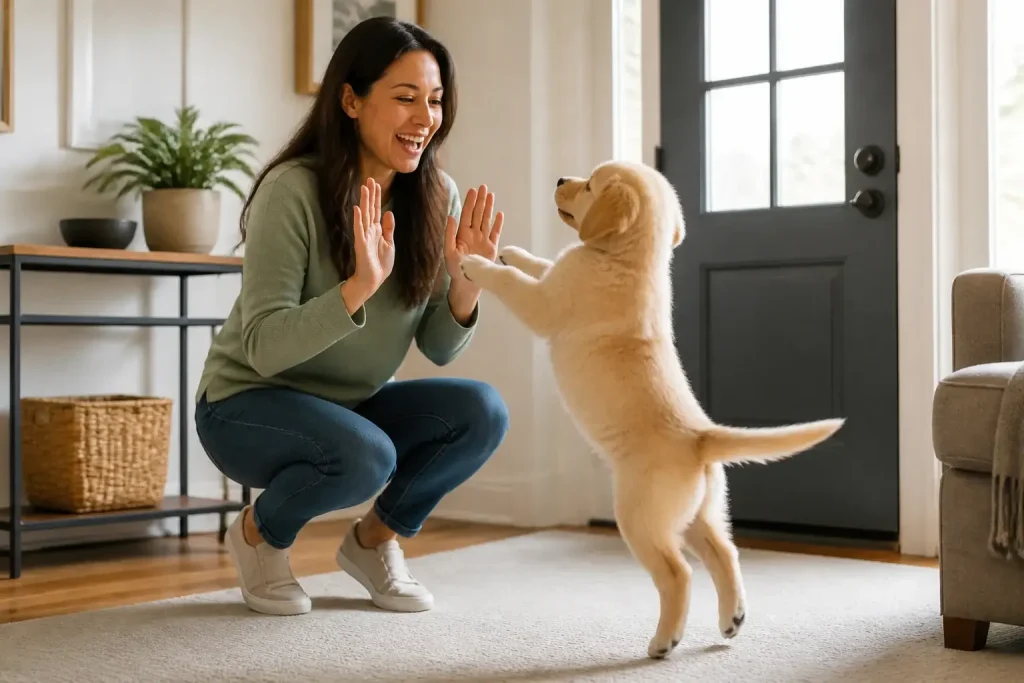
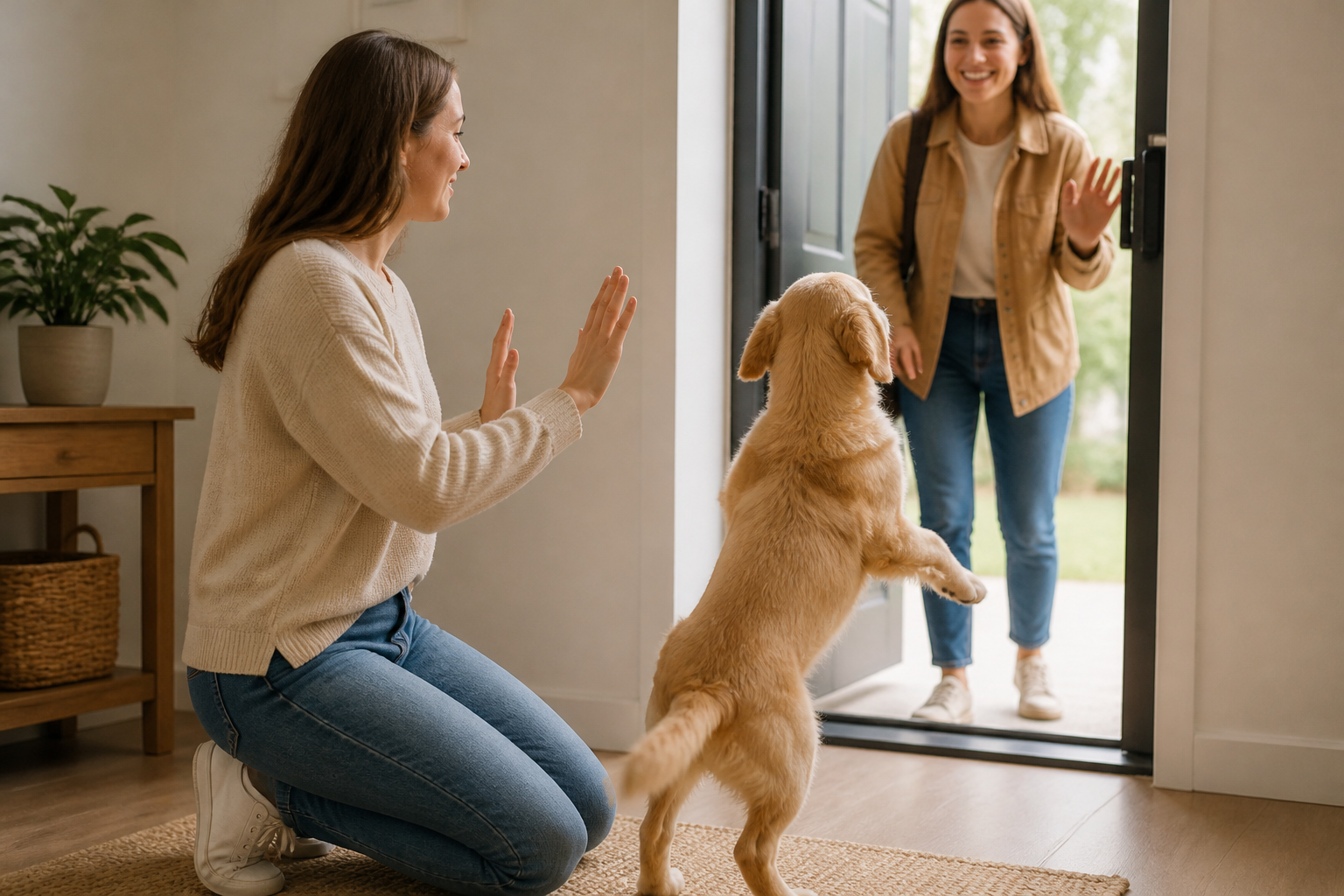
A puppy jumps because greeting people is exciting, movement is rewarding, and attention often arrives when paws leave the floor. The most effective solution is not to frighten, push, knee, or scold the puppy. Instead, prevent rehearsals, teach a behavior that cannot happen at the same time as jumping, and reward calm greetings consistently. Everyone who meets the puppy should follow the same plan, because occasional attention for jumping can keep the habit strong.
The goal is not to suppress friendliness. It is to show your puppy a polite way to say hello. With short practice sessions, suitable management, and rewards delivered at the right moment, most puppies can learn that four paws on the floor make people approachable, while jumping makes attention pause.
Why Puppies Jump
Jumping is usually normal puppy behavior rather than defiance. Puppies investigate the world with their bodies. People are tall, faces are interesting, and reaching upward may have been rewarded when someone bent down, spoke excitedly, or stroked the puppy. A puppy may also jump because greeting creates intense excitement that makes self-control difficult.
Punishment can add problems without teaching a replacement. A pushed puppy may interpret contact as play, while shouting can increase arousal or make visitors frightening. Physical corrections may also damage trust. Calm training gives the puppy clear information: jumping does not produce access, but standing, sitting, or orienting toward a person does.
Look for the reward maintaining the behavior. Common rewards include eye contact, hands, talking, petting, being picked up, access to a visitor, and movement during play. Food can reinforce jumping too if it is offered while paws are airborne. Once you identify the reward, arrange the environment so calm behavior earns it and jumping no longer pays.
Prepare Before Training
Manage greetings
Training works faster when the puppy has fewer chances to practice jumping. Use a baby gate, exercise pen, leash, or closed interior door when visitors arrive. Ask guests to wait while you secure the puppy, rather than allowing an uncontrolled rush to the entrance. Keep treats in several convenient locations, so you can reward appropriate behavior immediately.
Management is not a punishment or a permanent substitute for learning. It is a temporary safety arrangement that protects visitors and reduces repetition. If the puppy is especially excitable, offer a short sniffing walk, quiet exploration, or food puzzle before a planned visitor arrives. Avoid exhausting the puppy through frantic play; overarousal often makes greeting behavior worse.
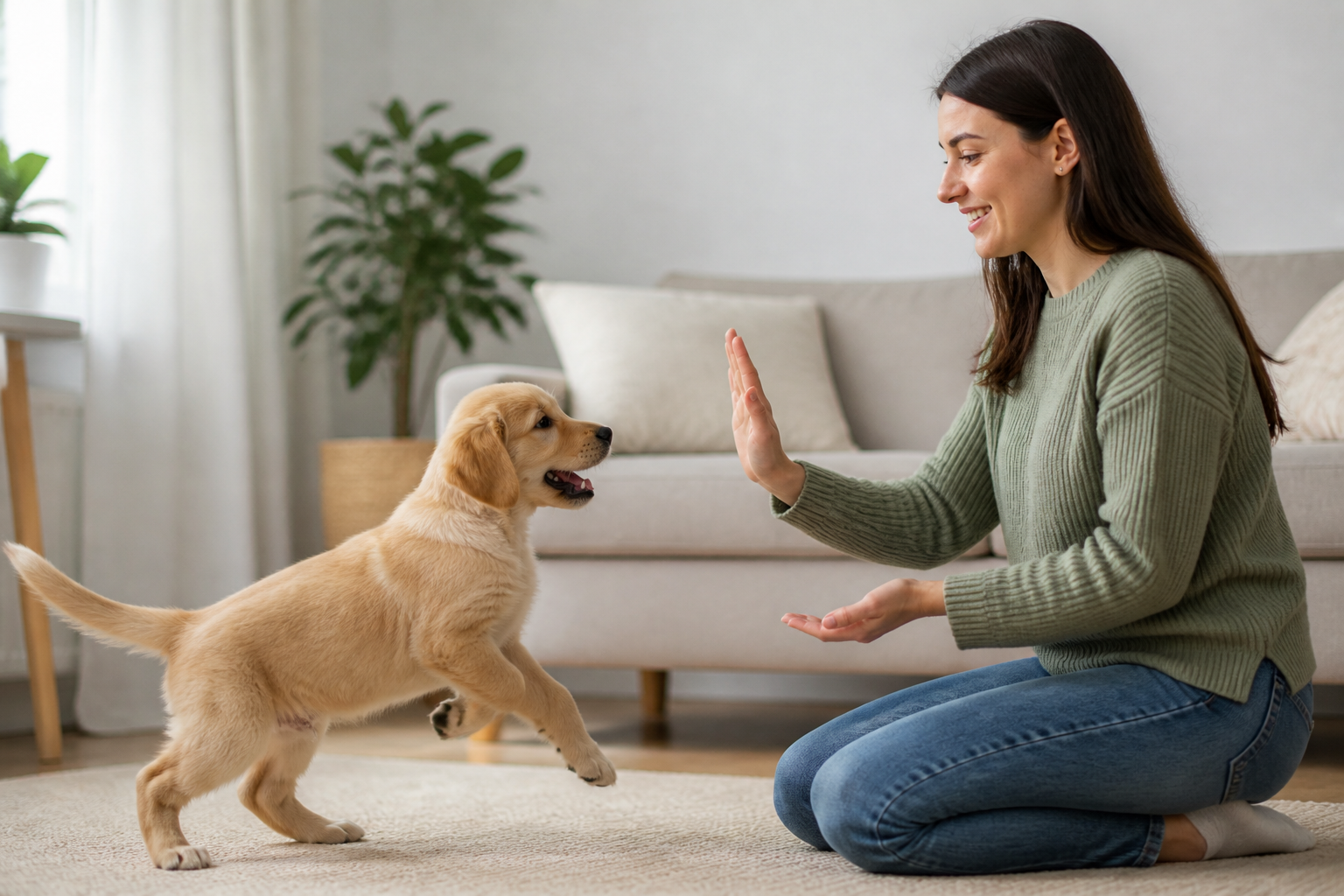
Tell visitors exactly what to do. Ask them to stand still, turn slightly away, keep hands quiet, and avoid speaking to the puppy while paws are off the floor. When the puppy settles, they can calmly reward the greeting. Clear instructions prevent well-meaning people from accidentally reinforcing the unwanted behavior.
Choose rewards
Use rewards your puppy genuinely values, but keep pieces small. Soft food is often convenient because it can be delivered quickly. Toys, access to sniffing, or gentle petting may also work, depending on the puppy and situation. Begin in a quiet area where the puppy can think. If the puppy cannot eat, respond, or remain near you, lower the excitement or increase distance.
A marker word such as “yes” can identify the exact moment of success. Say it calmly, then deliver the reward. A clicker can serve the same purpose if the puppy is comfortable with its sound. The marker is not a command; it tells the puppy which behavior earned the consequence.
Teach Four Paws on the Floor
Start with a familiar person in a low-distraction room. Stand near the puppy and wait. The instant all four paws touch the floor, mark and reward. You do not need to demand a sit at first. Many puppies can learn the essential rule more easily when the initial requirement is simply keeping paws down.
If the puppy jumps, freeze your hands, look away, and wait silently. Do not shove the puppy away, repeat commands, or wave food above its head. The moment paws return to the floor, mark and reward. If jumping continues, calmly step behind a gate or move out of reach for a few seconds, then try again with less excitement.
The checkpoint is observable: after several repetitions, the puppy should begin returning to the floor more quickly and looking toward you for the reward. If progress stalls, the setup is probably too difficult. Increase distance, reduce movement, invite a calmer helper, or reward sooner. Training should create frequent successes, not prolonged battles.
Gradually add mild movement. Walk past the puppy, turn your body, touch the door handle, or speak softly. Mark calm feet after each change. Then increase difficulty one element at a time. A visitor entering, carrying a bag, wearing unusual clothing, or greeting another person can each raise excitement. Separate these challenges rather than combining them immediately.
Add an Alternative Greeting
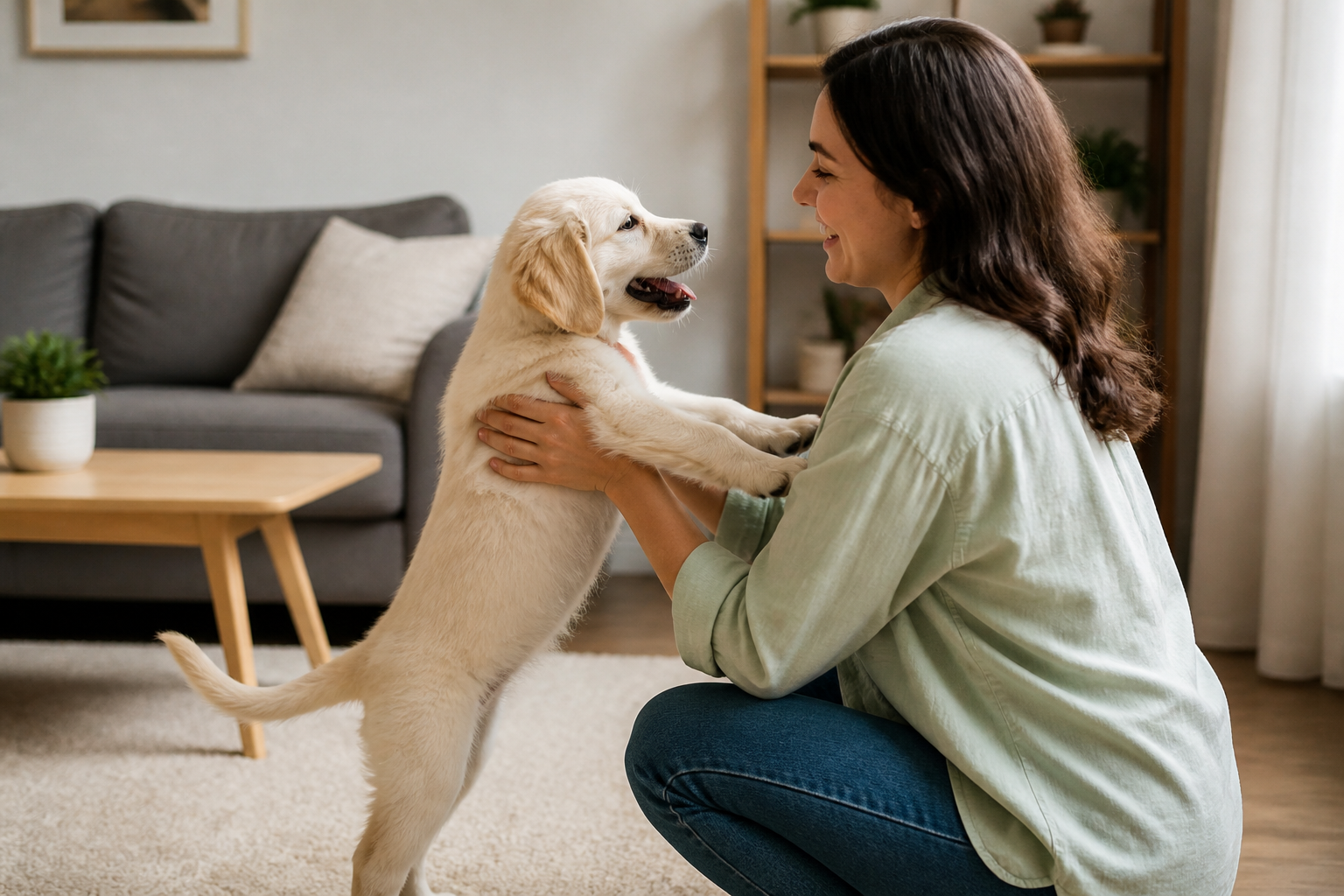
Once floor contact is becoming reliable, teach a behavior that gives the puppy a specific job. “Sit” is common, but standing calmly, touching a hand with the nose, or looking at the handler can be equally useful. Choose a behavior the puppy can perform comfortably and repeat around distractions.
Teach the alternative away from greetings first. Cue the behavior, mark completion, and reward. Practice in different rooms and positions. Then use it when a person is present but still far enough away for the puppy to respond. Ask for one easy repetition, reward, and release the puppy before excitement builds.
For a sit greeting, keep rewards low and close to the puppy’s nose, then deliver them between the front paws or slightly forward. Avoid lifting food overhead, which can encourage jumping. Do not repeatedly command “sit” while the puppy is already bouncing. Pause, create space, and ask once when the puppy is capable of responding.
The useful rule is simple: calm behavior opens the social door. When the puppy sits or stands politely, the person may approach, speak softly, and offer a brief stroke. If the puppy rises and jumps, the person becomes boring and steps back. When calm returns, access resumes. This teaches consequences without intimidation.
Use a reset
A reset should be quiet and brief. Guide the puppy behind a gate or farther from the visitor, wait for relaxed body language, and then offer another opportunity. Avoid dragging, grabbing, or angrily marching the puppy away. The purpose is to reduce stimulation and restore the ability to make a good choice.
A reset is especially useful when the puppy repeatedly launches toward a child, delivery worker, or elderly visitor. Safety comes first. Keep the puppy separated until the person is settled and you can control the interaction. Never require a visitor to tolerate jumping while training is underway.
Practice Real-Life Greetings
Begin with familiar adults who can follow instructions. Have the person approach slowly while you hold a leash attached to a comfortable harness or collar. Keep the leash loose when possible. If the puppy stays grounded, mark and reward. The guest can then offer attention for a few seconds before pausing.
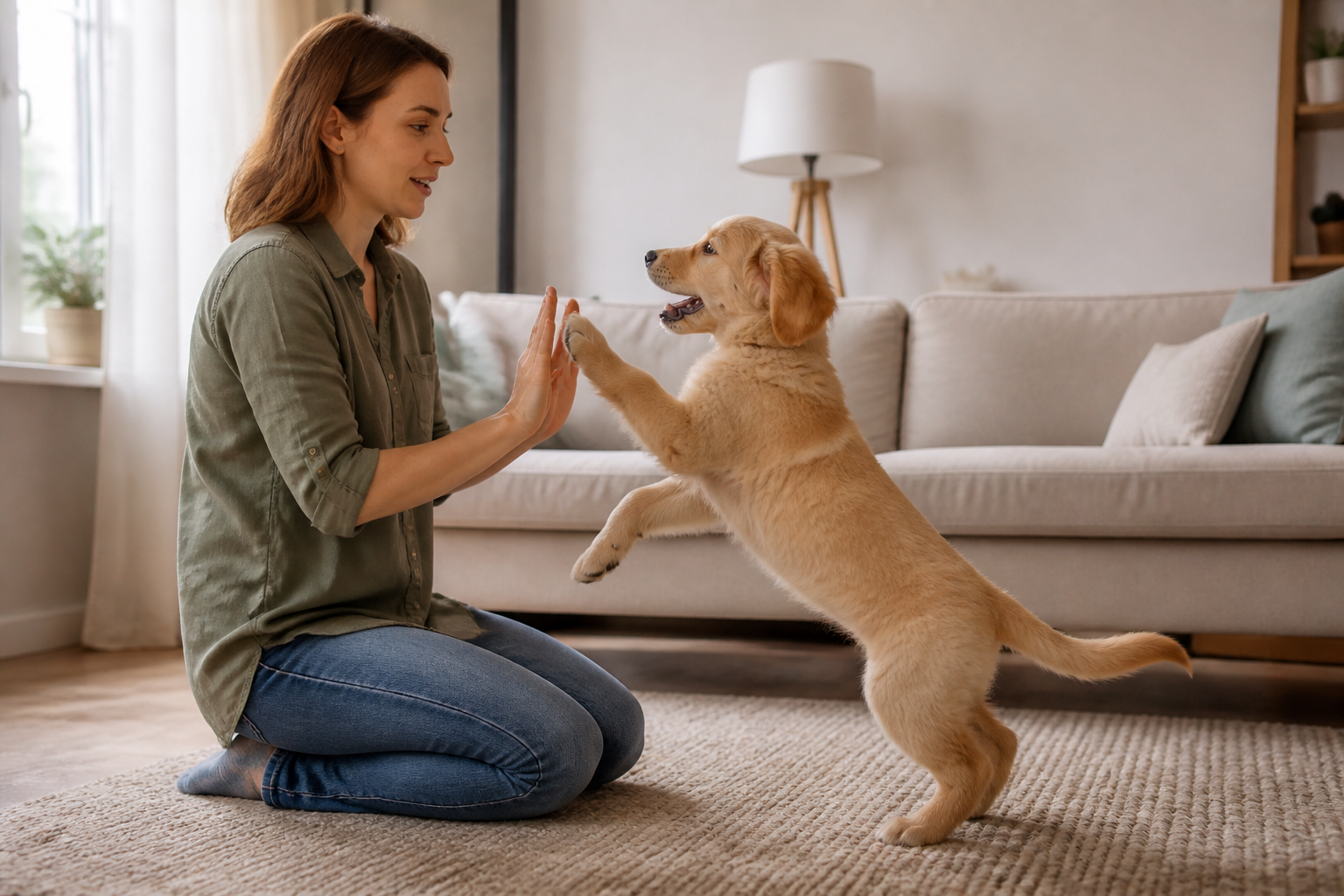
If the puppy jumps, the guest should immediately remove attention by turning away or stepping back. You can guide the puppy to a neutral position without a correction. Wait for four paws down, then reward and invite another approach. Several short repetitions are more effective than one long greeting that ends in chaos.
Train at the door separately. First, touch the handle and reward calmness. Next, open the door slightly, then close it and reward. Later, invite a helper to enter while the puppy remains behind a barrier. The door itself can become a cue for calm observation rather than a signal to explode forward.
Practice with varied people, but progress gradually. A puppy may behave beautifully with family and still jump on strangers, children, people carrying parcels, or someone wearing a hat. Change one variable at a time. Keep sessions brief, and finish after a successful greeting rather than waiting for fatigue or frustration.
Handle Children and Public Spaces
Children often move quickly, squeal, wave hands, or accidentally reward jumping. During training, use barriers and active adult supervision. Ask children to stand still like trees, fold their arms, and look away when the puppy jumps. They should not be responsible for managing the leash. Reward the puppy yourself, and end the interaction if excitement rises.
In public, prevent greetings from becoming automatic. You may tell people, “We are training; please wait for four paws down.” If the puppy cannot remain calm, increase distance or skip the greeting. A dog does not need to greet every passerby. Choosing not to interact is a valid training success.
Carry rewards, but do not use them to lure the puppy continuously toward every person. Luring can produce dependence and may pull the puppy into situations that feel overwhelming. Instead, observe the person from a comfortable distance, reward calm attention, and approach only when the puppy can remain responsive.
Troubleshoot Common Problems
If the puppy jumps more when ignored, the behavior may be experiencing an extinction burst: a temporary increase as the old strategy stops working. Stay consistent, improve management, and reward calm moments generously. If jumping includes biting clothing or painful pawing, create distance promptly and consult a qualified force-free trainer.
If the puppy jumps only on certain people, those people may move, speak, or touch differently. Analyze the trigger rather than labeling the puppy stubborn. Lower the intensity, increase distance, and reinforce an easier behavior. If fear, barking, tucked posture, freezing, or defensive lunging accompanies the greeting, prioritize emotional safety and seek professional guidance.
If food causes frantic behavior, use smaller rewards, place them on the floor, or switch to access to a toy or sniffing. Avoid scattering food where it encourages rushing into people. If the puppy ignores rewards, the environment may be too stimulating, the reward may be unappealing, or the puppy may need rest.
Progress is rarely perfectly linear. Teething, fatigue, new surroundings, visitors, and developmental changes can temporarily reduce self-control. Return to an easier version of the exercise instead of treating a setback as failure. Keep notes about what happened, including distance, visitor movement, and reward timing. Patterns often reveal the necessary adjustment.
Build a Household Routine
Every household member should use the same contingency. Jumping never earns attention; calm feet earn access. Inconsistency is confusing because the puppy learns that persistence may eventually pay. Ask family members to rehearse greetings deliberately rather than correcting the puppy after an accidental jump.
Give the puppy appropriate outlets for energy and social needs. Regular sleep, age-appropriate exercise, chewing, sniffing, and reward-based training support self-control. These activities do not replace greeting practice, but they make learning easier. Avoid deliberately hyping the puppy before training to test obedience.
Keep expectations realistic. A young puppy may need physical management for months while skills mature. “Polite” does not mean motionless or silent. A wiggling puppy can still greet appropriately if paws stay grounded and the person can choose whether to interact. Reward improvement, not perfection.
FAQ
Should I turn away whenever my puppy jumps?
Usually, yes, if turning away safely removes attention and does not increase excitement. Keep your body neutral, protect clothing and skin, and wait for paws to return to the floor. Then mark and reward promptly. If turning away makes the puppy chase or bite, use a gate, leash, or increased distance instead.
Is pushing a puppy down harmful?
Pushing may be interpreted as play, may frighten the puppy, and does not explain what to do instead. It can also place hands near an excited mouth. A safer plan is to become boring, create space, and reinforce grounded feet or another trained greeting behavior.
Should I always require a sit?
No. A sit can be useful, but it is not the only polite option. Some puppies find sitting difficult when excited, and forcing repeated sits may create frustration. Four paws on the floor, standing calmly, or orienting toward the handler can be practical alternatives.
How long will training take?
The timeline varies with age, temperament, practice quality, and how consistently jumping is prevented from earning rewards. You may see improvement quickly in controlled sessions, while reliable behavior around exciting strangers takes longer. Measure progress by shorter jumping episodes, faster recovery, and more successful greetings.
What if guests ignore my instructions?
Use management before opening the door. Keep the puppy behind a barrier or with you on leash, and do not allow an uncontrolled greeting. You can ask the guest to wait, postpone interaction, or meet outside after the puppy has settled. Protecting the training plan is reasonable.
Can treats create dependence?
Rewards do not inherently create dependence when they are gradually varied and paired with natural consequences, such as access to greeting or sniffing. Over time, reduce food frequency while continuing to reinforce unexpectedly. Maintain the behavior through attention, movement, play, and opportunities the puppy values.
Conclusion
Stopping puppy jumping without punishment requires a clear exchange: jumping makes attention pause, while calm feet make attention available. Prevent rehearsals with barriers and leashes, reward the first quiet moments, teach a practical alternative, and increase distractions gradually. Brief resets protect everyone when excitement exceeds the puppy’s current skill.
Success depends less on a perfect command than on consistent timing and thoughtful setup. Make the desired greeting easy, make jumping unrewarding without fear, and involve every person who interacts with the puppy. With patience, supervision, and force-free practice, enthusiastic greetings can become safe, predictable, and genuinely enjoyable for both puppies and people.