
Why Mat Settling Matters
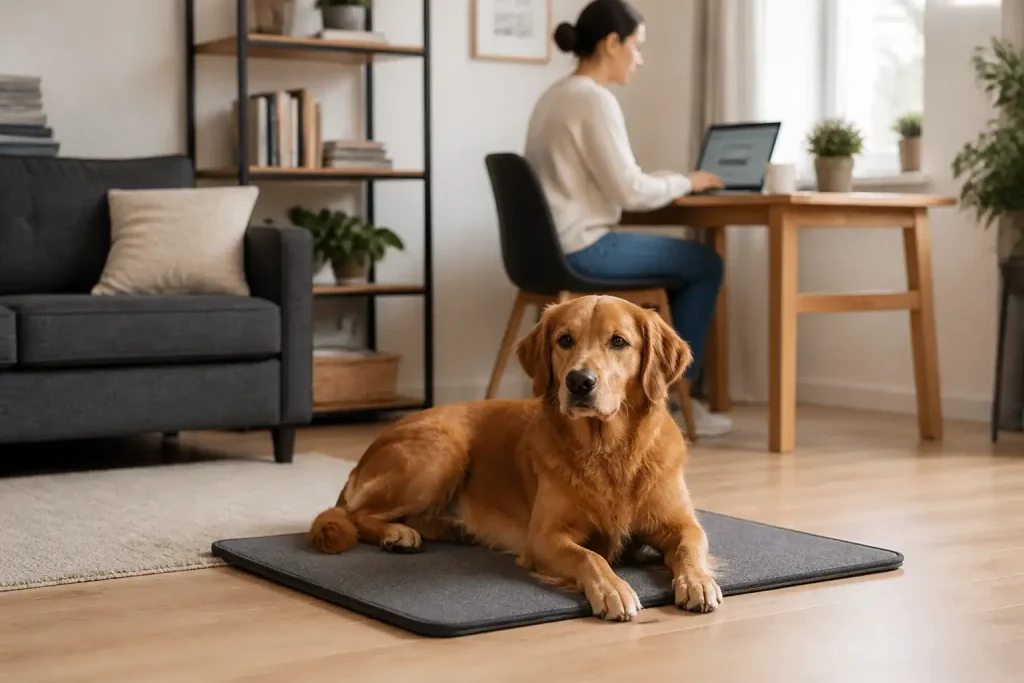
Teaching a dog to settle on a mat around distractions means building a calm, portable behavior rather than demanding perfect stillness. The dog learns that lying on a designated surface is safe, worthwhile, and compatible with activity nearby. This skill can help during meals, remote work, visitors, grooming, training classes, or quiet time in public places. It is not a way to suppress fear, pain, or overwhelming excitement. If a dog is frightened, aggressive, or unable to eat, move farther from the trigger and seek qualified professional guidance.
Begin in a quiet room with a nonslip mat, small treats, and a dog who is comfortable and alert. Keep sessions brief. Success depends on arranging the environment so the dog can respond correctly often, then gradually making the situation harder. Distractions should be introduced one variable at a time, with frequent opportunities to relax.
Choose Equipment and Readiness
Select a mat large enough for the dog to stand, turn, and lie down without slipping. A portable bed can work, but a thin mat often travels more easily and provides a clear visual boundary. Use treats your dog values, delivered in small pieces. A marker word such as “yes” or a clicker can identify the exact moment the desired behavior occurs. A release cue, such as “free,” tells the dog when the exercise ends.
Practice when the dog has had reasonable opportunities to exercise, eliminate, and drink. Avoid beginning immediately after a highly stimulating game or when the dog is exhausted. The goal is relaxed learning, not physical collapse. Watch body language. Soft muscles, normal breathing, a loose mouth, and the ability to take food suggest manageable difficulty. Repeated scanning, lip licking, tucked posture, trembling, barking, frantic movement, or refusal of treats indicate that the setup is too challenging.
Define the Target Behavior
Decide what “settle” means for your household. At first, it may mean placing one paw on the mat. Later, it can mean lying down, remaining there briefly, and relaxing while something mildly interesting happens. Do not require a particular head position or complete immobility unless that detail serves a clear purpose. A dog may shift weight, look around, or adjust its legs while still staying settled.
Write the criteria in observable terms. For example: “All four paws remain on the mat, the dog lies down, and the dog stays until released.” This prevents accidental changes during training. You can temporarily lower the criteria when distractions increase, then rebuild duration afterward.
Build Mat Value
Place the mat on the floor and wait. If the dog looks at it, moves toward it, or sniffs it, mark and reward. Tossing the treat onto the mat can encourage investigation, but avoid repeatedly luring the dog into position if you want an independent response. After several repetitions, pause and allow the dog to choose the mat.
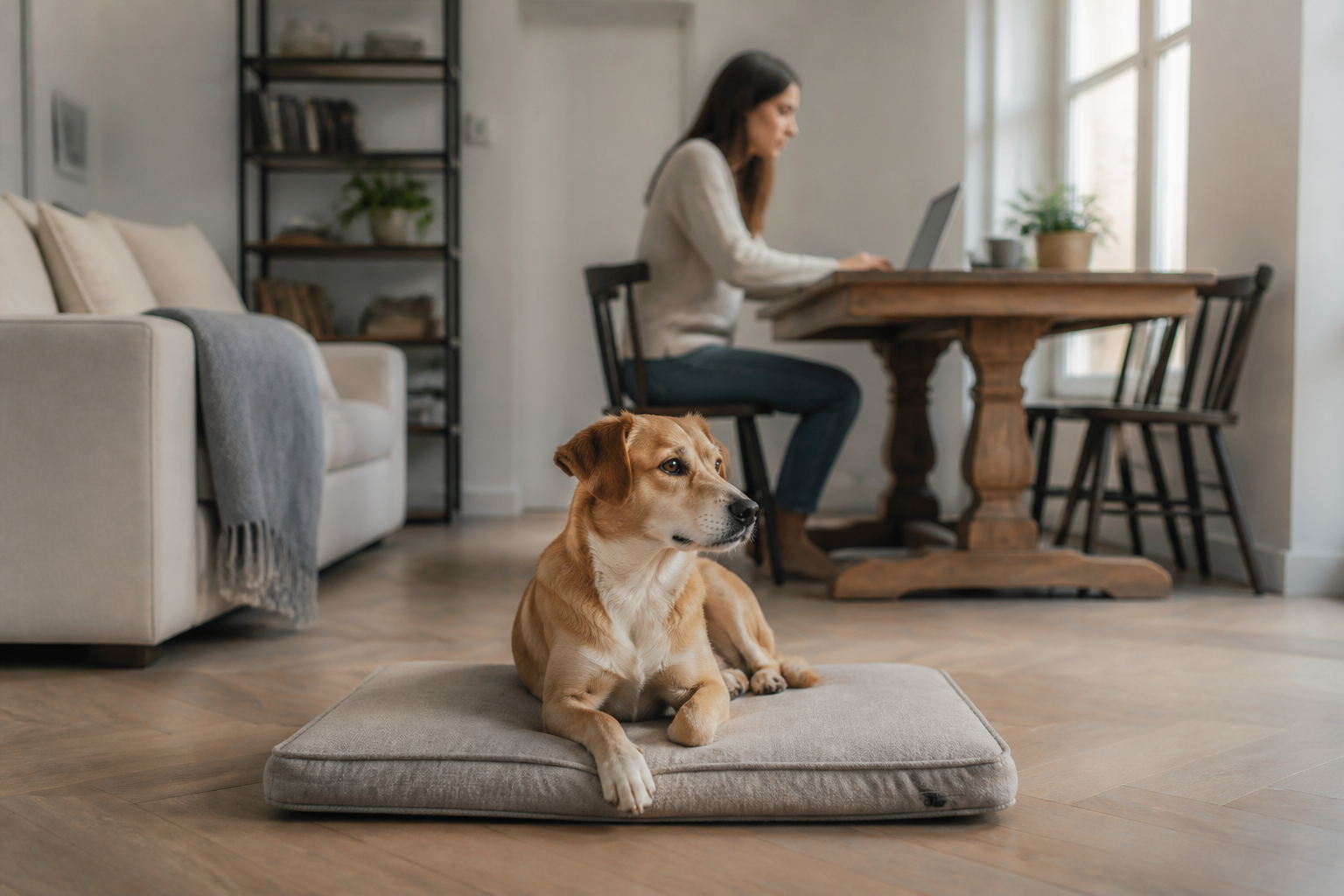
When the dog steps onto it, mark immediately and deliver the treat on the mat. Feeding there matters because it keeps the dog oriented toward the surface and makes leaving less likely. After a few rewards, give the release cue and toss a treat away from the mat. The dog learns two clear events: staying on the mat produces reinforcement, and the release cue permits movement.
Repeat until the dog readily approaches the mat. Then wait for a stand, sit, or down, depending on what the dog naturally offers. Mark the first calm down, reward between the front paws, and release after a short interval. If the dog stands before release, calmly reset without scolding. The exercise should communicate information, not create conflict.
Add a Cue Carefully
Once the dog frequently chooses the mat, say “mat” or another consistent cue just before the dog moves toward it. If the dog does not respond, make the surface easier to notice or guide with a treat once, then return to rewarding voluntary choices. A cue becomes reliable through repeated pairing with a behavior the dog already understands; repeating it loudly will not improve learning.
Practice from different starting points within the same room. Stand beside the mat, sit several steps away, and approach from an angle. Reward orientation, movement, and arrival. Keep the release cue distinct from casual conversation. If the dog leaves early, reduce distance or duration rather than adding restraint.
Shape Relaxed Duration
Duration should grow in small, uneven increments. Reward after one second, then perhaps two, then return to one. Variable timing helps the dog remain engaged without predicting that every repetition will last longer. Deliver food quietly and low between the paws. Excited voices, reaching over the dog, or rapid treat delivery can increase arousal.
Look for relaxation, not merely endurance. A dog staring rigidly at your hand may be technically stationary but emotionally tense. Reward softer signs: lowering the head, sighing, shifting onto a hip, blinking normally, or choosing to remain when food is not immediately visible. These signs may appear gradually and differ among dogs.
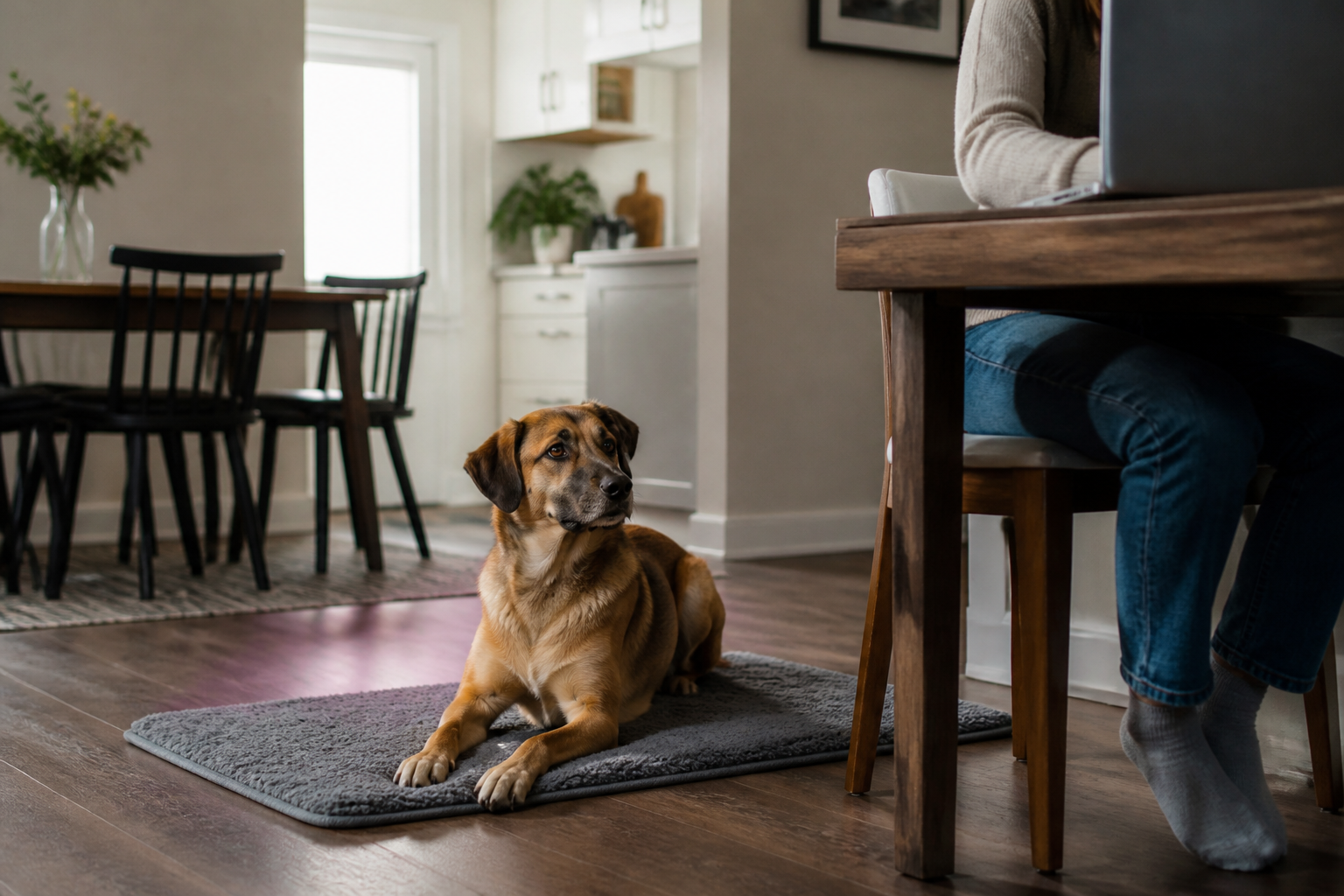
Use a simple pattern: cue the mat, reward arrival, wait briefly, reward calmness, wait again, then release. Occasionally provide several rewards close together when the dog relaxes. At other times, release after a short successful stay. Ending before failure preserves confidence.
Separate the Training Variables
Three major variables affect difficulty: duration, distance, and distraction. Change only one substantially at a time. If the dog can remain for one minute in a quiet room, do not simultaneously add a moving person, move ten feet away, and expect five minutes. Instead, keep the room quiet while increasing distance, or keep yourself close while introducing a mild sound.
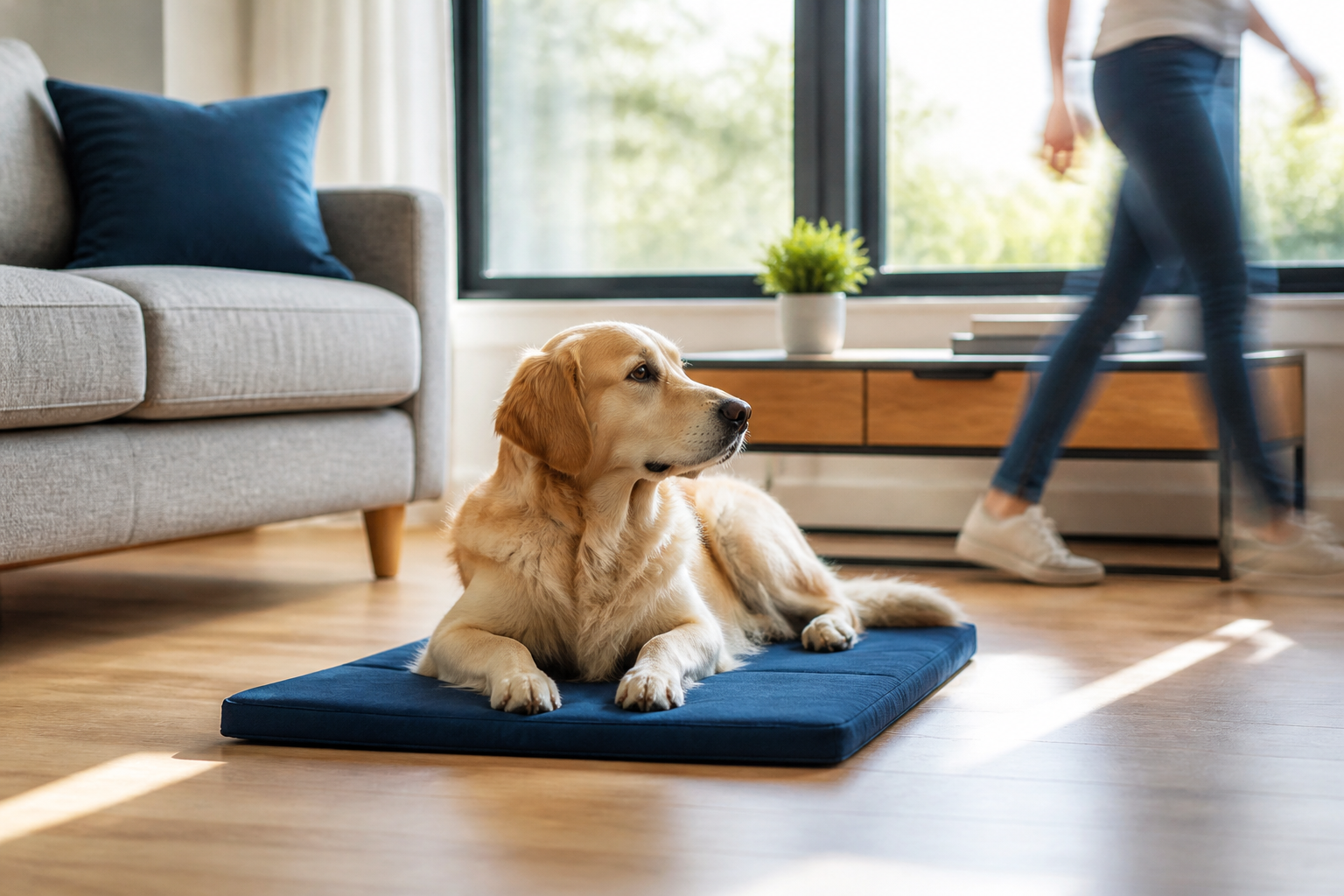
A useful progression might be: quiet room, stationary handler; quiet room, handler seated; handler standing; slow walking nearby; a household member moving; a soft door sound; and a visitor at a distance. This is not a fixed ladder. Some dogs find human movement easy but struggle with food, while others react strongly to outdoor noises. Rank distractions according to your dog’s actual responses.
The observable checkpoint is simple: the dog remains on the mat, accepts food, and can disengage from the distraction to soften or look back toward you. If those conditions disappear, lower the difficulty immediately. Move farther away, reduce movement, block the view, shorten the session, or return to an easier step.
Introduce Distractions Gradually
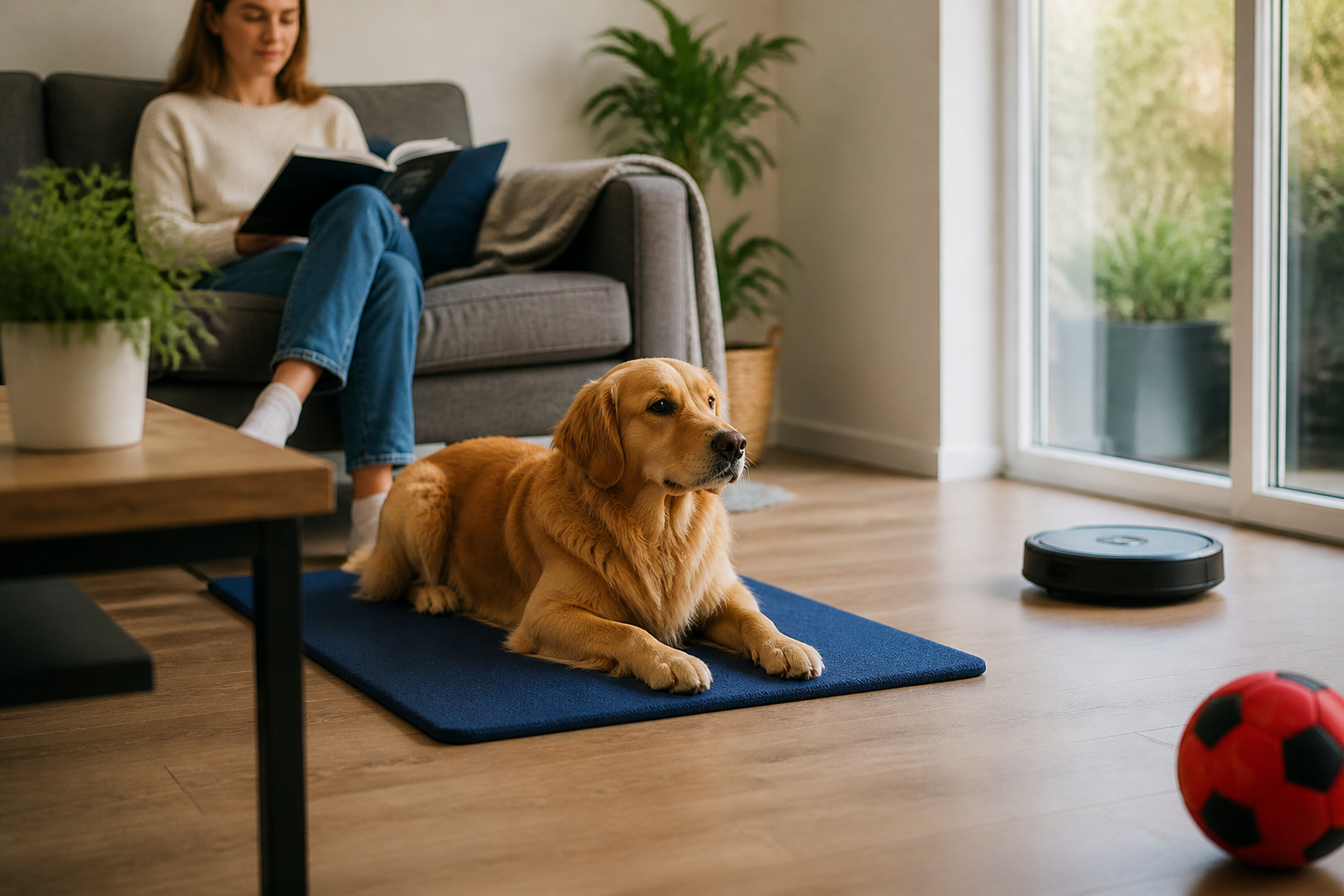
Begin with distractions that are noticeable but not compelling. A person might stand still across the room. A toy could rest on a chair rather than move. A quiet household sound may be played at low volume. Present the distraction for a second, mark the dog’s calm response, and reward on the mat. Then remove or pause the distraction before repeating.
The dog does not need to ignore everything. Looking at a sound or person is normal. The important response is recovery: noticing, remaining safe, and returning attention or relaxation to the mat. Reinforce that recovery rather than demanding constant eye contact. A dog that is allowed to observe without being pulled into the stimulus can learn useful emotional control.
Increase intensity in modest steps. For movement, use slower or smaller motion before faster or closer motion. For sounds, begin quietly and vary the interval. For people, start with one familiar person at a distance, then add standing, walking, sitting, and eventually greetings if appropriate. Keep greetings separate from mat work at first. Release the dog before allowing interaction so the dog does not learn that rushing off produces access.
Use Food Without Creating Frustration
Food can support learning, but its placement and timing matter. Deliver rewards on the mat, preferably near the dog’s front feet, so the dog does not have to leave to collect them. If the dog becomes fixated on your treat hand, hide the food behind your back or use a bowl placed nearby. Mark calm behavior first, then reach for the reward.
For some dogs, food itself creates excitement. Use lower-value treats, increase the interval between rewards, or offer a chew only if the dog can safely consume it without guarding. Never take food away as a test. If resource guarding appears, stop using that item and consult a qualified behavior professional.
Do not use the mat to trap a dog near a frightening stimulus. A settle is useful only when the dog retains the ability to move away and the situation remains below its coping threshold. Management, distance, visual barriers, and professional behavior plans may be more appropriate for intense fear or reactivity.
Practice Real-Life Scenarios
Once the dog succeeds indoors, rehearse situations that resemble daily life. Put the mat beside your desk and stand, sit, and type. Place it near the kitchen but outside walking paths. Ask a household member to move calmly while you reward settling. Later, practice near a quiet doorway, on a porch, or in another familiar location.
Generalization does not happen automatically. Dogs may understand “mat” in the living room but hesitate in a café, training hall, or friend’s house. Change locations gradually, bringing the familiar mat and using easier criteria. In a new place, reward simply looking at or stepping onto the mat before expecting a down. Environmental novelty is itself a distraction.
For visitors, prepare before the door opens. Put the mat at a comfortable distance, provide treats, and ask the visitor to ignore the dog initially. Reward calm observation, then release the dog if an interaction is appropriate. If the dog barks, rushes, or cannot eat, increase distance and use a barrier rather than repeating the cue.
Handle Common Setbacks
If the dog repeatedly leaves, identify what changed. The distraction may be too close, the session too long, the mat uncomfortable, or reinforcement too sparse. Return to the last successful arrangement and alter one factor. Avoid physically placing the dog back repeatedly, because that can turn the mat into a source of pressure.
If the dog lies down but remains tense, reduce stimulation and reward softer behavior. If the dog becomes sleepy because sessions are overly long, end and rest; fatigue is not the same as learned relaxation. If the dog ignores the mat, check temperature, surface comfort, noise, and competing smells. A new mat may require exploration before formal training.
If barking occurs at a trigger, do not punish the bark while keeping the dog close to the trigger. Create space, wait for recovery, and rebuild at a lower intensity. Punishment can suppress visible behavior without changing the underlying emotion and may make warning signals less clear.
Maintain and Measure Progress
Keep a short training record. Note the location, distraction, distance, duration, number of successful repetitions, and signs of stress or relaxation. This reveals patterns that memory can miss. Progress is not a straight line; sleep, health, weather, hormonal changes, and recent experiences can affect performance.
Use a practical success rule: finish while the dog is still succeeding, and make the next session only slightly harder. Several brief sessions usually provide clearer learning than one prolonged test. At home, reward occasionally even after the behavior is reliable, especially when the environment is unusually exciting. You can gradually replace some food with calm praise, access to a chew, or the opportunity to greet someone after release, provided those outcomes do not increase rushing.
Keep the mat available in ordinary life. Periodically cue it without turning every use into a formal drill. The dog should learn that the surface predicts rest, not continuous demands. Wash it regularly and inspect it for slipping, damage, or discomfort.
Frequently Asked Questions
How long does mat training take?
The foundation may develop over several short sessions, but reliable settling around major distractions can take weeks or longer. Time depends on the dog’s history, reinforcement, environment, and the intensity of the trigger. Measure small improvements, such as recovering faster or accepting food at a slightly shorter distance, rather than expecting a fixed timetable.
Should the dog stay on the mat for a specific time?
There is no universal duration. Choose a period that fits the real situation and remains successful. Build from seconds to minutes, then vary the length. A dog that can stay for ten minutes in silence may need a shorter interval when children move, food is prepared, or visitors arrive.
Can I use a verbal correction when the dog gets up?
A neutral reset is generally more useful than scolding. Say nothing or calmly guide the setup back to an easier level, then reward success. If getting up consistently produces no consequence while staying produces reinforcement, the dog receives clear information without added stress.
What if my dog cannot settle near other dogs?
Increase distance until the dog can eat and recover. Begin with a stationary dog far away, perhaps behind a barrier, and reward calm observation. Do not require close proximity or greetings. For lunging, intense barking, fear, or aggression, work with a qualified force-free trainer or veterinary behavior professional.
Should the mat always remain in one place?
No. A consistent mat helps establish the behavior, but gradual relocation builds flexibility. Move it only after success, and reduce expectations in each new location. Take it to calm, familiar places before attempting busy public settings.
Is a down required?
No. A down often supports relaxation, but the essential behavior is remaining safely on the surface and recovering from distractions. Some dogs settle comfortably in a sit or stand at first. Shape a down gradually if it is useful, but do not force a posture that increases discomfort or anxiety.
Conclusion
Effective mat training combines clear criteria, manageable distractions, and reinforcement for genuine calmness. Teach the surface first, add duration in small increments, and change distance or distraction separately. Watch the dog’s body language, protect the ability to move away, and treat setbacks as information about difficulty rather than defiance. With consistent practice, the mat can become a familiar station for rest during ordinary household activity and carefully chosen real-world situations. The most reliable progress comes from ending successful sessions, adjusting promptly when the dog struggles, and respecting emotional limits throughout the process.