
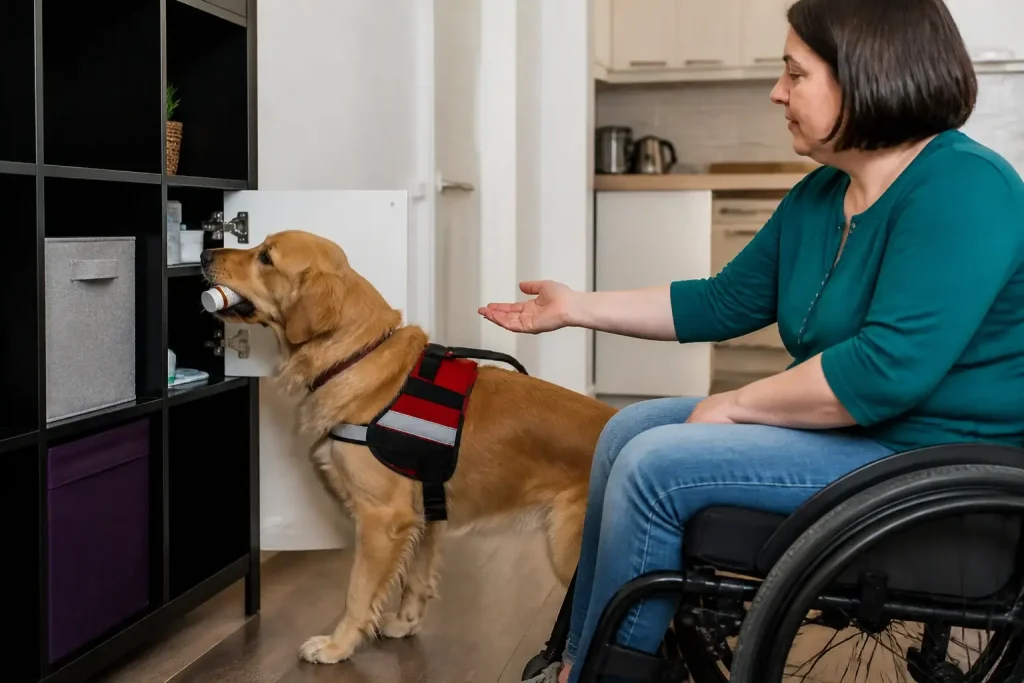
Medication retrieval is a practical service-dog task for people who cannot safely or reliably reach, carry, open, or collect essential medicine. Effective training is not simply teaching a dog to pick up a bottle. The dog must identify the correct container, respond to a clear cue, retrieve it without damaging it, deliver it to the handler, and remain reliable in ordinary household conditions. Because medication errors can be dangerous, training should be paired with secure storage, labeling, supervision, and advice from a qualified service-dog trainer. A dog should never be expected to distinguish pills, doses, or medical instructions independently.
What Medication Retrieval Involves
A retrieval task usually has several linked behaviors. The dog travels to a designated location, locates a specific item, grips it gently, returns, releases it into the handler’s hand, and finishes in a stable position. Some handlers need a bottle from a bedside table. Others need a pouch, organizer, inhaler case, or emergency kit. The target should be selected according to the handler’s medical plan and physical abilities.
The task can be trained as one sequence, but teaching separate components first is safer and clearer. A dog that rushes toward a bottle may knock it behind furniture. A dog that grabs with excessive pressure may puncture packaging or scatter tablets. A dog that returns but drops the container across the room has learned only part of the job.
The goal is dependable assistance, not a performance trick. Reliability means the dog can work after a mild interruption, in dim lighting, from several reasonable starting positions, and when the handler has limited strength or coordination. It does not mean the dog replaces reminders, clinical advice, or emergency services.
Before Training Begins
Choose a safe target
Use an empty, clean container during early sessions. Select a durable training object that resembles the final item in shape and texture, but do not use loose medication as a training prop. A medication bottle may contain residue, and a dog could chew the cap or swallow a tablet. A soft pouch or sealed case can be safer for practice, provided it does not contain medicine.
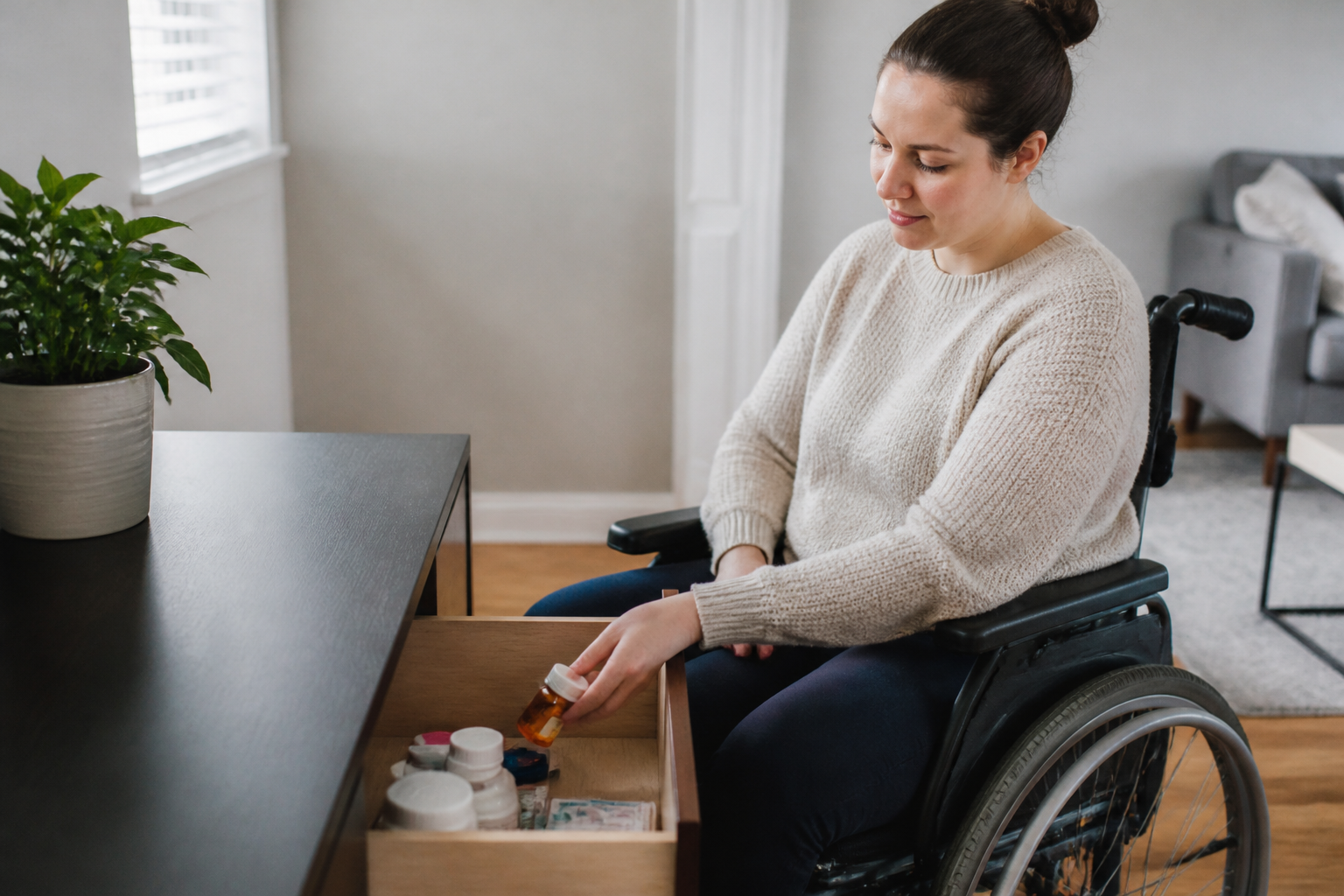
Keep actual medication in child-resistant, dog-resistant storage when possible. Storage should protect against chewing, spills, moisture, and accidental access. If retrieval is needed from a locked or secured location, the trainer must solve access without teaching the dog to open containers that could expose dangerous substances.
Assess the dog
The dog should be physically capable of carrying the target, comfortable working indoors, and willing to release objects calmly. Strong chasing, guarding, destructive chewing, or anxiety around handling can interfere with this task. These concerns do not automatically disqualify a dog, but they warrant professional assessment.
A dog working in public or as an assistance animal also needs broader preparation: loose-leash walking, calm behavior around people and animals, response to cues, and the ability to settle. Medication retrieval is only one task within a complete assistance partnership.
Define the finished behavior
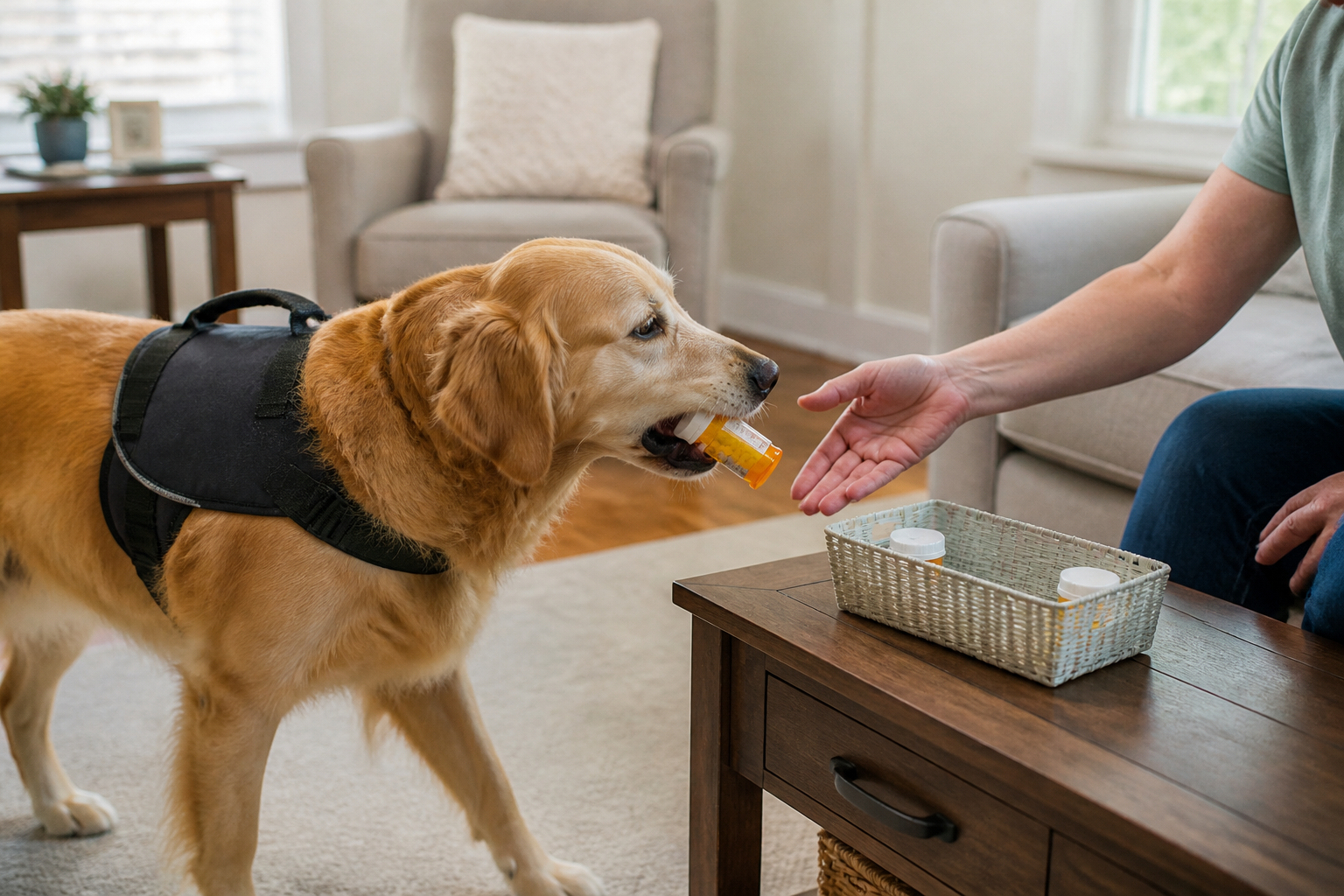
Write a short description before starting. For example: “On the cue ‘medicine,’ the dog goes to the marked shelf, picks up the sealed pouch, returns directly, and places it in my hand.” Decide whether the dog should retrieve from a shelf, table, drawer, or floor. Avoid changing the target location frequently at first.
Also define an interruption plan. If the dog cannot find the item, the dog should return or wait rather than chew random objects. A trained “leave it,” “wait,” and “drop” cue is essential.
Build the Foundation Skills
Teach a gentle grip
Begin with the training object in your hand. Present it at the dog’s nose level and reward investigation, such as looking, touching, or opening the mouth near it. Progress gradually to a brief hold. Mark the desired moment with a clicker or verbal marker, then exchange the object for a treat or toy.
Do not pull the item from the dog’s mouth. Pulling can create competition and encourage gripping harder. Instead, present the reward near the nose, say “release,” and reward when the dog lets go. Practice until the dog releases promptly without dropping the object in anticipation of the treat.
The observable checkpoint is a quiet, controlled hold for several seconds followed by a soft release. If the container shows tooth marks, shorten the hold, use a sturdier object, or reward lighter contact. If the dog refuses to hold it, make the object more familiar through brief, positive interactions and consult a trainer if discomfort persists.
Add a short carry
Place the object close to the dog’s mouth. Reward a hold, then take one step backward. Encourage the dog to follow while carrying it, and reward at once when the dog arrives. Increase distance in small increments. A dog that drops the item should not be scolded; simply reduce distance and reinforce the next successful carry.
Practice from different angles and surfaces, including a mat, carpet, and hard floor. Avoid adding distractions until the dog can carry calmly. The finished carry should be deliberate rather than hurried.
Teach delivery to hand
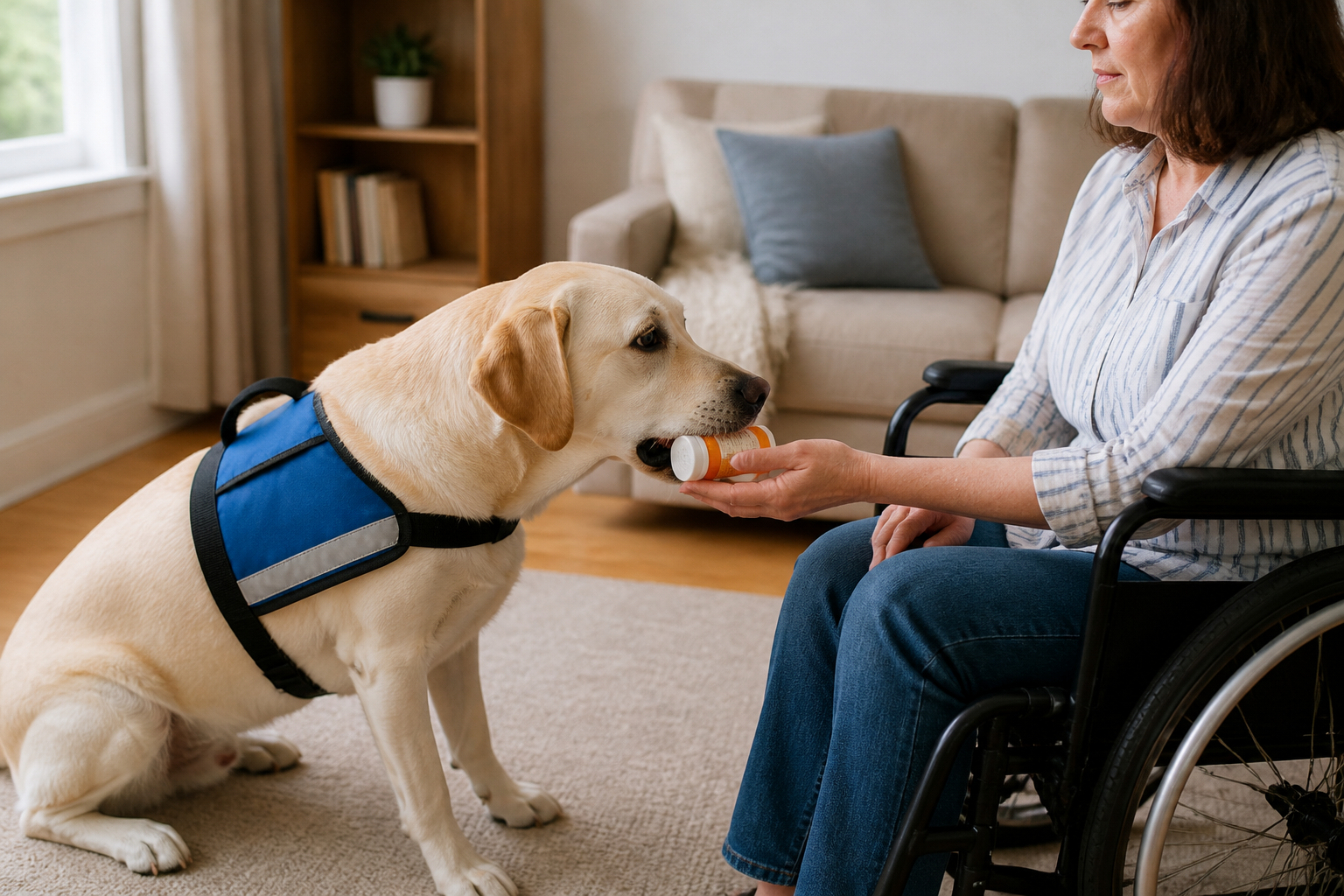
Hold your hand beneath the object and cue the dog to release. Reward only when the container reaches your hand, not when it falls nearby. At first, accept a low delivery. Later, shape a higher, more precise placement suited to the handler’s reach.
If the handler has limited hand strength, use a broad palm, lap, tray, or transfer platform. The dog should not need to place the object on an unstable surface. A professional trainer can adapt the delivery position to wheelchair height, bed height, or another accessible location.
Create the Retrieval Chain
Introduce a location cue
Teach the dog that a particular shelf, basket, or table is the starting point. Place the training object there while the dog watches. Say the location cue, walk with the dog toward it, and reward attention to the object. Then request the grip and return.
Do not hide the object immediately. The dog first needs a clear picture of the destination. Once the pattern is fluent, vary the distance and your position. Stand beside the dog, behind it, or several steps away. Reward the dog for orienting toward the correct location rather than guessing.
Add the task cue
When the dog can travel to the location and retrieve the object with guidance, add a distinct task cue such as “medicine.” Say it once, pause briefly, and allow the dog to work. Avoid repeating the cue rapidly. Repetition can teach the dog that the first cue is optional.
Fade visible hand signals and walking assistance gradually. If performance drops, restore one support temporarily, then remove it more slowly. The checkpoint is a complete retrieval after one cue, with the dog returning and delivering the container without chasing, dropping, or detouring.
Build duration and distance
Start with the object one step away. Increase distance only after several successful repetitions. Then practice from a chair, bed, doorway, or floor-level position, depending on the handler’s real needs. Change one variable at a time: distance, location, lighting, surface, or distraction.
Use intermittent reinforcement after the behavior is established, but continue meaningful rewards. A service dog should find the task valuable even when a treat is not immediately available. Praise, a short play interval, or access to rest can supplement food reinforcement.
Teach Reliable Searching
Some handlers need the dog to find a container that is not in its usual place. Searching is more complex than retrieving from a fixed station and should be trained separately. Begin with two obvious locations in one quiet room. Place the target in one location while the dog observes, then cue the search. Reward correct orientation and retrieval.
Later, hide the target partially, then fully, while keeping the environment simple. Add empty containers only when the dog understands the target’s odor and appearance. The dog should never be rewarded for selecting a random bottle. If several medicines look similar, use a distinct pouch, tactile cover, or labeled case rather than relying on visual discrimination alone.
An important safety rule is “search only for the designated item.” The dog should not investigate every container, bag, or pill organizer. If the target is absent, teach a clear response such as returning to the handler and sitting. This prevents persistent searching from becoming destructive behavior.
Generalize Without Losing Control
Practice realistic scenarios
Train at different times and in realistic positions, but keep sessions short. Rehearse retrieval when the handler is seated, lying down, using mobility equipment, or wearing loose clothing that might catch the dog’s paw. Practice with household sounds at a low level: a television, doorbell, or running appliance.
Introduce distractions gradually. A second person can walk through the room, or a toy can remain at a distance. Do not test the dog with overwhelming distractions. A failure should provide information, not become a repeated lesson in ignoring the handler.
Maintain emergency boundaries
Medication retrieval may support a health routine, but it is not a substitute for an emergency response plan. Keep emergency contacts, prescribed instructions, and backup access available. If a person may lose consciousness, become confused, or be unable to confirm the correct medicine, retrieval should be designed with medical professionals and caregivers.
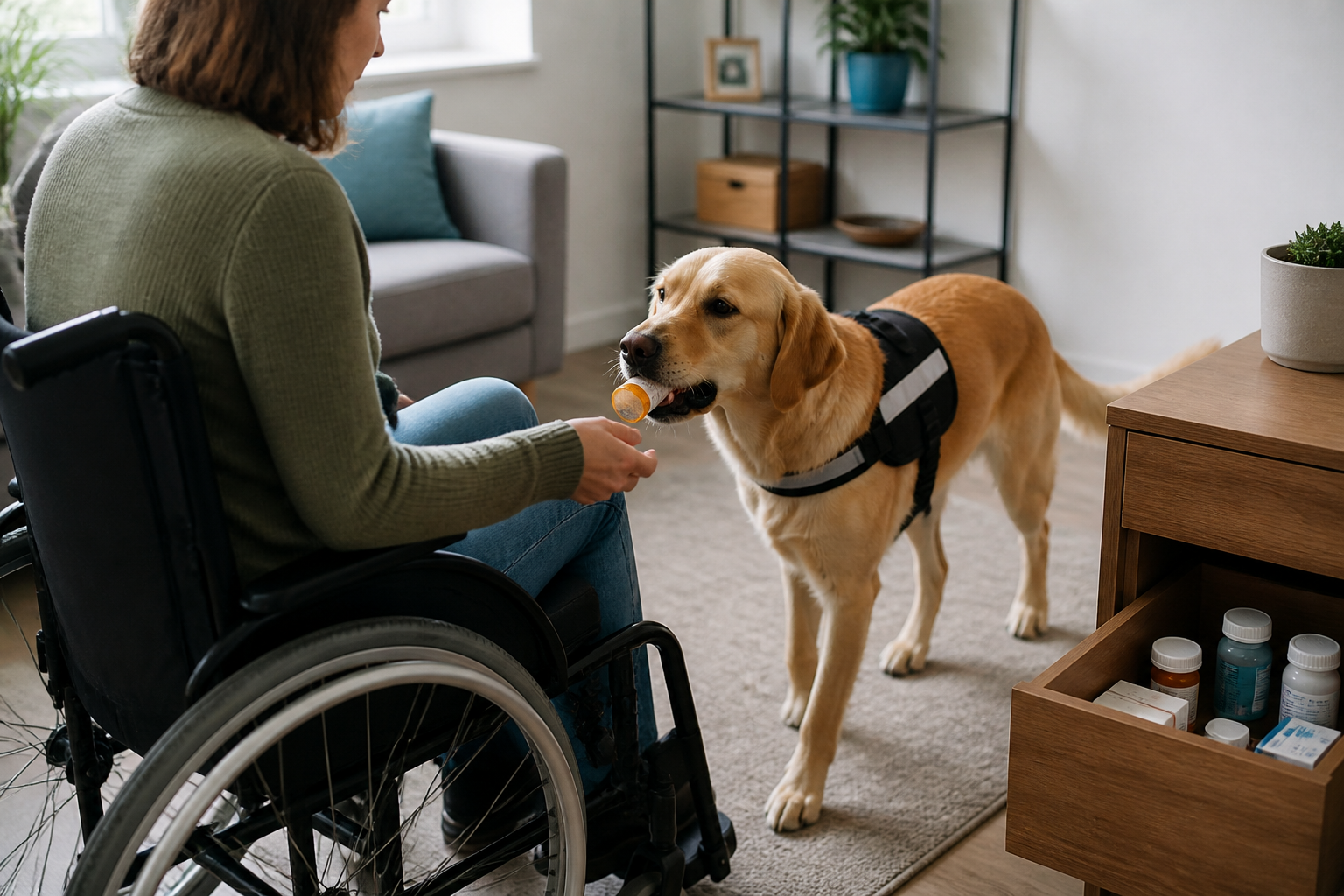
Never train a dog to choose a dose, open a bottle containing loose tablets, administer medicine, or decide whether medication is appropriate. The handler or authorized caregiver remains responsible for identifying and taking the correct medication. A dog can bring a sealed container; it cannot safely interpret a prescription.
Troubleshooting Common Problems
If the dog grabs and runs, reinforce returning immediately by shortening distance and rewarding near the handler. If the dog drops the object, improve the delivery reward and practice over a soft, accessible surface. If the dog chews, stop using the final container, offer a safer substitute, and return to gentle-grip exercises.
If the dog retrieves only when the handler points, fade the gesture gradually rather than removing it abruptly. If the dog searches the wrong place, simplify the setup and reward orientation to the correct station. If the dog becomes frustrated, end the repetition, offer an easy behavior, and resume later.
A sudden decline may signal pain, impaired vision, hearing changes, stress, or confusion. Arrange veterinary evaluation when behavior changes unexpectedly. Professional assistance is particularly important when the task concerns mobility limitations, psychiatric disabilities, seizure response, or medication with serious consequences for delay or error.
Measuring Reliability
Keep a simple training record. Note the date, location, target, cue, distractions, successful attempts, and errors. This reveals whether the dog is improving or merely succeeding in one familiar arrangement. A useful standard is consistent completion across multiple sessions and settings, with no prompting beyond the agreed cue.
Test one challenge at a time. For example, ask for the retrieval from a bed, then from a chair, then with a quiet visitor present. If accuracy falls sharply, return to the last successful level. Reliability is built by many manageable repetitions, not by forcing a difficult test.
Refresh the task regularly. Dogs can lose precision when routines change, equipment is replaced, or the handler’s physical abilities evolve. Reassess the target container, delivery height, storage location, and backup plan. Replace damaged training equipment promptly.
Frequently Asked Questions
Can any dog learn medication retrieval?
Many dogs can learn basic carrying and delivery, but not every dog is suitable for assistance work. Temperament, health, motivation, impulse control, and the handler’s needs all matter. A qualified trainer can assess the individual dog and recommend adaptations.
Should real medicine be used during training?
No. Use an empty, sealed, clearly different training container. Real medication creates avoidable risks from chewing, spills, contamination, and accidental ingestion. The final routine should keep medicine secured until the handler is ready to receive it.
How long does training take?
There is no universal timetable. Foundation skills, the dog’s learning history, task complexity, disability-related requirements, and practice consistency affect progress. Short, successful sessions generally support learning better than exhausting drills. A trainer can set milestones based on observable performance.
What if the dog cannot find the item?
Teach the dog to stop searching and return to the handler or a designated position. Keep a backup supply and an alternate human-access plan. Do not allow prolonged searching around medication storage, because persistence can become chewing or opening behavior.
Can the dog retrieve medication from a drawer?
Possibly, but the drawer must be safe, accessible, and designed to prevent the dog from reaching dangerous contents. Training a dog to open drawers can create risks elsewhere in the home. A marked pouch on an accessible shelf may be a safer alternative.
Is a service dog allowed to retrieve medication in public?
Access rules depend on location and applicable law. A service dog’s task must be connected to a person’s disability, and the dog must remain under control. Because legal definitions and local requirements vary, consult an appropriate disability-rights or access authority rather than relying on informal advice.
Should treats be used forever?
Food can establish the behavior efficiently, but the dog should gradually learn to work with varied reinforcement. Continue rewarding important assistance tasks, especially difficult or urgent ones. Reducing visible treats does not mean eliminating appreciation or maintenance practice.
When is professional help necessary?
Seek qualified help if the dog guards objects, damages containers, cannot release reliably, becomes distressed, or fails to generalize. Professional guidance is also appropriate when medication access intersects with medical emergencies, mobility equipment, or complex household risks.
Conclusion
Medication retrieval is a chain of precise, safety-sensitive behaviors. Build it from a gentle grip, calm carry, reliable release, clear location, and single task cue. Use empty training containers, secure real medication, vary practice gradually, and teach the dog what to do when the target is missing. Measure performance across realistic settings rather than judging success from one demonstration.
The strongest training plan respects both canine behavior and human medical responsibility. A dog can provide valuable physical assistance, but the system must prevent mistaken identification, accidental access, and dependence on an unproven behavior. Work with a qualified service-dog professional and appropriate healthcare or support providers when the task carries serious consequences. With thoughtful design, careful reinforcement, and regular review, medication retrieval can become a dependable part of a broader assistance routine.