
Start With the Right Foundation
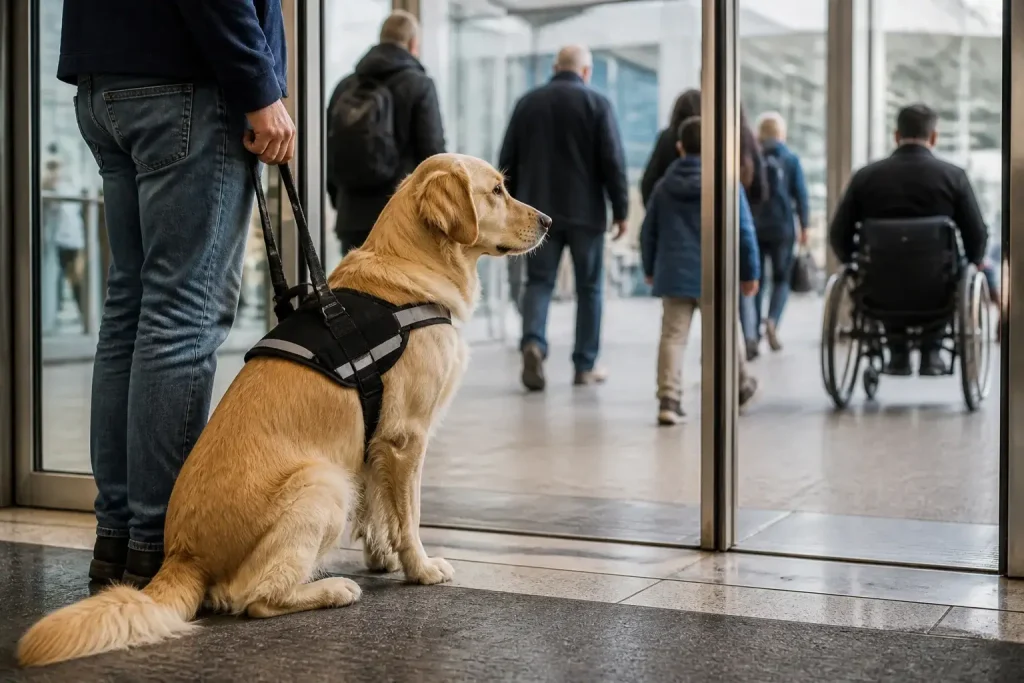
Service-dog public-access training teaches a dog to remain safe, calm, responsive, and unobtrusive in places where pets may not ordinarily go. The goal is not impressive tricks. It is dependable behavior around crowds, food, noise, mobility equipment, children, other animals, and unexpected interruptions.
Begin only after a veterinarian has assessed the dog’s health and a qualified trainer has considered temperament. A service dog needs sound physical structure, emotional stability, recovery after surprises, and genuine willingness to work. Training cannot reliably overcome severe fear, persistent aggression, or disabling reactivity. Selecting an unsuitable dog early and hoping to fix the problem later can waste time and create safety risks.
Public access is also different from task training. A dog may perform a useful disability-related task yet still lack the manners required for restaurants, stores, transportation, workplaces, or medical facilities. Train the two areas together, but evaluate them separately. Follow the laws that apply where you live, and never misrepresent a pet, emotional-support animal, or in-training dog as a fully qualified service animal.
Step One: Build Communication at Home
A reliable public-access dog first understands its handler. Establish a reward system using food, play, praise, or access to something desirable. Food is often efficient during early learning, but gradually teach the dog to work even when treats are not visible. Rewards should follow correct behavior promptly and should not become a bribe waved in front of the nose.
Teach a clear marker, such as a spoken word or click, meaning “that behavior earned reinforcement.” Pair the marker with a reward repeatedly, then use it while shaping simple actions. Practice the dog’s name response, hand targeting, eye contact, recall, sit, down, stand, wait, release, and a calm settle on a mat.
Observable checkpoint
At home, the dog should respond promptly in a quiet room, recover when a toy or food is present, and remain settled for several minutes. Do not measure success by occasional perfection. Look for a pattern of correct responses and a relaxed body.
Adjust the difficulty
If the dog ignores you, reduce distractions, shorten the session, increase reward value, or teach the behavior in smaller pieces. Avoid repeating a cue many times. Give the dog a moment, help with a simpler version, and reward the response you can obtain.
Step Two: Teach Loose-Leash Walking
Public access requires safe movement, not a rigid competition heel. Choose equipment that fits correctly and does not cause pain. A standard leash is usually easier to manage than a retractable leash in crowded places. Keep the leash short enough for safety while allowing natural movement, and follow local rules about identification, harnesses, or other equipment.
Reward the dog for walking beside you with a loose leash. Change direction before tension becomes habitual. Stop, wait, or calmly turn when pulling begins; resume movement when the leash relaxes. Reinforce check-ins, polite passage through doorways, and stopping beside you at crossings.
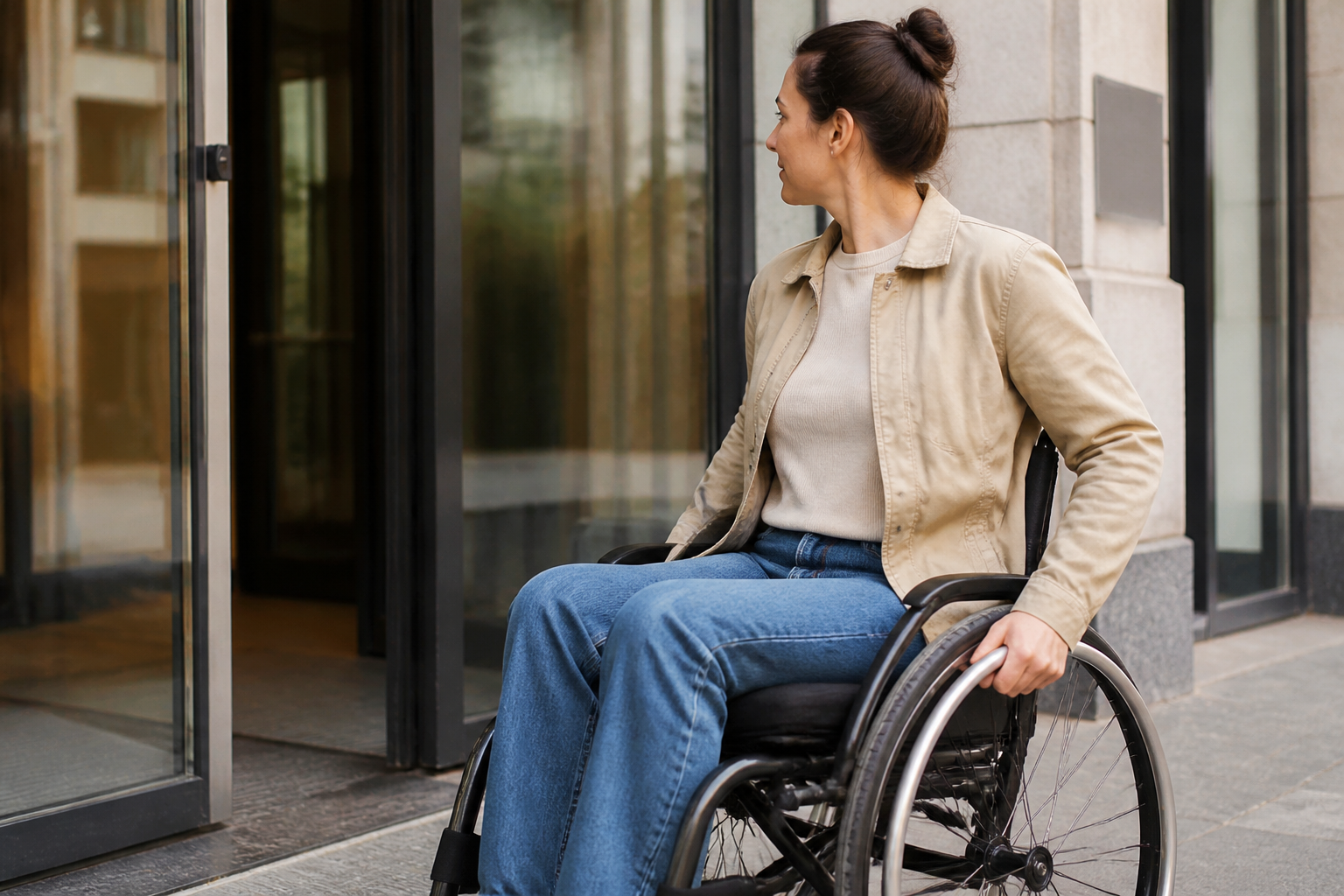
Practice first in a hallway, then a quiet sidewalk, parking area, and low-traffic business district. Vary speed, turns, surfaces, and stopping points. Teach the dog not to greet every person or animal. A neutral dog is generally more useful than one that expects constant social interaction.
Observable checkpoint
The dog can walk a short route without dragging you, can pass ordinary distractions while maintaining a loose leash, and can stop when you stop. The handler should be able to control the leash without constant physical restraint.
Adjust the difficulty
If pulling returns, shorten the route and increase reinforcement for voluntary proximity. Avoid marathon walks that rehearse failure. If equipment creates coughing, pain, panic, or escape attempts, stop and seek qualified guidance rather than tightening it.
Step Three: Develop a Reliable Settle
A service dog must be able to do nothing for long periods. Teach a mat or under-seat settle by rewarding the dog for lying down, relaxing its head, and remaining quiet. Begin at home. Add duration gradually, then practice while you read, work, eat, or speak with another person.
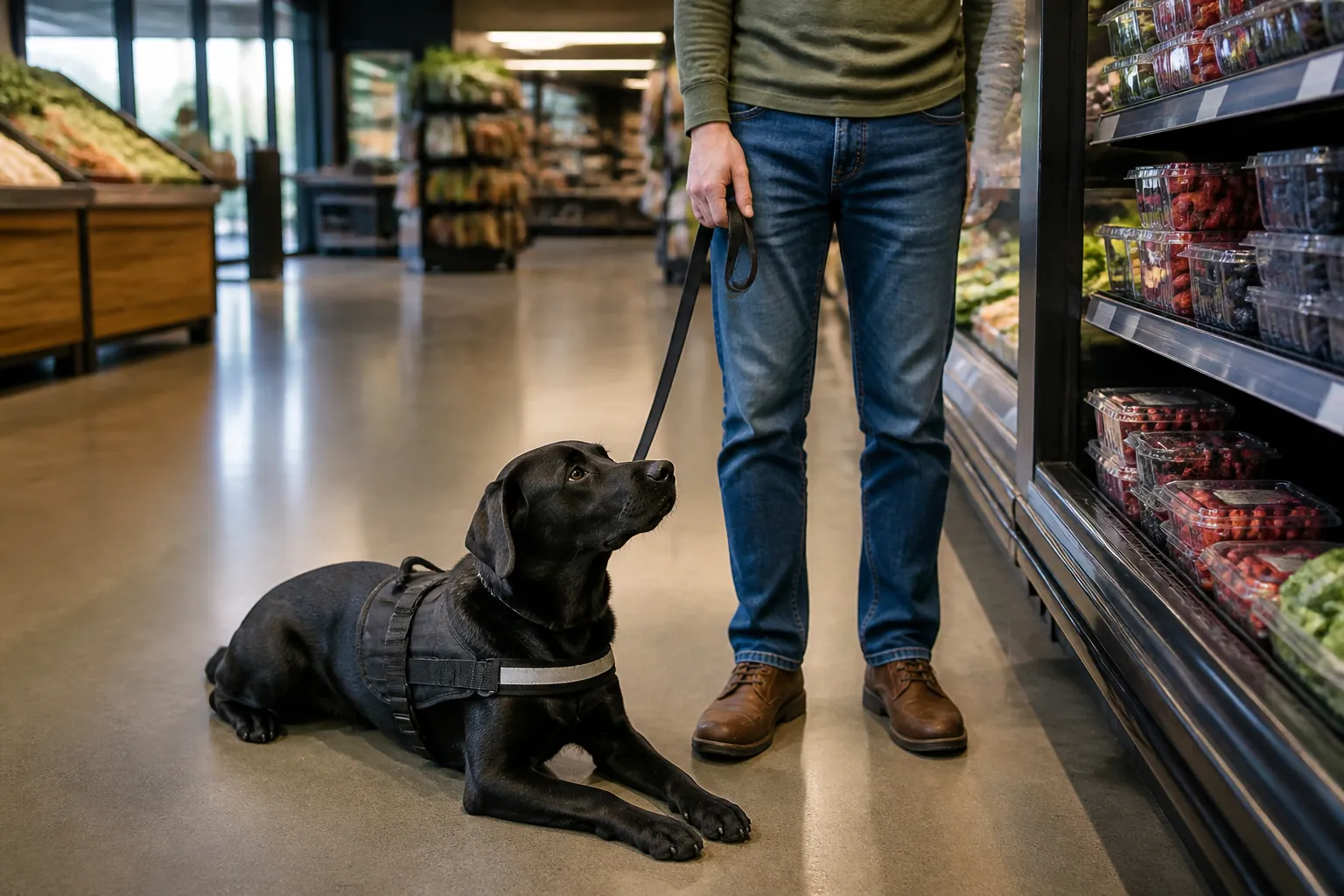
Move the mat to a porch, quiet café patio where permitted, lobby, or friend’s home. Later, practice beside a chair, under a table, or in another position appropriate to the dog’s size and the setting. The dog should remain clear of aisles, exits, service counters, and other people’s space.
Release the dog before restlessness becomes a problem. Calmly reward small signs of relaxation, including soft muscles, slower breathing, and choosing to stay. Do not punish a dog for needing a break; instead, identify whether duration, heat, hunger, noise, or physical discomfort is excessive.
Step Four: Train Neutrality Around People and Animals
Public spaces contain unpredictable social pressure. Teach the dog that strangers, children, wheelchairs, canes, uniforms, and other dogs are background events. Arrange controlled exposures with safe distances. Reward the dog for noticing a trigger and returning attention to the handler.
Do not force greetings or use crowded settings as surprise tests. A person should never hug, feed, call, or touch a working dog without permission. Teach an automatic orientation to the handler when someone approaches. Practice passing calmly, waiting while a person moves around you, and remaining settled while someone speaks nearby.
Other animals require special care. A service dog should not play, stare, bark, lunge, or attempt to greet animals encountered during work. Maintain distance and leave if necessary. A dog that cannot disengage safely is not ready for crowded public access.
Step Five: Add Realistic Distractions
After basic skills are dependable, introduce sounds, movement, surfaces, smells, and confined spaces in a planned sequence. Examples include carts, automatic doors, elevators, alarms at safe volume, dropped objects, busy intersections, restaurant odors, polished floors, grates, stairs, and people carrying unusual items.
Change one variable at a time whenever possible. A dog may handle a quiet elevator but struggle when the elevator contains several people and a rolling suitcase. Build complexity gradually. Pair novel experiences with distance, choice, and reinforcement. Never deliberately frighten the dog to test obedience.
Use a training ladder
Rank situations from easy to difficult. Start where the dog can eat, respond, and remain loose. Repeat until behavior is consistent, then add a modest challenge. If the dog freezes, scans intensely, pants, vocalizes, pulls away, or stops taking food, the situation is too difficult. Leave or create distance, allow recovery, and return to an easier level later.
Step Six: Practice Access Skills in Order
Use a progression rather than entering a crowded shopping center immediately.
1. Home and driveway
Practice equipment, toileting before work, entering and exiting a vehicle, waiting at doors, and checking in with the handler.
2. Quiet outdoor locations
Walk near a library, office complex, or nearly empty parking area. Practice curbs, automatic doors, carts, and passing people.
3. Pet-friendly businesses
Where legally and practically appropriate, visit brief, calm locations. Focus on walking, settling, ignoring merchandise, and exiting smoothly. Pet-friendly access is useful rehearsal, but it does not prove readiness for restricted environments.
4. Public transportation and busy facilities
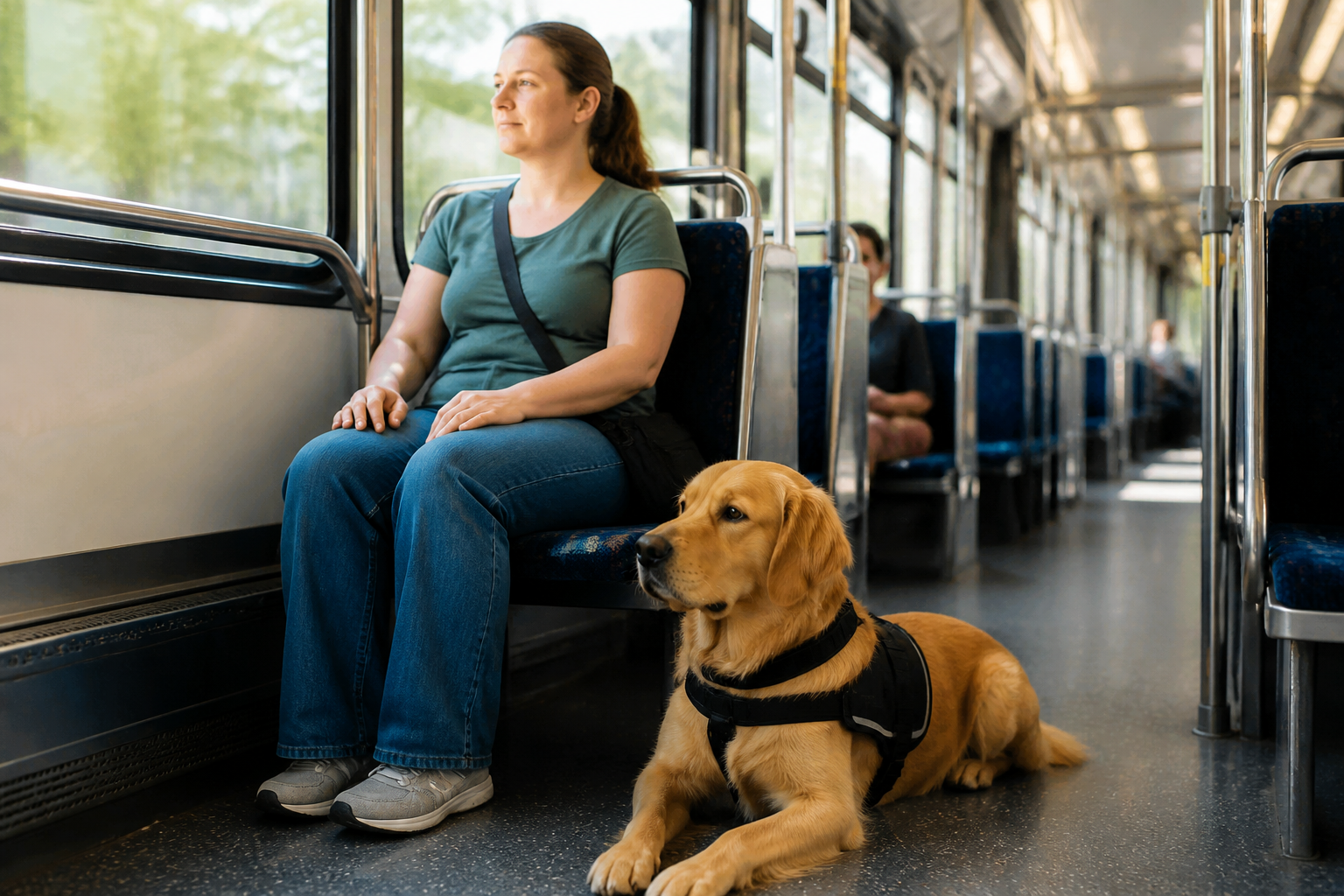
Introduce buses, trains, stations, airports, hospitals, or government buildings only when foundational skills are reliable. Start during quieter periods. Identify exits, relief areas, and a recovery plan.
5. Longer real-world outings
Increase duration slowly. A successful ten-minute visit is more valuable than a stressful hour. End while the dog is still succeeding.
At every location, prevent contact with food, shelves, displays, waste, and strangers. The dog should not block aisles or occupy seats. Keep identification and relevant documentation available when required, while remembering that documents do not replace behavior.
Step Seven: Teach Toileting and Emergency Responses
A working dog must toilet on cue in appropriate places and remain clean indoors. Establish a consistent outdoor routine. Use a cue as the dog begins eliminating, reward immediately afterward, and provide enough time for complete relief. Never assume a long outing guarantees success.
Teach emergency responses such as coming when called, stopping at a curb, dropping an unsafe item, and moving with you when the environment changes. A “leave it” cue should begin with low-value objects and progress carefully. A recall should be protected: do not repeatedly call the dog for unpleasant events or use it casually when failure is likely.
If the dog becomes ill, injured, overheated, unusually tired, or distressed, stop working. A service dog is not required to push through a medical problem. Arrange safe transportation home and seek veterinary advice when appropriate.
Step Eight: Integrate Disability-Related Tasks
Public manners support task performance, but tasks must be trained as distinct behaviors. Define the task precisely: what signal starts it, what action does the dog perform, how long does it continue, and what tells the dog to stop? Break complex tasks into safe components.
For retrieval, teach targeting, holding, carrying, and delivery separately. For interruption or alert work, use carefully designed criteria and avoid reinforcing false alarms. For mobility assistance, consult qualified professionals because poorly designed resistance or balance work can injure both dog and handler. Psychiatric or medical tasks also require individualized planning and should never replace appropriate clinical care.
Practice tasks first at home, then in quiet public settings, while preserving the dog’s ability to disengage and settle. If a task causes distress or interferes with safety, pause and obtain expert assessment.
Step Nine: Generalize Across Handlers and Locations
Dogs often perform differently with another person, another leash, or another building. The primary handler should teach the behavior, then carefully generalize it with trusted helpers. Maintain the same cues and reinforcement standards. Do not allow helpers to create chaotic interactions.
Train in varied weather, lighting, flooring, crowd density, and time of day, provided conditions remain safe. A dog that works only in one familiar store has learned a location, not a dependable skill. Keep sessions short enough to protect confidence and physical comfort.
Step Ten: Evaluate, Maintain, and Retire When Necessary
Create a written checklist covering leash behavior, response to cues, settling, neutrality, toileting, recovery from surprises, vehicle travel, and task performance. Record context, duration, distractions, and signs of stress. Honest notes reveal patterns that memory can miss.
A qualified trainer or behavior professional can conduct neutral observations and identify gaps. Seek help promptly for aggression, repeated escape attempts, severe fear, guarding, sudden behavior change, or task-related risk. Veterinary evaluation is appropriate when behavior changes abruptly, because pain or illness can affect performance.
Maintenance is lifelong. Continue short practice sessions after training appears complete. Reinforce excellent behavior unpredictably, refresh difficult skills, and inspect equipment. Adjust workloads as the dog ages. Retirement may be responsible when health, confidence, recovery, or willingness declines. A dog’s welfare must remain more important than preserving access convenience.
Common Mistakes to Avoid
Moving too quickly is the most common error. Public access should expand only as the dog demonstrates reliable behavior at the current level. Another mistake is correcting visible symptoms without addressing the cause. Pulling may reflect confusion, fear, fatigue, or excessive stimulation. Punishment can suppress communication while increasing anxiety.
Handlers also sometimes overwork dogs, allow public petting, use treats as constant lures, or confuse stillness with relaxation. A motionless dog may be frightened. Watch the whole body: loose posture, normal breathing, easy recovery, and willingness to eat are more informative than a rigid sit.
Finally, do not train for public approval. The aim is safe, unobtrusive access and effective disability-related work. Explain little to strangers, protect the dog’s focus, and leave before a manageable challenge becomes a public failure.
FAQ
How long does training take?
There is no universal timetable. It depends on temperament, age, health, prior learning, task complexity, handler skill, and training opportunities. Consistent short sessions generally outperform occasional intensive outings. Readiness should be based on observable reliability, not a calendar.
Can any breed become a service dog?
Breed alone does not determine suitability. Individual health, temperament, size, energy, resilience, and task requirements matter. Some dogs are excellent companions but unsuitable for sustained public work. A professional assessment can help identify realistic options.
Should the dog greet people?
Usually, no. A working dog should remain neutral unless a greeting is specifically necessary and safely controlled. Preventing greetings protects concentration and reduces unwanted public interaction.
What if the dog makes a mistake?
Stay calm, manage the immediate risk, and leave or simplify the situation if needed. Review what preceded the mistake. Was the outing too long, too crowded, or poorly reinforced? Train that component separately before returning to the same environment.
Are online videos enough?
Videos can demonstrate techniques, but they cannot observe your dog, assess safety, or adapt a plan. Professional guidance is especially valuable for fear, aggression, mobility tasks, medical alerts, and complex public environments.
How can I tell whether my dog is stressed?
Look for persistent panting unrelated to heat, lip licking, yawning, tucked posture, whale eye, scanning, trembling, avoidance, sudden sniffing, refusal of food, barking, or difficulty recovering. One sign may have several causes, so consider context. Give distance and a break rather than demanding obedience.
Can I use a vest to identify the dog?
Equipment may communicate that the dog is working, but it does not create legal status or guarantee access. Research local requirements and use identification honestly. Behavior remains the strongest practical evidence of readiness.
What is the best reward in public?
Use the reward the dog values while remaining safe and discreet. Small food rewards work for many dogs, but praise, a toy used privately, movement, or a brief sniff break may also help. Vary reinforcement while keeping criteria clear.
Conclusion
Effective public-access training is a gradual process of teaching communication, neutrality, loose-leash movement, settling, recovery, toileting, emergency responses, and disability-related tasks. Begin in easy environments, measure observable behavior, increase one challenge at a time, and adjust immediately when stress or failure appears. Protect the dog from unnecessary contact, fatigue, pain, and frightening tests.
The most persuasive proof of readiness is not equipment, paperwork, or confidence in the handler. It is consistent, safe behavior across people, places, surfaces, distractions, and durations, combined with humane training and a dog that remains physically and emotionally able to work. Seek qualified assistance for difficult behavior, follow applicable law, and remember that responsible access includes knowing when to pause, simplify, or retire a dog.